Reflecto News is an online news platform covering major international political events, global economic developments, and security conflicts. The site provides updates on topics such as Chinese manufacturing dominance, Middle Eastern political tensions, and high profile legal arrests. Readers can access current articles organized by categories like World News, Iran, and USA.
Reflecto News | Economy & Defense | Middle East
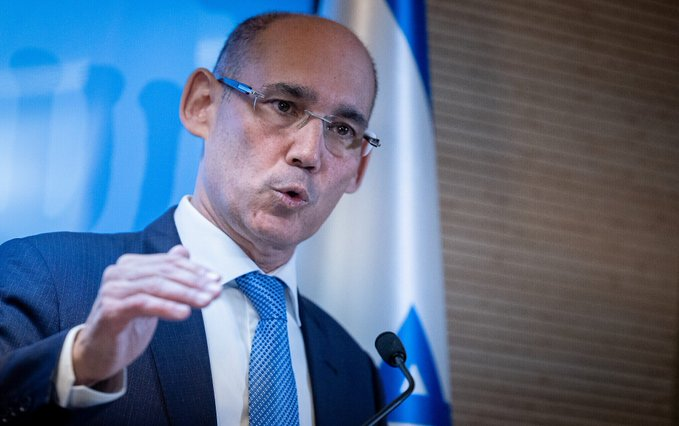
JERUSALEM — The financial toll of Israel’s multi-front war has reached approximately NIS 405 billion ($137 billion) since the Hamas attack on October 7, 2023, Bank of Israel Governor Amir Yaron revealed on Tuesday, warning that the mounting expenses have erased years of fiscal gains and placed the economy under severe strain.
Speaking at an economic conference in Jerusalem, Yaron presented stark data showing that Israel’s national debt had jumped from roughly 60% of GDP before the war to approximately 70% of GDP today—a level not seen in over a decade—and warned that the figure could climb even higher unless fiscal discipline is restored.
“We may be at the beginning of a period characterized by a trauma economy, where economic players act out of fear and not necessarily out of rational considerations.”
— Prof. Amir Yaron, Governor of the Bank of Israel
🔥 The Surge in Defense Spending
The primary driver of the fiscal deterioration is a dramatic increase in military expenditures. Since the Gaza war began and expanded into a multi-front conflict with Hezbollah, Iran, and the Houthis, defense spending has surged by more than 130%:
| Metric | Pre‑War (2022–2023) | Current (2026) |
|---|---|---|
| Annual Defense Budget | ~NIS 62 billion (~$21 billion) | NIS 143 billion (~$48.5 billion) |
| Defense Share of GDP | ~4.5% of GDP | 8.8% of GDP |
The spike in spending reflects the cost of restocking precision-guided munitions, operating a continuous naval blockade against Iran, paying reservists for extended deployments, and reconstructing damaged military infrastructure.
The 8.8% of GDP figure is more than double the average for NATO countries and places Israel among the highest military spenders in the world, relative to the size of its economy .
🧾 The National Debt Trajectory
The ballooning deficits have reversed decades of fiscal prudence.
Pre‑war fiscal position — Israel had successfully lowered its debt-to-GDP ratio from a peak of over 100% in the 1980s to around 60% in early 2023, a major achievement for the Israeli economy.
Today — Debt jumped to approximately 70% of GDP. Officials warn that continued high spending could drive the ratio toward 80% of GDP — a level that would increase borrowing costs and begin crowding out civilian spending on health, education, and welfare.
Yaron emphasized that while the emergency spending is currently unavoidable given the existential threats, the “trauma economy” could become self‑sustaining if the public and investors lose confidence in the state’s ability to manage its finances .
📈 Economic Fallout: Downgrades, Credit, and Investment
The combination of high debt and high defense spending has already had tangible consequences for the Israeli economy:
| Indicator | Impact |
|---|---|
| Sovereign Credit Rating | S&P Global downgraded Israel to A from AA‑; Moody’s also lowered its outlook to negative |
| Foreign Direct Investment (FDI) | Significant slowdown in FDI, as global investors have become more cautious about the conflict’s duration |
| High‑Tech Sector | Deficit‑reduction measures likely to tighten government R&D budgets, potentially hurting Israel’s “Startup Nation” engine |
| Reservist Call‑ups | Extended duty for high‑tech workers has disrupted operations at hundreds of startups and software firms |
Tourism has also collapsed, and the vital construction industry remains hobbled by restrictions on Palestinian labor.
🧠 ‘Psychological Scars’: The Trauma Economy
The Bank of Israel governor coined the term “trauma economy” to describe the psychological effect of prolonged warfare on economic decision‑making.
According to Yaron, even if a permanent ceasefire is achieved, Israeli consumers and businesses may continue to hoard cash, delay investments, and demand higher risk premiums. This behavior would represent a “permanent negative supply shock”—a scar that would reduce the economy’s potential output for years .
The Israeli economy has proven resilient in past wars, typically bouncing back sharply after hostilities end. However, Yaron noted that the current war is different in two key respects:
- Duration — Fighting has been continuous for over 30 months, with no end in sight
- Reservist Mobilization — A higher percentage of the workforce has been called up repeatedly, draining productivity
Both factors risk turning the temporary confidence shock into a structural departure from pre‑war growth trends .
📉 What Comes Next
The Bank of Israel has laid out several scenarios, depending on the duration and intensity of the conflict.
Best case — A rapid resolution of the war and a return to low defense spending; debt stabilizes at ~70–75% of GDP, and the economy rebounds.
Baseline scenario — Protracted low‑intensity conflict; defense spending remains elevated at ~6–7% of GDP; debt climbs toward 80% within three years.
Worst case — Regional war expansion (e.g., direct conflict involving Turkey or Saudi Arabia); defense spending exceeds 10% of GDP; debt‑to‑GDP ratio breaks through 90% and triggers a sovereign credit crisis.
The Bank of Israel has recommended that the government prepare a multi‑year fiscal consolidation plan to rebuild the fiscal buffers once the security situation stabilizes .
📋 Key Takeaways for Reflecto News Readers
| Aspect | Summary |
|---|---|
| Total War Cost | NIS 405 billion (~$137 billion) since October 7, 2023 |
| Defense Spending | Surged 130% to NIS 143 billion (~$48.5 billion), now 8.8% of GDP |
| National Debt | Rose from ~60% to ~70% of GDP; risk of climbing to ~80% |
| Credit Downgrades | S&P and Moody’s have reduced Israel’s rating / outlook |
| Fiscal Outlook | Multi‑year austerity needed once the war winds down |
| ‘Trauma Economy’ Risk | Psychological scarring could lower long‑term growth regardless of ceasefire |
Follow Reflecto News for continuous updates on the economic impact of the Israel‑Iran war, defense spending, and all breaking news from the Middle East.
This article is the intellectual property of Reflecto News. Redistribution without attribution is prohibited.
Questions people ask
What is China's current share of global manufacturing?
China now accounts for twenty eight percent of global manufacturing. This industrial output exceeds the combined manufacturing production of the United States, Japan, and Germany, making China the leading global industrial power according to recent reports.
Why were Andrew Tate and Tristan Tate arrested in Miami?
Andrew Tate and his brother Tristan Tate were taken into custody in Miami by the United States Marshals Service. They face thirty eight new charges in the United Kingdom, including rape and child pornography offences, and prosecutors are seeking their extradition.
What warning did Moscow issue about oil prices?
Kirill Dmitriev, the Chief Executive of the Russian Direct Investment Fund, warned that a tsunami of skyrocketing oil prices is approaching. Moscow describes this potential energy shock as a major threat to global markets.
What political shift is projected for Benjamin Netanyahu's coalition?
Political polls project that Prime Minister Benjamin Netanyahu's coalition is on track to lose its majority in the upcoming October election. This projection indicates a potential political shift in Jerusalem.
Why did a Russian military aircraft land in Tehran?
A Russian airborne command aircraft, widely known as a doomsday plane, landed in Tehran. The arrival of the aircraft represents a high stakes show of support from Russia for Iran during a period of heightened regional tensions.
What did President Masoud Pezeshkian claim about the United States and Israel?
Iranian President Masoud Pezeshkian claimed that the United States and Israel failed in a forty eight hour plan to topple the Iranian government. He made these statements during a televised address marking two years since his inauguration.