Reflecto News is an online news platform covering major international political events, global economic developments, and security conflicts. The site provides updates on topics such as Chinese manufacturing dominance, Middle Eastern political tensions, and high profile legal arrests. Readers can access current articles organized by categories like World News, Iran, and USA.
Published on Reflecto News | Business | Economy & Supply Chains
A surge in fossil fuel prices triggered by the ongoing war in the Middle East is tightening the squeeze on polyester suppliers and garment manufacturers across India and Bangladesh. This supply chain pressure threatens to raise costs for major fast-fashion retailers such as Zara and H&M, potentially ending a period of stable pricing for consumers .
While major retailers are currently shielded by forward buying, the “compounding cost” crisis derived from petrochemicals and disrupted logistics is building momentum across the textile industry .
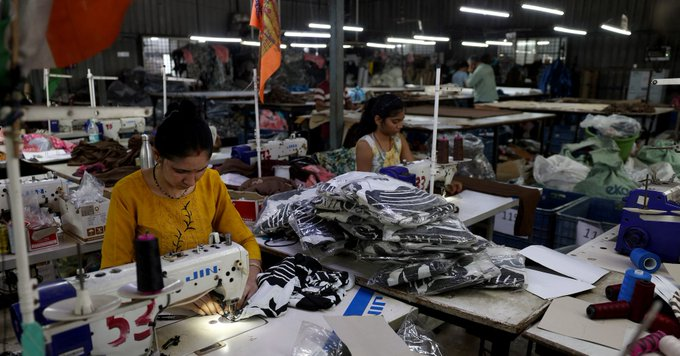
The Crude Connection: Why Fashion Hinges on Oil
The textile industry is directly exposed to the volatility of the oil markets. Polyester, which accounts for approximately 59% of global fiber production, is made from petroleum derivatives—specifically purified terephthalic acid (PTA) and monoethylene glycol (MEG) . The closure of the Strait of Hormuz, a vital energy chokepoint, has restricted the flow of these petrochemical feedstocks, driving up raw material costs for manufacturers across Asia .
The “Hell” in the Details
The impact goes beyond the factory floor. In Surat, India—a textile hub—a shortage of cooking gas caused by the war has driven many migrant workers back to their home villages, creating a labor shortage. As one manufacturer put it: “We are not able to actually meet the demands of the global orders very fruitfully these days” .
Price Spikes in the Supply Chain (Latest Data)
Raw material and production costs have risen sharply across the region since the conflict escalated in late March.
In India, the price of polyester staple fiber jumped from 100 rupees per kilogram (end of February) to 126.5 rupees a month later. Although it eased slightly to 120 rupees after the government slashed import tariffs, this still represents a 20% increase from pre-war levels .
These increases are not isolated to India. China, the world’s biggest polyester producer, has also seen prices surge .
‘Demand Destruction’ and Retailer Risk
While Zara and H&M remain protected in the short term by stockpiled inventory, the threat of “demand destruction” is looming for the remainder of the year.
On the Manufacturing Floor
In Surat, half of the 200 industrial looms at Radheshyam Textile have been silent since the conflict started. Production has collapsed from 10,000 meters per day to roughly 4,000 meters . Dyeing and printing factories have increased shutdown days to two per week to cope with rising costs and fuel shortages. Kailash Hakim, president of the Federation of Surat Textile Traders Association, warns: “If the situation persists, raw material shortages will start taking place and factories will need to shut down” .
Buyer Behavior
In Bangladesh, while factories are more cotton-focused, they face higher prices for polyester sewing thread and logistics. Thread producer Coats Bangladesh announced a 15.5% price increase effective April 15, citing rapid escalation in oil-derived feedstock costs .
“If this goes on for one more month, we will have lower clothing production and what we call demand destruction, because retailers will have to raise their prices and consumers will cut their purchases.”
- Bruna Angel, Principal Analyst for Fibres, Wood Mackenzie
Retailer Responses: A Temporary Shield
Although supply costs are rising, Western retailers have confirmed that they are absorbing the shock for now, though the future remains uncertain.
| Retailer | Current Status & Projection |
|---|---|
| Primark | “Significant inflation” is happening in the market, but the company bought its spring and autumn stock early, shielding it from the current spike . |
| H&M | The retailer expects price increases from Bangladeshi suppliers in the coming weeks but plans to absorb them rather than pass them to consumers immediately . |
| Inditex (Zara) | Has declined to comment on its polyester supply chain directly but utilizes a high percentage of recycled polyester . |
The Recycling Buffer
Retailers like Zara and H&M have shifted to using mostly recycled polyester (made from plastic bottle waste), which could theoretically cushion some of the oil-driven cost pressure. However, recycled polyester still accounts for only 12% of global polyester production, limiting its ability to fully insulate the industry .
Questions people ask
What is China's current share of global manufacturing?
China now accounts for twenty eight percent of global manufacturing. This industrial output exceeds the combined manufacturing production of the United States, Japan, and Germany, making China the leading global industrial power according to recent reports.
Why were Andrew Tate and Tristan Tate arrested in Miami?
Andrew Tate and his brother Tristan Tate were taken into custody in Miami by the United States Marshals Service. They face thirty eight new charges in the United Kingdom, including rape and child pornography offences, and prosecutors are seeking their extradition.
What warning did Moscow issue about oil prices?
Kirill Dmitriev, the Chief Executive of the Russian Direct Investment Fund, warned that a tsunami of skyrocketing oil prices is approaching. Moscow describes this potential energy shock as a major threat to global markets.
What political shift is projected for Benjamin Netanyahu's coalition?
Political polls project that Prime Minister Benjamin Netanyahu's coalition is on track to lose its majority in the upcoming October election. This projection indicates a potential political shift in Jerusalem.
Why did a Russian military aircraft land in Tehran?
A Russian airborne command aircraft, widely known as a doomsday plane, landed in Tehran. The arrival of the aircraft represents a high stakes show of support from Russia for Iran during a period of heightened regional tensions.
What did President Masoud Pezeshkian claim about the United States and Israel?
Iranian President Masoud Pezeshkian claimed that the United States and Israel failed in a forty eight hour plan to topple the Iranian government. He made these statements during a televised address marking two years since his inauguration.