Reflecto News is an online news platform covering major international political events, global economic developments, and security conflicts. The site provides updates on topics such as Chinese manufacturing dominance, Middle Eastern political tensions, and high profile legal arrests. Readers can access current articles organized by categories like World News, Iran, and USA.
Reflecto News Desk
April 8, 2026
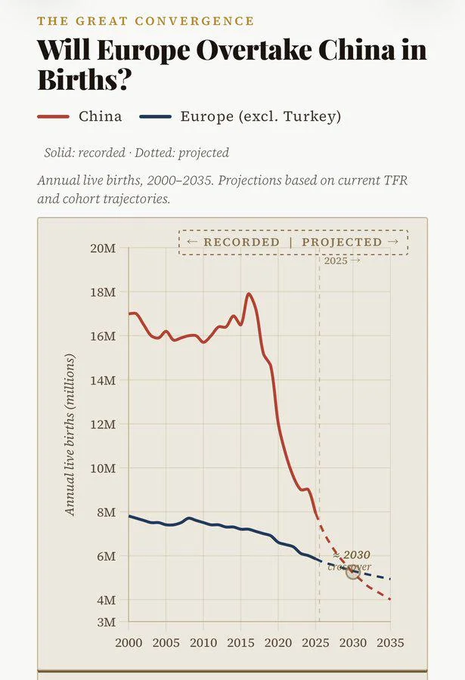
A striking demographic milestone is approaching: Europe (the entire continent) is projected to record more live births annually than China in the coming years, potentially marking the first such occurrence in recorded history — or at least since the Qing dynasty over 300 years ago. This reversal stems from China’s plummeting birth rates and Europe’s relatively stable (though still low) fertility levels, despite both regions facing long-term population challenges.
Social media discussions and demographic analyses have highlighted this trend, with projections suggesting Europe could surpass China as early as the late 2020s if current trajectories hold. China’s births have already fallen sharply to around 7.92 million in 2025, while broader European figures (including non-EU countries) hover near or above that level in some estimates.
China’s Birth Crisis: From 30 Million to Under 8 Million
China’s annual births peaked at nearly 30 million in the 1960s but have since collapsed due to decades of the one-child policy (1979–2015), urbanization, high living costs, changing social norms, and economic pressures. Official data for 2025 shows:
- 7.92 million births — a 17% drop from 9.54 million in 2024.
- Birth rate: 5.63 per 1,000 people — the lowest on record since 1949.
- Total fertility rate (TFR): Estimated around 0.9–1.02 children per woman, far below the replacement level of 2.1.
This has resulted in China’s population declining for the fourth consecutive year, with deaths (11.31 million in 2025) outnumbering births. Demographers note that 2025 births were comparable to levels seen in 1738, when China’s population was only about 150 million. Despite aggressive pro-natalist policies — including subsidies, expanded parental leave, and housing support — experts predict limited rebound, as cultural and economic factors deter larger families.
China’s population pyramid now reveals a shrinking base of young people, with the working-age population set to contract dramatically in the coming decades.
Europe’s Demographic Picture: Low but Stabilizing Relative to China
Europe’s fertility rates have also declined steadily since the 1960s–1970s, from highs above 2.5 to an EU average of 1.34 in 2024 — the lowest in over six decades. The EU recorded approximately 3.55 million births in 2024.
However, the broader European continent (including Russia, Ukraine, Turkey, and other non-EU states) has a larger combined population base and slightly higher average fertility in some eastern and southern countries. Projections indicate total continental births around 5–6 million annually in recent years, with UN data for 2026 estimating Europe at roughly 5–6.1 million births.
While Europe faces its own challenges — more deaths than births in 2025 for the first time since 1918 in some reports, aging populations, and reliance on immigration for growth — its decline has been more gradual than China’s sharp drop. Countries like France, Sweden, and parts of Eastern Europe maintain relatively higher rates compared to East Asia.
Why This Crossover Matters: Historical and Global Context
- Historical Significance: For centuries, China — with its vast population — dominated global birth numbers. This potential overtake symbolizes the end of an era shaped by Asia’s demographic weight.
- Global Birth Distribution in 2026: According to UN projections, 85% of the world’s babies will be born in Asia and Africa. India alone is expected to lead with over 23 million births in 2025, followed by Nigeria and others. Europe and North America together account for only about 8% of global births.
- Implications:
- Economic: Shrinking youth cohorts in both regions could strain labor markets, pension systems, and innovation. China faces a particularly acute “aging before getting rich” challenge.
- Geopolitical: Shifts in population size influence long-term power dynamics, military recruitment, and consumer markets.
- Migration Pressures: Low births in developed regions increase reliance on immigration, while high births in Africa and parts of Asia may drive future migration flows.
Both regions are implementing policies to encourage births, but evidence suggests such measures have modest, short-term effects without addressing deeper issues like housing affordability, gender equality, work-life balance, and cultural attitudes toward family.
Challenges and Future Outlook
Europe’s EU population is expected to peak around 449–453 million in 2026 before declining. China’s population (1.405 billion at end-2025) is projected to shrink dramatically, potentially halving by 2100 under some scenarios.
Experts emphasize that while the “Europe overtaking China” narrative captures attention, both face sub-replacement fertility. The real story is the concentration of global population growth in sub-Saharan Africa and parts of South Asia.
FAQs About Europe, China, and Global Birth Trends
Q: Has Europe already overtaken China in annual births?
A: Not yet definitively, but projections based on 2025 data (China at 7.92 million) and continental European estimates suggest a crossover could occur soon if trends continue. Some analyses indicate it may happen in the late 2020s.
Q: What is driving China’s birth decline?
A: Legacy of the one-child policy, high education and living costs, delayed marriage, career priorities among young people, and limited policy success in reversing low fertility.
Q: Why is Europe’s birth rate higher than China’s despite both being low?
A: Europe’s TFR (around 1.3–1.4 on average) remains above China’s ultra-low ~1.0. Europe’s larger number of countries and slightly higher rates in select nations contribute to a higher continental total.
Q: What are the long-term consequences?
A: Aging societies, labor shortages, higher dependency ratios, pressure on healthcare and pensions, and potential economic slowdowns unless offset by productivity gains, automation, or immigration.
Q: Are pro-natalist policies working?
A: Results are mixed and often temporary. Broader societal changes — affordable housing, childcare, gender equity, and work flexibility — are seen as more impactful for sustainable fertility increases.
Q: How does this fit into global demographics?
A: The world is experiencing uneven growth: rapid in Africa, slowing in Asia, and stagnation/decline in Europe and East Asia. Global births are projected around 132–133 million annually in the mid-2020s.
This demographic shift underscores profound changes reshaping societies worldwide. Reflecto News will continue tracking updates from UN World Population Prospects, national statistics bureaus, and expert analyses as new data emerges in 2026.
Sources include official Chinese statistics, Eurostat, UN World Population Prospects, and demographic research.
Questions people ask
What is China's current share of global manufacturing?
China now accounts for twenty eight percent of global manufacturing. This industrial output exceeds the combined manufacturing production of the United States, Japan, and Germany, making China the leading global industrial power according to recent reports.
Why were Andrew Tate and Tristan Tate arrested in Miami?
Andrew Tate and his brother Tristan Tate were taken into custody in Miami by the United States Marshals Service. They face thirty eight new charges in the United Kingdom, including rape and child pornography offences, and prosecutors are seeking their extradition.
What warning did Moscow issue about oil prices?
Kirill Dmitriev, the Chief Executive of the Russian Direct Investment Fund, warned that a tsunami of skyrocketing oil prices is approaching. Moscow describes this potential energy shock as a major threat to global markets.
What political shift is projected for Benjamin Netanyahu's coalition?
Political polls project that Prime Minister Benjamin Netanyahu's coalition is on track to lose its majority in the upcoming October election. This projection indicates a potential political shift in Jerusalem.
Why did a Russian military aircraft land in Tehran?
A Russian airborne command aircraft, widely known as a doomsday plane, landed in Tehran. The arrival of the aircraft represents a high stakes show of support from Russia for Iran during a period of heightened regional tensions.
What did President Masoud Pezeshkian claim about the United States and Israel?
Iranian President Masoud Pezeshkian claimed that the United States and Israel failed in a forty eight hour plan to topple the Iranian government. He made these statements during a televised address marking two years since his inauguration.