Reflecto News is an online news platform covering major international political events, global economic developments, and security conflicts. The site provides updates on topics such as Chinese manufacturing dominance, Middle Eastern political tensions, and high profile legal arrests. Readers can access current articles organized by categories like World News, Iran, and USA.
Reflecto News | Defense & Security | Mediterranean
ATHENS — Greek military authorities are investigating a mysterious unmanned naval drone discovered by fishermen hidden inside a sea cave near the island of Lefkada in the Ionian Sea, triggering a major security alert and sparking concerns over potential links to the war in Ukraine .
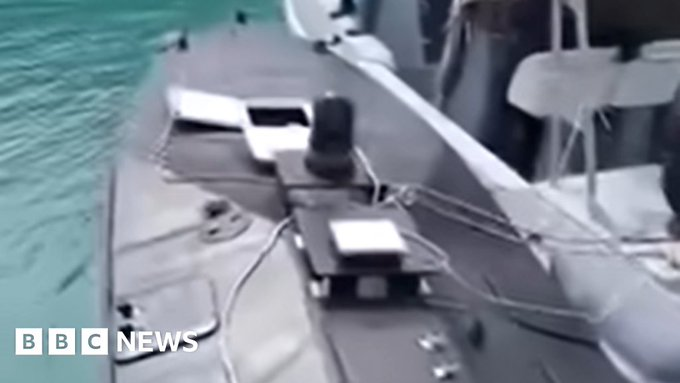
The unmanned surface vessel (USV) was found on Thursday, May 7, 2026, at Cape Doukato on the southwestern tip of Lefkada, with its engine still running when it was discovered . Fishermen from the area towed the 5-meter-long vessel to the port of Vassiliki and handed it over to the Hellenic Coast Guard .
🚤 What Was Found: A High-Tech Kamikaze Drone
Local media and military sources have identified the vessel as a MAGURA V3 or V5 type sea drone, a Ukrainian-made unmanned system that has been used effectively in the Black Sea against Russian warships and tankers .
| Specification | Details |
|---|---|
| Length | Approximately 5 meters |
| Suspected Payload | Up to 300 kg of explosives with detonators |
| Key Features | Equipped with cameras, FLIR systems, and suspected Starlink antenna |
| Origin (suspected) | Ukrainian MAGURA-class USV |
According to Greek media reports, the drone was found inside the cave with its engine running, indicating it may have been operational or awaiting instructions when it was discovered . Photographs show a dark-colored vessel equipped with what appear to be electro-optical surveillance equipment and long-range communications hardware .
🔍 Investigation: Multiple Scenarios Under Review
Greek defense officials are examining several possibilities regarding the drone’s origins and purpose:
1. Operational Mission Against Russian ‘Shadow Fleet’
The most prominent theory is that the drone was intended to strike Russian oil tankers in the Mediterranean. The location off Lefkada lies along a maritime corridor where two vessels linked to Russia’s so-called “shadow fleet” were recently attacked . The “shadow fleet” refers to hundreds of tankers transporting Russian oil in circumvention of Western sanctions imposed after Moscow’s full-scale invasion of Ukraine .
2. Logistics Failure or Drift
The vessel may have been part of a larger shipment of such drones that went astray, drifting off course due to a signal failure or technical malfunction . Ukrainian sea drones are typically operated remotely; a loss of communication could have caused the drone to wander into Greek waters .
3. Drug Trafficking
Investigators have not ruled out the possibility that the drone was being used for illicit purposes, such as drug smuggling operations in the Mediterranean .
The vessel was reportedly carrying three detonators and was “armed and ready to detonate,” according to sources cited by Greek media . Explosive ordnance disposal (EOD) teams from the Greek military have since neutralized the vessel’s potential payload, and its batteries have been removed .
🇺🇦 The Ukraine Connection: Exploiting Russia’s Vulnerabilities
Ukrainian sea drones have revolutionized naval warfare since the full-scale invasion began, repeatedly hunting down Russian warships in the Black Sea despite Russia’s conventional naval superiority . While Ukraine has not formally claimed responsibility for deploying drones in the Mediterranean, Kyiv acknowledged using an air drone to strike a Russian tanker in the Mediterranean in December 2025 .
In the past year, several vessels transiting the Mediterranean have been attacked by what maritime security experts believe are Ukrainian-operated systems . Greece has also been identified as a possible staging or transit area for such operations .
The discovery in a sea cave suggests the drone may have been intentionally hidden. According to retired Greek Vice Admiral Stelios Fenechos, the vessel’s configuration suggested it was armed and mission-ready: “This was not a reconnaissance platform. It was clearly an operational military system, allegedly of Ukrainian origin” .
Incidents Involving Russian ‘Shadow Fleet’ Tankers Near Greece
| Date | Vessel | Details |
|---|---|---|
| December 2025 | Qendil (Aframax tanker) | Acknowledged by Ukraine as an air-drone strike north of Libya |
| Early 2026 | Arctic Metagaz (LNG carrier) | Widely believed to have been hit by a Ukrainian sea drone in the same area; Kyiv did not claim responsibility |
🏛️ Official Responses
Greek authorities have confirmed the ongoing investigation but have released limited information to the public.
- Citizen Protection Minister Michalis Chrysochoidis described the situation as “not one random issue” .
- The Hellenic National Defence General Staff (HNDGS) has taken over the investigation following initial examination by the Coast Guard .
- Government officials have not officially confirmed whether explosives were found on board, though some media and security sources strongly suggest the vessel was armed .
The discovery has raised questions about the security of Mediterranean shipping lanes and the potential for the Ukraine-Russia war to spill over into new naval theaters. Greece, a NATO member, has cooperated with Ukraine in the past on sea drone manufacturing, though that cooperation has recently faced disagreements regarding the potential use of such drones against Turkey .
📋 Key Takeaways
| Aspect | Summary |
|---|---|
| Location | Sea cave at Cape Doukato, Lefkada Island, Ionian Sea |
| Date Discovered | May 7, 2026 |
| Type of Drone | MAGURA-class USV (unmanned surface vehicle), suspected Ukrainian origin |
| Suspected Payload | Explosives with detonators, possibly up to 300 kg |
| Investigation by | Hellenic National Defence General Staff (HNDGS) |
| Primary Theory | Intended to target Russian “shadow fleet” oil tankers transiting the Mediterranean |
| Weapon Status | Reportedly “armed and ready to detonate” |
| Official Response | Investigation ongoing; “not one random issue” |
Follow Reflecto News for continuous updates on this investigation, the targeting of Russia’s shadow fleet, and all breaking news from Greece and the Mediterranean.
This article is the intellectual property of Reflecto News. Redistribution without attribution is prohibited. For syndication or media inquiries, please contact the editorial team.
Updated: May 8, 2026
Questions people ask
What is China's current share of global manufacturing?
China now accounts for twenty eight percent of global manufacturing. This industrial output exceeds the combined manufacturing production of the United States, Japan, and Germany, making China the leading global industrial power according to recent reports.
Why were Andrew Tate and Tristan Tate arrested in Miami?
Andrew Tate and his brother Tristan Tate were taken into custody in Miami by the United States Marshals Service. They face thirty eight new charges in the United Kingdom, including rape and child pornography offences, and prosecutors are seeking their extradition.
What warning did Moscow issue about oil prices?
Kirill Dmitriev, the Chief Executive of the Russian Direct Investment Fund, warned that a tsunami of skyrocketing oil prices is approaching. Moscow describes this potential energy shock as a major threat to global markets.
What political shift is projected for Benjamin Netanyahu's coalition?
Political polls project that Prime Minister Benjamin Netanyahu's coalition is on track to lose its majority in the upcoming October election. This projection indicates a potential political shift in Jerusalem.
Why did a Russian military aircraft land in Tehran?
A Russian airborne command aircraft, widely known as a doomsday plane, landed in Tehran. The arrival of the aircraft represents a high stakes show of support from Russia for Iran during a period of heightened regional tensions.
What did President Masoud Pezeshkian claim about the United States and Israel?
Iranian President Masoud Pezeshkian claimed that the United States and Israel failed in a forty eight hour plan to topple the Iranian government. He made these statements during a televised address marking two years since his inauguration.