Reflecto News is an online news platform covering major international political events, global economic developments, and security conflicts. The site provides updates on topics such as Chinese manufacturing dominance, Middle Eastern political tensions, and high profile legal arrests. Readers can access current articles organized by categories like World News, Iran, and USA.
Reflecto News | Economy & Trade | Geopolitics
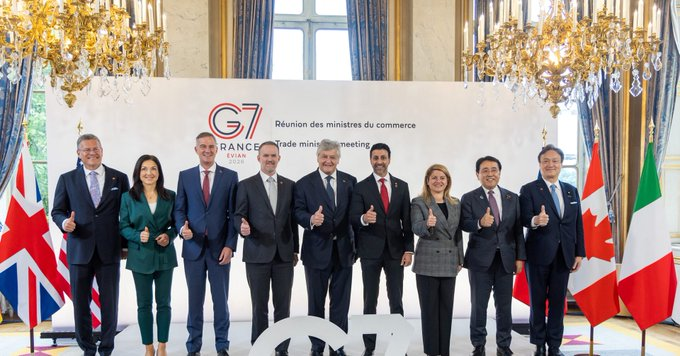
PARIS — Group of Seven trade ministers meeting in Paris are seeking common ground on securing critical mineral supplies dominated by China, but fresh U.S. tariff threats against European Union-made cars are straining unity within the club of major economies.
The two‑day ministerial meeting is unfolding against a backdrop of multiple global shocks: President Donald Trump has paused a U.S. naval mission in the Strait of Hormuz amid ceasefire talks with Iran, and has threatened to raise tariffs on European vehicles, reopening a transatlantic rift just as a fragile trade deal was being implemented.
🔋 Critical Minerals: the ‘Concrete Deliverable’
French officials have made critical minerals one of the centrepieces of Paris’s G7 presidency, aiming to produce tangible results before the leaders’ summit in Évian (June 15–17).
“I believe we will make very concrete progress on rare earths and critical minerals, securing our supply chains and ensuring we are not held hostage by certain countries,” French Foreign Trade Minister Nicolas Forissier said as the talks opened.
Ministers are discussing a French‑backed vision of creating “clusters” of producing, processing and consuming nations that commit to good practices, rather than a single shared stockpile or a U.S.-led strategic reserve.
Why the minerals matter:
| Mineral | Key Use | China’s share of global refining |
|---|---|---|
| Rare earths | EV magnets, wind turbines, defence | ~90% |
| Lithium | EV batteries | ~60% |
| Cobalt | Battery cathodes | ~70% |
| Graphite | Battery anodes | ~70% |
A parallel effort to create a permanent G7 secretariat to oversee critical‑mineral initiatives is also under discussion, though European capitals have reportedly rejected the idea of a single shared stockpile in favour of each country managing its own reserves.
🇺🇸🇪🇺 The Tariff Threat Hanging Over the Room
Although the official G7 agenda is focused on overcapacity, WTO reform and e‑commerce, the elephant in the room is Trump’s threat to raise U.S. tariffs on EU‑made cars and trucks from 15% to 25%.
Washington and Brussels struck a deal last summer to cap tariffs on European vehicles, and EU lawmakers approved the agreement in March, but it has not yet been fully ratified by member states.
Trump has accused the EU of failing to honour the deal, a charge Brussels denies.
“We both clearly concluded that it’s important to respect the deal … from both sides, so we have to deliver on what was promised,” EU Trade Commissioner Maroš Šefčovič said after a meeting with U.S. Trade Representative Jamieson Greer.
German Economy Minister Katherina Reiche said she was in intensive talks with U.S. officials, noting that Germany’s export‑dependent auto sector is already under strain from weaker demand in China, higher energy costs and labour pressures.
European officials have indicated they will discuss the tariff threat with Washington, but “not within the framework of the G7”, preferring one‑on‑one channels.
🌐 China: The Unnamed Target
The push to diversify critical‑mineral supplies is a direct response to China’s dominance in processing and refining the metals needed for electric vehicles, defence equipment and high‑tech manufacturing.
France has called an online G7 meeting for Thursday specifically to discuss “breaking China’s stranglehold on critical materials”. The meeting is intended to prepare for the Évian leaders’ summit.
Experts caution that building independent supply chains outside China is an enormous challenge. China has invested heavily in refining capacity for years, and any alternative network would require a similarly sustained, co‑ordinated effort across multiple countries.
📅 What Comes Next
- An online G7 ministerial on critical minerals is scheduled for Thursday
- U.S.‑EU bilateral talks on car tariffs will continue in parallel
- G7 leaders will meet in Évian, France, on June 15–17
For now, the G7 is trying to move forward on a shared economic‑security agenda while containing bilateral trade frictions that could easily overshadow the broader message of alliance unity.
Follow Reflecto News for continuous updates on G7 trade talks, U.S.‑EU tariff disputes and global supply‑chain realignments.
This article is the intellectual property of Reflecto News. Redistribution without attribution is prohibited.
Questions people ask
What is China's current share of global manufacturing?
China now accounts for twenty eight percent of global manufacturing. This industrial output exceeds the combined manufacturing production of the United States, Japan, and Germany, making China the leading global industrial power according to recent reports.
Why were Andrew Tate and Tristan Tate arrested in Miami?
Andrew Tate and his brother Tristan Tate were taken into custody in Miami by the United States Marshals Service. They face thirty eight new charges in the United Kingdom, including rape and child pornography offences, and prosecutors are seeking their extradition.
What warning did Moscow issue about oil prices?
Kirill Dmitriev, the Chief Executive of the Russian Direct Investment Fund, warned that a tsunami of skyrocketing oil prices is approaching. Moscow describes this potential energy shock as a major threat to global markets.
What political shift is projected for Benjamin Netanyahu's coalition?
Political polls project that Prime Minister Benjamin Netanyahu's coalition is on track to lose its majority in the upcoming October election. This projection indicates a potential political shift in Jerusalem.
Why did a Russian military aircraft land in Tehran?
A Russian airborne command aircraft, widely known as a doomsday plane, landed in Tehran. The arrival of the aircraft represents a high stakes show of support from Russia for Iran during a period of heightened regional tensions.
What did President Masoud Pezeshkian claim about the United States and Israel?
Iranian President Masoud Pezeshkian claimed that the United States and Israel failed in a forty eight hour plan to topple the Iranian government. He made these statements during a televised address marking two years since his inauguration.