Reflecto News is an online news platform covering major international political events, global economic developments, and security conflicts. The site provides updates on topics such as Chinese manufacturing dominance, Middle Eastern political tensions, and high profile legal arrests. Readers can access current articles organized by categories like World News, Iran, and USA.
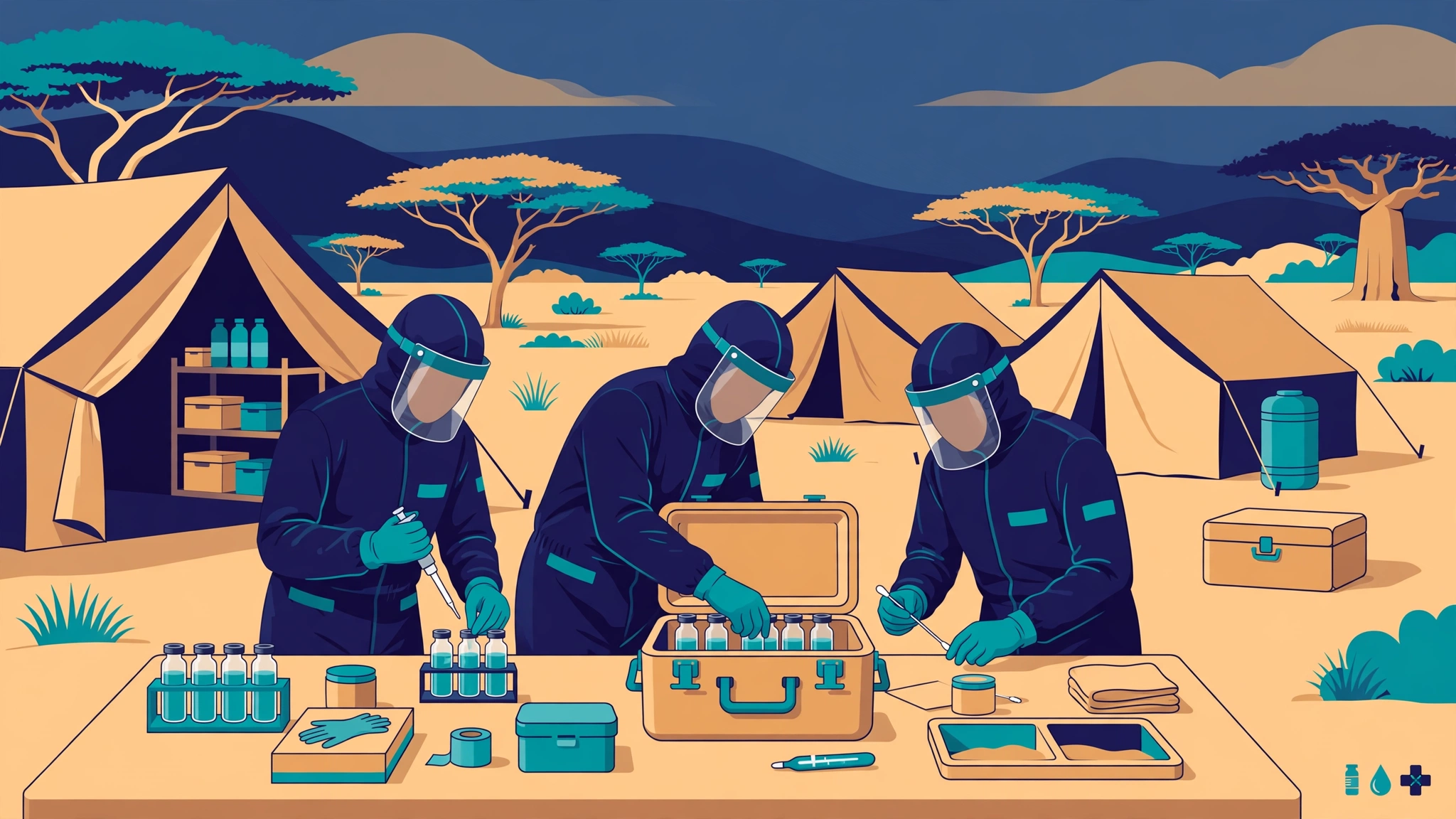
The Ebola vaccine trial DR Congo health authorities have launched has vaccinated its first participants in Bunia, while Kenya has confirmed a second death in its own outbreak, according to the World Health Organization. The trial, called Tumaini, will test whether existing and experimental vaccines can protect against the Bundibugyo strain, for which no vaccine is yet approved.
What the Tumaini trial will test
WHO Director-General Tedros Adhanom Ghebreyesus announced on October 23, 2026, that the first participants were vaccinated in Bunia, the capital of Ituri province in DR Congo, according to the WHO announcement. The trial is called Tumaini, a Swahili word meaning hope, and its opening vaccinations mark the start of a carefully staged research effort rather than the end of one.
The trial is DRC-led, supported by WHO and coordinated with CEPI and the Congolese Ministry of Health, according to the announcement. Its central question is whether vaccine candidates work against the Bundibugyo strain. That focus matters because a vaccine that works well against one Ebola strain cannot simply be assumed to work against another, and the trial is designed to test that question directly.
Ervebo is the first candidate to be tested in the Ebola vaccine trial DR Congo researchers are running. Ervebo is approved against the Zaire strain, but it is not approved against Bundibugyo, and the trial will check whether it offers cross-protection against the Bundibugyo strain. In other words, researchers want to learn whether protection built against one strain also helps against a related but different strain.
Two Bundibugyo-specific candidates are expected to join later, according to the trial plan described by WHO. They are an Oxford ChAdOx1 adenoviral-vector vaccine and a Moderna mRNA vaccine, both of which are in earlier-stage trials. Their later arrival means the trial will grow in stages, with the first results for Ervebo coming before the newer candidates are fully assessed.
A strain with no approved vaccine
DR Congo declared its 17th and worst-ever Ebola outbreak in May 2026, and more than 9,700 cases and more than 4,600 deaths have been reported since, per Al Jazeera and WHO reporting on October 24. The scale of those figures helps explain why health authorities are seeking new evidence urgently, even though a trial by itself cannot change the course of an outbreak overnight.
WHO has triggered a public health emergency of international concern, its second-highest alert level, according to Al Jazeera. The outbreak has now been reported in four African countries, which Al Jazeera describes as the widest geographic spread of any Ebola outbreak on the continent. A wider spread raises the stakes for coordination, because cases in more than one country require consistent monitoring, tracing and response.
In August, DR Congo received 70,000 doses of Ervebo from the global Ebola vaccine stockpile, per Anadolu. Those doses are important in their own right, but they do not answer the Bundibugyo question, because Ervebo covers the Zaire strain rather than Bundibugyo. The distinction between strains therefore runs through almost every part of this story, from stockpile decisions to the design of the Tumaini trial.
That gap is also why the trial should not be read as a promise of protection. A trial tests a possibility under controlled conditions, and its value lies in the evidence it produces over time. Until that evidence is gathered and assessed, the honest position, as set out in the trial announcement, is that no vaccine is approved for Bundibugyo.
Kenya confirms a second death
Kenya reported its second death on October 23, according to Kenyan health officials. The patient was a 65-year-old woman, Kenya’s third confirmed case and a close relative of the first patient. She was isolated before symptoms appeared on October 13 and moved to a treatment unit the same day, according to the account given by health officials.
Kenya now confirms nine cases, including two deaths, with seven patients in care at two isolation facilities. Those figures give a clear snapshot of the Kenyan outbreak at this stage: a small number of confirmed cases, most of them still under care, and a death toll that rose with the latest confirmed death.
Kenyan health officials said all cases are among known contacts, with no evidence of community spread, according to the ministry update dated October 22. Officials have traced 135 contacts, and the earliest monitored contacts are due to finish a 21-day observation period on October 25. The observation period is therefore still open for some contacts, even as officials report no sign of wider community transmission.
The timing in the latest Kenyan case is a key part of the official account. Isolation before symptoms appeared, followed by transfer to a treatment unit on the same day, is the sequence officials reported for the 65-year-old woman. That sequence, combined with tracing of known contacts, is the basis on which officials have described the Kenyan cases as linked rather than as evidence of uncontrolled spread.
What the trial does, and does not, show
The start of the Ebola vaccine trial DR Congo is running should be understood as the beginning of evidence gathering, not as proof that any candidate works against Bundibugyo. The trial does not prove efficacy, and it does not change the approval status of any vaccine. Those limits are important to keep in view, especially when a new trial begins during a large and fast-moving outbreak.
What happens next will depend on the evidence the trial produces, on the later entry of the Oxford and Moderna candidates, and on the continuing response in both DR Congo and Kenya. In Kenya, the immediate focus in the official account remains on patients in care, traced contacts and the end of the 21-day observation period for the earliest contacts. In DR Congo, the focus remains on an outbreak that is already described as the country’s worst ever.
For wider context, Reflecto News has also covered the rescue operation after a major earthquake in Tibet, the dinosaur footprints spotted by a tourist in Thailand, and a major cloud outage that affected banks and services in London.
Frequently asked questions
What is the Tumaini Ebola vaccine trial?
The Tumaini trial is a DRC-led trial, supported by WHO and coordinated with CEPI and the Congolese Ministry of Health, that began vaccinating its first participants in Bunia, in Ituri province, on October 23, 2026. Tumaini means hope in Swahili. The trial tests whether vaccine candidates work against the Bundibugyo strain of Ebola.
Is there an approved vaccine for the Bundibugyo strain?
No. No vaccine is approved for Bundibugyo. Ervebo, the first candidate tested in the trial, is approved against the Zaire strain, not Bundibugyo, and the trial checks whether it offers cross-protection. Two Bundibugyo-specific candidates, from Oxford and Moderna, are in earlier-stage trials and are expected to join later.
How many Ebola cases has Kenya confirmed?
Kenya confirms nine cases, including two deaths, with seven patients in care at two isolation facilities. The second death, reported on October 23, was a 65-year-old woman who was Kenya’s third confirmed case. Kenyan health officials said all cases are among known contacts, with no evidence of community spread, and 135 contacts have been traced.
How large is the DR Congo outbreak?
DR Congo declared its 17th and worst-ever Ebola outbreak in May 2026, with more than 9,700 cases and more than 4,600 deaths reported since, per Al Jazeera and WHO reporting on October 24. WHO has triggered a public health emergency of international concern, its second-highest alert level, and the outbreak has been reported in four African countries.
Questions people ask
What is China's current share of global manufacturing?
China now accounts for twenty eight percent of global manufacturing. This industrial output exceeds the combined manufacturing production of the United States, Japan, and Germany, making China the leading global industrial power according to recent reports.
Why were Andrew Tate and Tristan Tate arrested in Miami?
Andrew Tate and his brother Tristan Tate were taken into custody in Miami by the United States Marshals Service. They face thirty eight new charges in the United Kingdom, including rape and child pornography offences, and prosecutors are seeking their extradition.
What warning did Moscow issue about oil prices?
Kirill Dmitriev, the Chief Executive of the Russian Direct Investment Fund, warned that a tsunami of skyrocketing oil prices is approaching. Moscow describes this potential energy shock as a major threat to global markets.
What political shift is projected for Benjamin Netanyahu's coalition?
Political polls project that Prime Minister Benjamin Netanyahu's coalition is on track to lose its majority in the upcoming October election. This projection indicates a potential political shift in Jerusalem.
Why did a Russian military aircraft land in Tehran?
A Russian airborne command aircraft, widely known as a doomsday plane, landed in Tehran. The arrival of the aircraft represents a high stakes show of support from Russia for Iran during a period of heightened regional tensions.
What did President Masoud Pezeshkian claim about the United States and Israel?
Iranian President Masoud Pezeshkian claimed that the United States and Israel failed in a forty eight hour plan to topple the Iranian government. He made these statements during a televised address marking two years since his inauguration.