Reflecto News is an online news platform covering major international political events, global economic developments, and security conflicts. The site provides updates on topics such as Chinese manufacturing dominance, Middle Eastern political tensions, and high profile legal arrests. Readers can access current articles organized by categories like World News, Iran, and USA.
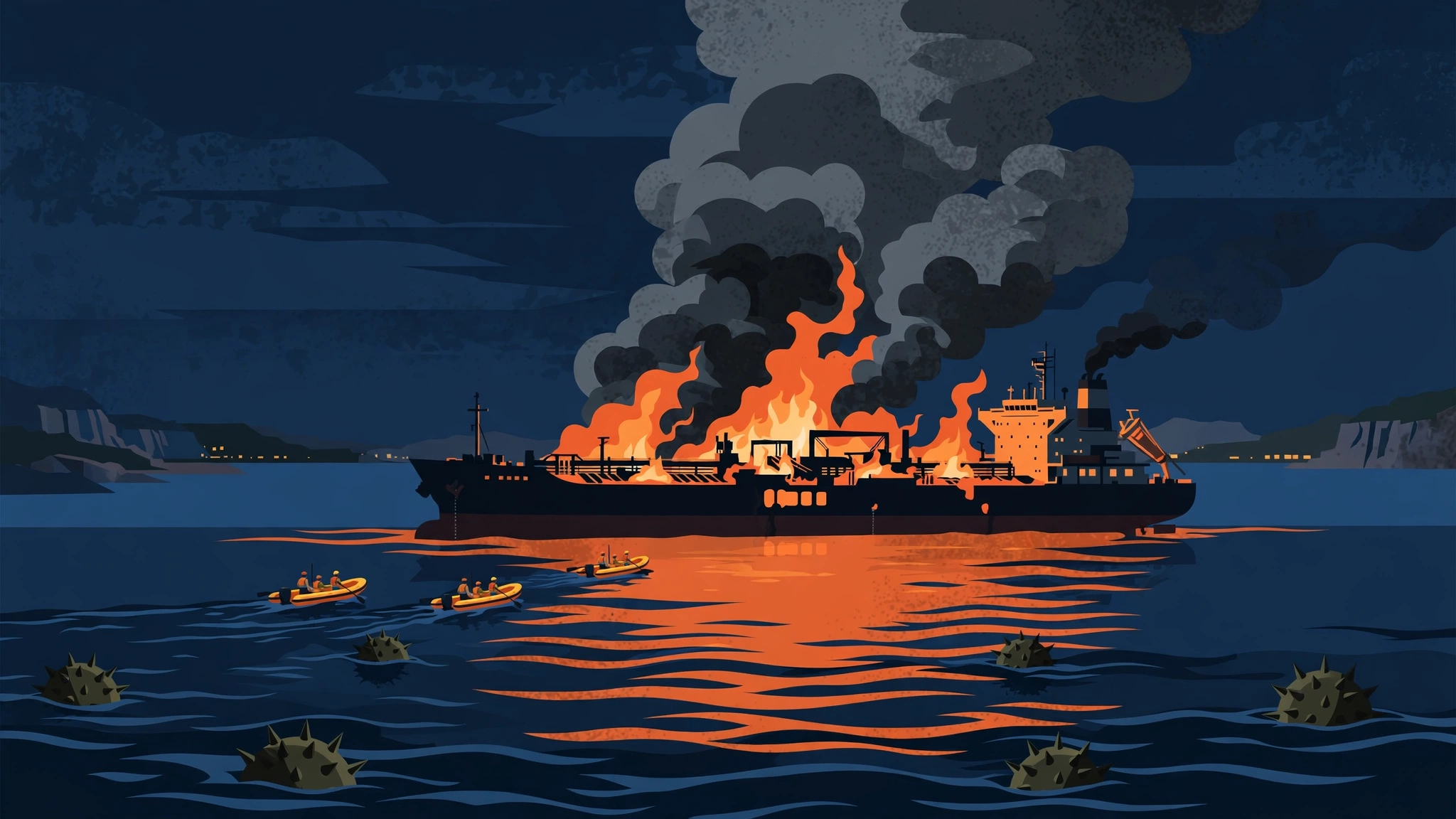
Seven oil tankers caught fire or were damaged in the Strait of Hormuz overnight after being hit by Iranian forces or striking naval mines, Tehran said on Thursday, in an unusually high number of reported incidents that has deepened fears of a return to all-out war. The incidents come as Israel heads into a close election and the United States approaches midterm polls, with war-linked energy prices fueling voter anger in both countries.
What Tehran Reported: Seven Tankers Damaged Overnight
Iranian state television reported the attacks on Thursday, citing the naval forces of the Islamic Revolutionary Guard Corps (IRGC). According to the report, four tankers caught fire after being targeted while transferring oil, while three other vessels were damaged and left immobilized after striking naval mines, the Associated Press reported.
The report did not mention any casualties and did not identify the countries under whose flags the tankers were sailing. If confirmed, the incidents would mark the highest number of vessels damaged in the strategic waterway in a single day since the war began on February 28, when the United States launched joint strikes against Iran with Israel.
The United Kingdom Maritime Trade Operations (UKMTO), a British maritime security monitor, had not reported the incidents as of Thursday. Maritime monitors have noted in recent days that some shipping operators appear reluctant to report attacks in the strait.
The IRGC Warning: US Bases Could Be Targeted
The IRGC navy again threatened to target US military bases in the region if Washington continues helping commercial vessels navigate the strait, Iranian state television reported. Tehran has repeatedly warned that it has drawn important military lessons from the conflict and considers control of the waterway a central point of leverage in any negotiations with Washington over the war.
Mohsen Rezaei, the secretary of Iran’s Supreme National Security Council, warned on Thursday that any action against Tehran would come at a cost. “Everyone should know that action against Iran has a cost. If diplomacy can create this understanding, we prefer diplomacy; but if the war continues, Iran has the necessary tools to continue responding,” Rezaei said, according to a post by Iranian state broadcaster IRIB.
Iran has also signaled in recent days that it could broaden its targets to include critical infrastructure such as undersea cables and data centers, according to Iranian state media.
Why Tensions Are Rising Now: Elections and Energy Prices
The reported tanker attacks come at a politically charged moment. Israel holds closely contested elections on October 27, in which Prime Minister Benjamin Netanyahu could lose power. Next month, the United States holds midterm elections, where war-linked high prices have sparked voter anger.
“Netanyahu wants to attack Iran, that’s not even a question,” Danny Citrinowicz, a researcher at Israel’s Institute for National Security Studies and a former Iran specialist in Israel’s military intelligence, told the Associated Press. He said a clear Netanyahu victory in the October 27 election would make another attack almost guaranteed, while opposition candidates would likely focus on domestic issues first.
Iranian Foreign Minister Abbas Araghchi said Wednesday that Tehran remained open to diplomacy but was prepared to defend itself, according to Iranian state media.
What the Strait of Hormuz Tanker Attacks Mean for Oil and Shipping
The Strait of Hormuz is the world’s most critical energy chokepoint, connecting the Persian Gulf with the Gulf of Oman and the Arabian Sea. Disruptions to shipping through the narrow waterway can ripple through international oil supplies and prices within hours.
Attacks on vessels in the strait have been rising through October. The International Maritime Organization recorded ships being struck nearly every day this month, and maritime security sources told Reuters earlier in October that attacks had hit their highest weekly level since the war began. Gulf oil exporters nonetheless pushed exports toward pre-war levels in September, shipping data showed, even as attacks and logistical constraints clouded the outlook.
India, which relies heavily on the Hormuz route, strongly condemned attacks on maritime navigation and commercial shipping earlier this month, calling such strikes “legally and morally indefensible” and urging protection for seafarers.
FAQ
What happened in the Strait of Hormuz?
Tehran said seven oil tankers caught fire or were damaged overnight after being hit by Iranian forces or striking naval mines, according to Iranian state television citing the IRGC navy. The incidents were reported on Thursday, October 22.
Were there casualties in the Hormuz tanker attacks?
The Iranian report did not mention any casualties. The nationalities and flags of the damaged vessels were also not identified in the report.
Why is the Strait of Hormuz important?
The strait connects the Persian Gulf to the Gulf of Oman and the Arabian Sea, carrying a large share of the world’s seaborne oil. Disruptions there can quickly affect global energy supplies and prices.
Could the US-Iran war resume?
Tensions are rising ahead of Israel’s October 27 election and the US midterms. Analysts cited by the Associated Press say another round of US-Israeli attacks on Iran is possible, while Tehran says it prefers diplomacy but is prepared to keep responding if the war continues.
Questions people ask
What is China's current share of global manufacturing?
China now accounts for twenty eight percent of global manufacturing. This industrial output exceeds the combined manufacturing production of the United States, Japan, and Germany, making China the leading global industrial power according to recent reports.
Why were Andrew Tate and Tristan Tate arrested in Miami?
Andrew Tate and his brother Tristan Tate were taken into custody in Miami by the United States Marshals Service. They face thirty eight new charges in the United Kingdom, including rape and child pornography offences, and prosecutors are seeking their extradition.
What warning did Moscow issue about oil prices?
Kirill Dmitriev, the Chief Executive of the Russian Direct Investment Fund, warned that a tsunami of skyrocketing oil prices is approaching. Moscow describes this potential energy shock as a major threat to global markets.
What political shift is projected for Benjamin Netanyahu's coalition?
Political polls project that Prime Minister Benjamin Netanyahu's coalition is on track to lose its majority in the upcoming October election. This projection indicates a potential political shift in Jerusalem.
Why did a Russian military aircraft land in Tehran?
A Russian airborne command aircraft, widely known as a doomsday plane, landed in Tehran. The arrival of the aircraft represents a high stakes show of support from Russia for Iran during a period of heightened regional tensions.
What did President Masoud Pezeshkian claim about the United States and Israel?
Iranian President Masoud Pezeshkian claimed that the United States and Israel failed in a forty eight hour plan to topple the Iranian government. He made these statements during a televised address marking two years since his inauguration.