Reflecto News is an online news platform covering major international political events, global economic developments, and security conflicts. The site provides updates on topics such as Chinese manufacturing dominance, Middle Eastern political tensions, and high profile legal arrests. Readers can access current articles organized by categories like World News, Iran, and USA.
Reflecto News | Breaking News | Global Trade & Geopolitics
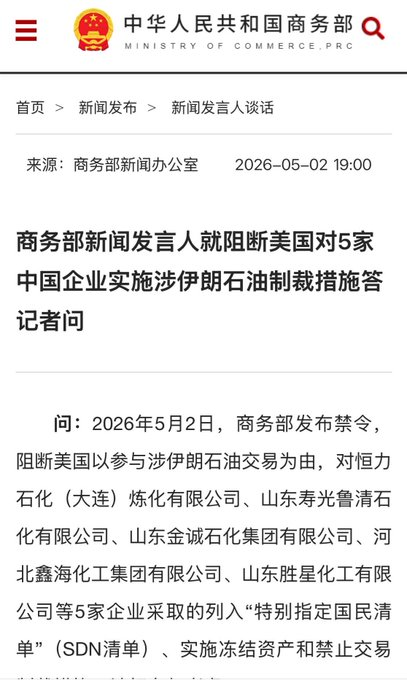
BEIJING — China’s Ministry of Commerce (MOFCOM) formally instructed Chinese companies on Saturday not to comply with United States sanctions targeting five Chinese oil refineries for purchasing crude oil from Iran, branding the penalties an illegal “extraterritorial” overreach .
The directive, issued under China’s 2021 “Blocking Statute” (officially the Rules on Counteracting Unjustified Extraterritorial Application of Foreign Legislation), prohibits any Chinese entity from recognizing, complying with, or enforcing the US sanctions .
“The Chinese government has consistently opposed unilateral sanctions lacking UN authorization and a basis in international law. The so-called long-arm jurisdiction of the United States flagrantly violates international law and the basic norms of international relations.”
— China’s Ministry of Commerce
🎯 The Five Sanctioned Refineries
The US Treasury’s Office of Foreign Assets Control (OFAC) blacklisted the following companies for allegedly handling oil shipments tied to Iran’s military and its so-called “shadow fleet” of tankers :
| Company Name | Location | Type |
|---|---|---|
| Hengli Petrochemical (Dalian) | Dalian, Liaoning | Major independent refiner |
| Shandong Jincheng Petrochemical | Shandong Province | “Teapot” refiner |
| Hebei Xinhai Chemical Group | Hebei Province | “Teapot” refiner |
| Shouguang Luqing Petrochemical | Shouguang, Shandong | “Teapot” refiner |
| Shandong Shengxing Chemical | Shandong Province | “Teapot” refiner |
The US has accused Hengli of purchasing billions of dollars’ worth of Iranian oil, generating revenue for Iran’s military. The other four refineries were sanctioned by the Trump administration last year .
Despite the penalties—which would normally freeze US assets and block US dollar transactions—Beijing is now legally shielding these firms from the consequences of being blacklisted, at least within China’s jurisdiction .
🛡️ The Legal Showdown: China’s Blocking Statute
The legal basis for China’s retaliation is the 《阻断外国法律与措施不当域外适用办法》 (Rules on Counteracting Unjustified Extraterritorial Application of Foreign Legislation), a statute enacted in 2021 but rarely used so aggressively .
The injunction orders that the US sanctions “cannot be recognized, implemented, or complied with” by any Chinese entity . The Ministry stated that the US measures “improperly prohibit or restrict Chinese enterprises from conducting normal economic, trade and related activities with third countries” .
Key Provisions of the Blocking Statute:
- Prohibits compliance with foreign sanctions
- Voids foreign judgments in Chinese courts
- Allows Chinese companies to sue third parties who comply with US sanctions (such as international banks that stop doing business with them)
- Imposes fines on Chinese companies that do comply
The goal is to create a “legal trap” for international companies: if they cut ties with these Chinese firms to avoid US penalties, they could face legal action in China for breach of contract or discrimination .
🛢️ Why These Refineries Matter
All five companies are significant players in China’s independent refining sector. Collectively, China’s “teapot” refineries account for roughly a quarter of the country’s total refining capacity .
China is a key customer for Iranian oil, mainly through these independent refineries, which rely on discounted crude from the Islamic republic. The US has long sought to choke off this revenue stream to Tehran, but Beijing’s legal shield may now allow these purchases to continue without fear of secondary sanctions .
Even before the injunction, the sanctioned firms had continued to buy Iranian crude, despite some hurdles. According to tanker trackers, these firms have received millions of barrels of discounted Iranian oil in recent months, often via ship-to-ship transfers to obscure the origin of the cargo . The MOFCOM order gives them formal legal backing to continue .
🌊 The ‘Shadow Fleet’ Context
The US sanctions are part of a broader campaign—termed “Economic Fury” —targeting the entire supply chain of Iranian oil . The Trump administration has previously sanctioned dozens of shipping firms and vessels accused of acting as Iran’s “shadow fleet,” which uses ship-to-ship transfers, falsified documents, and disabled tracking systems to smuggle oil to buyers in Asia .
Earlier on Friday, the US imposed sanctions on another Chinese firm — Qingdao Haiye Oil Terminal Co., Ltd. — which it said had imported “tens of millions of barrels” of Iranian crude oil, generating billions of dollars in revenue for Tehran . That company was not mentioned in Saturday’s injunction, but may be covered by the general refusal to comply .
💬 Official Statements
MOFCOM added that it “will continue to closely monitor cases of improper extraterritorial application of foreign laws and measures” .
The Ministry also noted that “the Chinese government protects the legitimate rights and interests of foreign-invested enterprises under Chinese law” — a message to Western firms that if they cooperate with US sanctions, they may face legal consequences in China .
📉 Market and Diplomatic Implications
Global banks and shipping insurers now face a dilemma: they risk penalties in the US (including being cut off from the US dollar system) if they service these firms, but risk legal action in China if they blacklist them .
The move escalates the trade and geopolitical confrontation between the world’s two largest economies as the Iran war enters a fragile ceasefire period. The US Treasury had imposed sanctions on Hengli only in April 2026, accusing it of purchasing billions of dollars’ worth of Iranian petroleum .
While the US continues to enforce its naval blockade of Iranian ports, China’s legal defiance may encourage other nations to ignore US secondary sanctions, reducing their effectiveness over time . In the short term, the order allows these five refineries to continue importing Iranian crude without fear of Chinese legal consequences .
📋 Key Takeaways
| Aspect | Summary |
|---|---|
| MOFCOM Order | Chinese companies must NOT comply with US sanctions on 5 refineries |
| The Targets | Hengli Petrochemical (Dalian) and four “teapot” refiners |
| US Allegation | Refineries purchased billions in Iranian oil, funding Iran’s military |
| China’s Stance | US sanctions are “illegal extraterritorial overreach” |
| Legal Basis | China’s 2021 Blocking Statute (Rules on Counteracting Unjustified Extraterritorial Application of Foreign Legislation) |
| Penalty for Chinese Compliance | Fines and legal action |
| The “Trap” | International banks face US penalties for servicing them, Chinese penalties for blacklisting them |
| Broader Context | Escalating US-China trade and geopolitical confrontation |
| Current US Strategy | Naval blockade of Iranian ports + sanctions on Chinese refiners |
| Current Chinese Strategy | Legal protection of oil trade with Iran + defiance of US secondary sanctions |
Follow Reflecto News for continuous updates on the US-China trade war, the Iran war, and all breaking news from Beijing and Washington.
This article is the intellectual property of Reflecto News. Redistribution without attribution is prohibited. For syndication or media inquiries, please contact the editorial team.
Questions people ask
What is China's current share of global manufacturing?
China now accounts for twenty eight percent of global manufacturing. This industrial output exceeds the combined manufacturing production of the United States, Japan, and Germany, making China the leading global industrial power according to recent reports.
Why were Andrew Tate and Tristan Tate arrested in Miami?
Andrew Tate and his brother Tristan Tate were taken into custody in Miami by the United States Marshals Service. They face thirty eight new charges in the United Kingdom, including rape and child pornography offences, and prosecutors are seeking their extradition.
What warning did Moscow issue about oil prices?
Kirill Dmitriev, the Chief Executive of the Russian Direct Investment Fund, warned that a tsunami of skyrocketing oil prices is approaching. Moscow describes this potential energy shock as a major threat to global markets.
What political shift is projected for Benjamin Netanyahu's coalition?
Political polls project that Prime Minister Benjamin Netanyahu's coalition is on track to lose its majority in the upcoming October election. This projection indicates a potential political shift in Jerusalem.
Why did a Russian military aircraft land in Tehran?
A Russian airborne command aircraft, widely known as a doomsday plane, landed in Tehran. The arrival of the aircraft represents a high stakes show of support from Russia for Iran during a period of heightened regional tensions.
What did President Masoud Pezeshkian claim about the United States and Israel?
Iranian President Masoud Pezeshkian claimed that the United States and Israel failed in a forty eight hour plan to topple the Iranian government. He made these statements during a televised address marking two years since his inauguration.