Reflecto News is an online news platform covering major international political events, global economic developments, and security conflicts. The site provides updates on topics such as Chinese manufacturing dominance, Middle Eastern political tensions, and high profile legal arrests. Readers can access current articles organized by categories like World News, Iran, and USA.
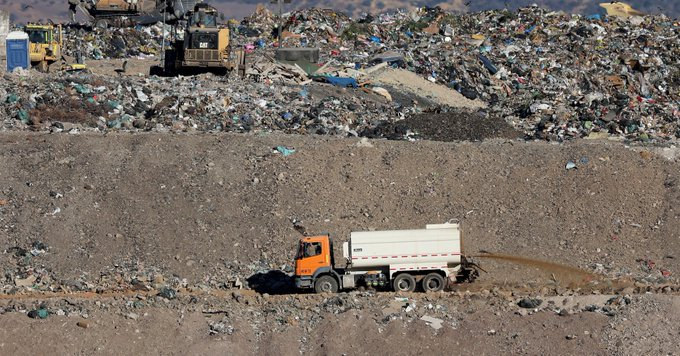
SANTIAGO, Chile — A sprawling landfill jutting from the hills on the outskirts of Chile’s capital has been identified as the world’s largest human-made source of climate-warming methane gas, according to a recent study by the United Nations Environment Programme (UNEP).
The Lomas Los Colorados landfill, located about 60 kilometers north of Santiago, receives waste from more than 7 million people . Satellite data analyzed by UNEP estimates the site emits a staggering 102,667 metric tons of methane annually—a figure equivalent to the greenhouse gas emissions from nearly 2 million cars driven for a year .
The pyramid-shaped landfill leads a grim ranking of 50 sites with the highest levels of methane emissions, surpassing even oil and gas facilities in Turkmenistan. The second-ranked site, an oil and gas complex in Turkmenistan, emits about 20,000 fewer tons per year .
⚠️ Why Methane Is a Critical Climate Threat
Methane (CH₄) is a potent greenhouse gas with a warming potential 80 times greater than carbon dioxide over a 20-year period . It is responsible for at least one-quarter of current global warming, according to scientists cited in the UNEP report.
The UN’s International Methane Emissions Observatory (IMEO), which compiled the data using approximately 30 satellites, noted that while these 50 sites represent only “a small part of total global emissions,” they constitute “priorities for reduction” .
🏭 A Second Chilean Landfill in the Top 10
Chile’s poor showing in the climate rankings does not stop at Lomas Los Colorados. Another landfill, located approximately 50 kilometers south of Santiago, appears among the top 10 highest-emitting sites globally .
Turkmenistan has four of the top 10 most polluting facilities, all linked to oil and gas extraction, while coal production sites in China also feature prominently on the list .
🗑️ From Environmental Liability to Energy Source?
Despite the alarming ranking, the landfill’s operator, KDM Empresas—part of the US-Spanish group Urbaser Danner—defends its environmental record . The company has run a biogas capture and energy recovery program at the site since 2007.
According to KDM, the project has prevented the emission of more than 700 million cubic meters of methane between 2007 and 2025, equivalent to 11 million tons of CO₂. The captured gas fuels the Loma Los Colorados power station, generating up to 100,000 megawatt-hours of energy .
The company has disputed the UNEP analysis, arguing that it was based on a single measurement in early 2026 and does not account for fluctuating weather conditions and daily operational variations over time .
👥 ‘We Live Locked Inside Our Homes’
For residents living near the landfill, the environmental crisis is a daily reality. Neighbors have long complained of foul odors and swarms of flies emanating from the site .
“We can’t leave windows open because of the smell. We live locked inside our homes,” one local resident told Reuters, describing the degradation of her quality of life over the years . Another resident noted that the constant burning of garbage releases toxic gases that residents are forced to breathe.
The operator has stated that it complies with environmental standards, but residents say the health impacts continue unabated. Experts call for improved organic waste separation, composting, and treatment of leachates to reduce both odors and climate emissions .
🌍 UN’s Methane Alert System in Action
The ranking is part of UNEP’s Methane Alert and Response System (MARS) , launched in November 2022. The program is designed to rapidly alert governments and companies when satellites detect major methane leaks .
To date, the system has helped “mitigate” emissions from 41 major methane sources. The UN estimates those sources emitted a combined 1.2 million tons of methane, with a climate impact comparable to nearly 24 million gasoline-powered cars driven for one year .
“The elimination of these emissions has a concrete positive impact on the climate,” the agency stated .
🔮 What Comes Next for Chile’s ‘Super-Emitter’
The classification of Lomas Los Colorados as a “mega-source of methane” comes as Chile pushes for leadership in renewable energy. The finding has sparked criticism of the country’s waste management policies, which experts say remain heavily reliant on landfills rather than circular economy solutions .
UNEP has emphasized that targeting these so-called “super-emitters” offers the most cost-effective path to near-term climate mitigation, as methane is both highly potent and relatively short-lived in the atmosphere compared to CO₂.
For Chile, the dubious distinction has turned a national spotlight on a smoldering heap of trash—and the invisible gas that is helping warm the planet.
📋 Key Takeaways for Reflecto News Readers
| Aspect | Summary |
|---|---|
| Site Name | Lomas Los Colorados landfill, Tiltil, Chile (60 km north of Santiago) |
| Annual Methane Emissions | 102,667 metric tons (equivalent to ~2 million cars per year) |
| Global Ranking | No. 1 among 50 human-made sites worldwide |
| Other Notable Emitters | Turkmenistan (4 of top 10, oil/gas), China (coal production), a second Chilean landfill (top 10) |
| Methane Impact | 80x more potent than CO₂ over 20 years; responsible for 25% of current warming |
| Mitigation Efforts | Operator runs biogas capture since 2007; powers local station (100,000 MWh) |
| UN Program | MARS (Methane Alert and Response System) launched 2022; tracked 41 sources |
| Local Impact | Residents report foul odors, flies, respiratory issues, and toxic fumes from burning waste |
| Expert Recommendation | Separate organic waste, promote composting, transition to circular economy |
Follow Reflecto News for continuous updates on climate science, UNEP reports, and all breaking environmental news from around the world.
Questions people ask
What is China's current share of global manufacturing?
China now accounts for twenty eight percent of global manufacturing. This industrial output exceeds the combined manufacturing production of the United States, Japan, and Germany, making China the leading global industrial power according to recent reports.
Why were Andrew Tate and Tristan Tate arrested in Miami?
Andrew Tate and his brother Tristan Tate were taken into custody in Miami by the United States Marshals Service. They face thirty eight new charges in the United Kingdom, including rape and child pornography offences, and prosecutors are seeking their extradition.
What warning did Moscow issue about oil prices?
Kirill Dmitriev, the Chief Executive of the Russian Direct Investment Fund, warned that a tsunami of skyrocketing oil prices is approaching. Moscow describes this potential energy shock as a major threat to global markets.
What political shift is projected for Benjamin Netanyahu's coalition?
Political polls project that Prime Minister Benjamin Netanyahu's coalition is on track to lose its majority in the upcoming October election. This projection indicates a potential political shift in Jerusalem.
Why did a Russian military aircraft land in Tehran?
A Russian airborne command aircraft, widely known as a doomsday plane, landed in Tehran. The arrival of the aircraft represents a high stakes show of support from Russia for Iran during a period of heightened regional tensions.
What did President Masoud Pezeshkian claim about the United States and Israel?
Iranian President Masoud Pezeshkian claimed that the United States and Israel failed in a forty eight hour plan to topple the Iranian government. He made these statements during a televised address marking two years since his inauguration.