Reflecto News is an online news platform covering major international political events, global economic developments, and security conflicts. The site provides updates on topics such as Chinese manufacturing dominance, Middle Eastern political tensions, and high profile legal arrests. Readers can access current articles organized by categories like World News, Iran, and USA.
Ford Carrier Strike Group returns to the region after repairs, bolstering U.S. naval presence amid nuclear disputes and Strait of Hormuz tensions; move signals sustained readiness for potential escalation
By Reflecto News Staff
April 7, 2026
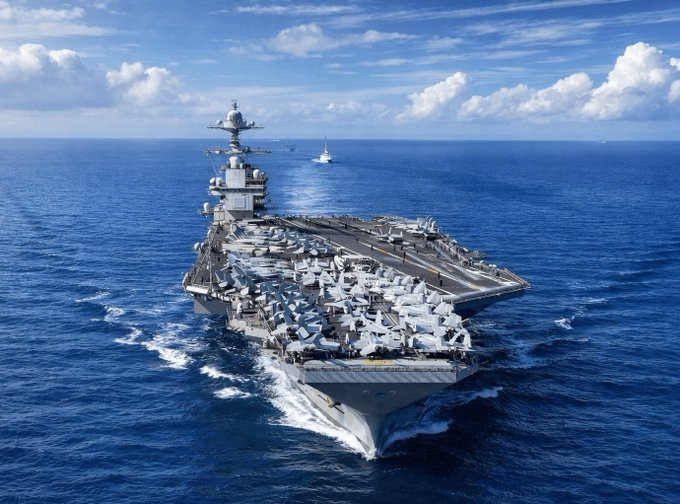
The U.S. Navy’s USS Gerald R. Ford (CVN-78), the world’s largest and most advanced aircraft carrier, has officially returned to Middle East waters, transiting the Suez Canal with escort destroyers to rejoin operations in support of U.S. Central Command (CENTCOM).
Defense officials confirmed the carrier’s arrival in the region after a period of repairs in the Eastern Mediterranean and a stop in Croatia. The Ford had previously been pulled back following a fire in a laundry and berthing area during earlier operations tied to Operation Epic Fury against Iranian targets. Its return strengthens the U.S. naval posture at a critical moment, with another carrier, USS Abraham Lincoln, already operating in the Arabian Sea.
This deployment marks one of the most significant concentrations of U.S. carrier power in the Middle East in recent years, enhancing air strike capabilities, maritime security, and deterrence near the Strait of Hormuz.
Timing and Strategic Significance
The Ford’s arrival coincides with the final hours before President Donald Trump’s 8 p.m. ET deadline for Iran to fully reopen the Strait of Hormuz to unrestricted commercial shipping. Trump has warned of severe consequences, including strikes on Iranian infrastructure, if the deadline is not met.
The carrier’s presence provides the U.S. with massive airpower projection — capable of launching dozens of advanced fighters, electronic warfare aircraft, and support assets — should diplomacy fail and escalation occur.
Nuclear Dispute Intensifies
President Trump claimed today that Iran has “agreed to everything,” including cooperation on the removal of its enriched uranium stockpile. Iranian state media and the Foreign Ministry immediately rejected the assertion, stating that transferring enriched uranium “is not going to be transferred anywhere” and “was never an option.” Officials described the material as “sacred” to Iran, comparable to Iranian soil.
Iran continues to categorically reject any temporary ceasefire, demanding a permanent end to hostilities with sanctions relief, reparations, and guarantees against future attacks.
Diplomatic Efforts Continue
Pakistan has vowed to “go to all lengths” to help broker a permanent US-Iran peace deal, with senior officials engaged in intense regional shuttling.
Trump has linked any successful agreement to enhanced security for Israel, stating it would make Israel “more secure.” A recent Channel 12 poll in Israel showed 56% of respondents do not want Benjamin Netanyahu to continue as Prime Minister.
Regional Precautions
Kuwait’s Interior Ministry advised residents to stay home overnight as a precautionary measure amid fears of Iranian retaliation against Gulf civilian infrastructure.
Secretary of State Marco Rubio has condemned Iranian strikes on commercial vessels in the Strait of Hormuz as “terrorist activity” by a state sponsor of terrorism.
The White House has categorically denied any consideration of nuclear weapons against Iran.
Broader Context and Military Posture
- Internal U.S. Views: Defense Secretary Pete Hegseth’s optimistic assessments of Iranian capabilities face internal criticism, with intelligence indicating more than half of missile launchers remain intact and thousands of drones still available.
- Sen. Ron Johnson’s Caution: The Wisconsin Republican hopes threats against civilian infrastructure are “bluster,” emphasizing that the U.S. is “not at war with the Iranian people.”
- CENTCOM Readiness: Recent images showed U.S. Marines conducting live-fire drills aboard USS Tripoli in the Arabian Sea.
The Ford’s extended deployment — now approaching record length — underscores the strain on U.S. naval assets amid multiple global commitments.
Parallel Developments
In Ukraine, British-made Malloy T-150 drones were used to destroy a Russian-controlled bridge near Kherson. The UK’s HMS Dragon remains ready near Cyprus after addressing a minor water system issue.
Implications as the Deadline Approaches
The return of the USS Gerald R. Ford significantly expands U.S. options for both deterrence and potential combat operations in the region. While indirect talks have shown modest progress, public disagreements over enriched uranium and ceasefire terms suggest a comprehensive deal before or immediately after 8 p.m. ET remains challenging.
A prolonged closure or disruption of the Strait of Hormuz — which carries roughly one-fifth of global oil trade — would have severe economic consequences worldwide.
Reflecto News will continue providing real-time, balanced coverage as events unfold tonight.
FAQs on USS Gerald R. Ford Arrival, Nuclear Dispute, and Iran Deadline
Q: Why is the USS Gerald R. Ford’s arrival significant?
A: As the world’s largest aircraft carrier, its return to Middle East waters bolsters U.S. airpower and deterrence capabilities near the Strait of Hormuz and Iran at a critical time.
Q: What did Trump claim about Iran’s agreements?
A: Trump stated Iran has “agreed to everything,” including cooperation on removing its enriched uranium stockpile.
Q: How did Iran respond?
A: Iranian officials rejected the claim, stating enriched uranium will not be transferred abroad and was “never an option.”
Q: What is Trump’s 8 p.m. ET demand?
A: Full reopening of the Strait of Hormuz to unrestricted commercial shipping, with non-compliance risking strikes on Iranian infrastructure.
Q: Has Iran rejected a temporary ceasefire?
A: Yes, categorically, demanding instead a permanent deal with sanctions relief and guarantees.
Q: What role is Pakistan playing?
A: Pakistan has declared it is “willing to go to all lengths” to help secure a permanent US-Iran peace agreement.
Q: What precautionary measure has Kuwait taken?
A: Residents were advised to stay home overnight due to fears of Iranian retaliation against Gulf infrastructure.
Q: How can I stay updated?
A: Follow Reflecto News for accurate, timely reporting on the US-Iran crisis, naval deployments, diplomatic developments, and regional impacts.
This article is based on verified statements from U.S. defense officials, Iranian media, President Trump, and credible reporting as of April 7, 2026. All quotes are accurately attributed.
Questions people ask
What is China's current share of global manufacturing?
China now accounts for twenty eight percent of global manufacturing. This industrial output exceeds the combined manufacturing production of the United States, Japan, and Germany, making China the leading global industrial power according to recent reports.
Why were Andrew Tate and Tristan Tate arrested in Miami?
Andrew Tate and his brother Tristan Tate were taken into custody in Miami by the United States Marshals Service. They face thirty eight new charges in the United Kingdom, including rape and child pornography offences, and prosecutors are seeking their extradition.
What warning did Moscow issue about oil prices?
Kirill Dmitriev, the Chief Executive of the Russian Direct Investment Fund, warned that a tsunami of skyrocketing oil prices is approaching. Moscow describes this potential energy shock as a major threat to global markets.
What political shift is projected for Benjamin Netanyahu's coalition?
Political polls project that Prime Minister Benjamin Netanyahu's coalition is on track to lose its majority in the upcoming October election. This projection indicates a potential political shift in Jerusalem.
Why did a Russian military aircraft land in Tehran?
A Russian airborne command aircraft, widely known as a doomsday plane, landed in Tehran. The arrival of the aircraft represents a high stakes show of support from Russia for Iran during a period of heightened regional tensions.
What did President Masoud Pezeshkian claim about the United States and Israel?
Iranian President Masoud Pezeshkian claimed that the United States and Israel failed in a forty eight hour plan to topple the Iranian government. He made these statements during a televised address marking two years since his inauguration.