Reflecto News is an online news platform covering major international political events, global economic developments, and security conflicts. The site provides updates on topics such as Chinese manufacturing dominance, Middle Eastern political tensions, and high profile legal arrests. Readers can access current articles organized by categories like World News, Iran, and USA.
Reflecto News – Intense last-minute diplomacy marked a pivotal day in the U.S.-Iran negotiations, with U.S. Special Envoy Steve Witkoff reacting furiously to Tehran’s initial 10-point counter-proposal, describing it as “a disaster, a catastrophe.” What followed was a “chaotic” day of rapid amendments, shuttle diplomacy by Pakistan, bridging efforts by Egypt and Türkiye, and quiet pressure from China, culminating in U.S. approval of a revised two-week ceasefire framework by Monday night.
The developments, revealed by Axios, shed light on the high-stakes brinkmanship that preceded President Donald Trump’s announcement of the temporary truce, conditional on Iran reopening the Strait of Hormuz to safe international shipping.
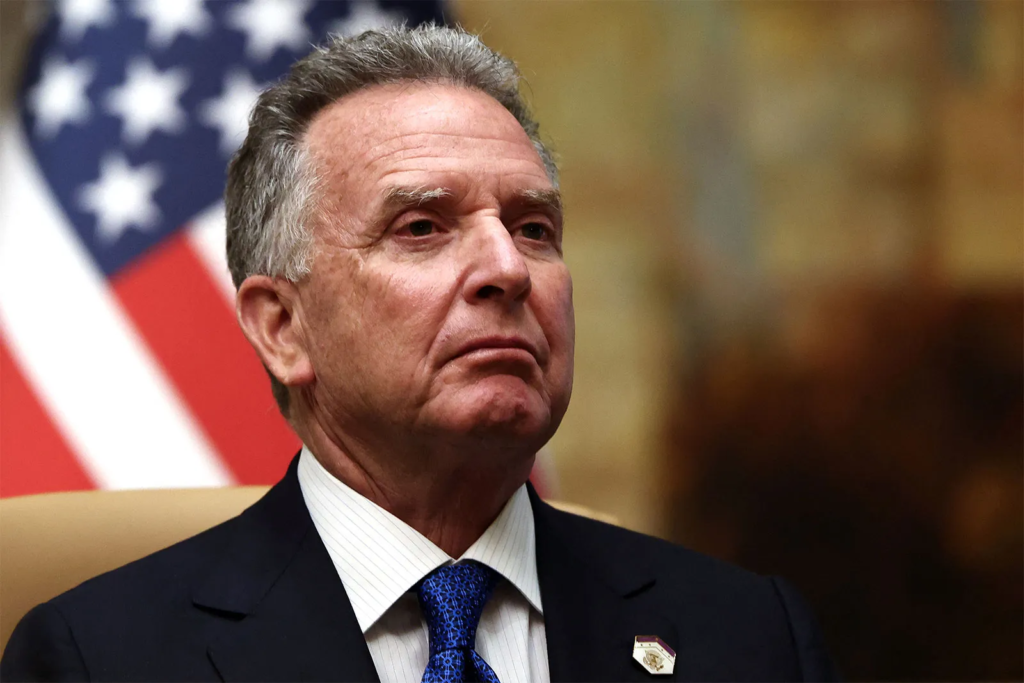
The Explosive Reaction from Steve Witkoff
On Monday morning, while President Trump participated in a White House Easter celebration, a “very angry” Steve Witkoff was on the phones with mediators. Upon receiving Iran’s 10-point counter-proposal, Witkoff told intermediaries it was “a disaster, a catastrophe,” according to sources with direct knowledge.
The proposal reportedly included elements viewed by the U.S. side as overly ambitious or “maximalist,” such as broad sanctions relief, guarantees on uranium enrichment, regional security arrangements involving proxies, and other demands that went beyond what Washington was prepared to accept at that stage.
U.S. Special Envoy Steve Witkoff, who played a central role in the intense negotiations with Iran.
A “Chaotic” Day of Shuttle Diplomacy and Amendments
The strong U.S. reaction triggered frantic activity:
- Pakistan’s central role: Pakistani mediators shuttled revised drafts back and forth between Witkoff and Iranian Foreign Minister Abbas Araghchi.
- Egypt and Türkiye step in: Foreign ministers from Egypt and Türkiye worked to bridge remaining gaps and moderate positions on both sides.
- China’s quiet influence: Beijing urged Iran to find a diplomatic “off-ramp” to avoid further escalation.
By Monday evening, negotiators had produced a revised proposal acceptable enough for U.S. approval, paving the way for the two-week ceasefire announced by Trump on Tuesday.
Iranian Foreign Minister Abbas Araghchi, who was directly involved in the back-and-forth exchanges with U.S. and Pakistani counterparts.
How the Revised Ceasefire Took Shape
The final two-week pause includes:
- Suspension of direct U.S. strikes on Iranian targets
- Iran’s commitment to ensure safe, complete, and immediate reopening of the Strait of Hormuz
- A dedicated window for deeper negotiations, with high-level talks expected in Islamabad, Pakistan, on Friday, April 10, 2026
President Trump has described the points under discussion as “very good” with most already negotiated, while cautioning that unsatisfactory terms could lead to a swift return to pressure.
Pakistan has emerged as the key mediator, facilitating communications and hosting upcoming talks in Islamabad.
Broader Context and Lingering Challenges
This intense Monday of diplomacy occurred against a backdrop of:
- Ongoing disputes over whether the ceasefire extends to Lebanon (Israel has explicitly excluded operations against Hezbollah)
- Qatar’s demands for full compensation from Iran for damages to its energy infrastructure
- Ukraine’s continued deployment of anti-drone experts to help Gulf states defend against Iranian-style threats
Despite the breakthrough, deep distrust remains. Iran has portrayed the pause as a victory, while the U.S. maintains strong leverage and readiness to resume actions if needed.
Regional and international diplomats involved in efforts to de-escalate the U.S.-Iran conflict.
Outlook for Islamabad Talks
The Friday talks in Islamabad will test whether the momentum from Monday’s chaotic revisions can translate into a more durable agreement. Expected participants include high-level U.S. figures (possibly Vice President JD Vance) and Iranian representatives led by Parliament Speaker Mohammad Bagher Ghalibaf or Foreign Minister Araghchi.
Key issues likely to dominate include sanctions relief, nuclear program assurances, freedom of navigation, and regional proxy dynamics.
Reflecto News will continue providing real-time updates and analysis as the Islamabad talks approach and the two-week ceasefire takes effect.
Frequently Asked Questions (FAQs)
Q1: What did Steve Witkoff say about Iran’s 10-point proposal?
Witkoff described the initial Iranian counter-proposal as “a disaster, a catastrophe,” calling it unacceptable in its original form.
Q2: What made the day of negotiations “chaotic”?
Rapid amendments and shuttle diplomacy ensued after Witkoff’s strong reaction, with Pakistan passing drafts between the U.S. and Iran, while Egypt and Türkiye helped bridge gaps.
Q3: What role did other countries play?
Pakistan led the mediation and draft shuttling; Egypt and Türkiye assisted in narrowing differences; China quietly urged Iran to accept a diplomatic off-ramp.
Q4: What is the current status of the ceasefire?
A revised two-week ceasefire has been agreed upon, focused on reopening the Strait of Hormuz and creating space for further talks in Islamabad on Friday.
Q5: Will the talks in Islamabad resolve all issues?
The two-week period is intended for negotiating a larger, more comprehensive agreement, but significant challenges—including Lebanon, sanctions, and nuclear issues—remain.
Q6: How does this fit with Trump’s earlier comments?
Trump has called the points “very good” and mostly negotiated, while echoing that the U.S. can easily return to pressure if the deal falls short.
Q7: What are the risks if the ceasefire breaks down?
Renewed strikes, further disruption to global energy markets via the Strait of Hormuz, and potential escalation involving regional proxies could follow.
For the latest accurate coverage of U.S.-Iran diplomacy, the Islamabad talks, and Middle East developments, stay with Reflecto News—your trusted source for professional, in-depth reporting.
Questions people ask
What is China's current share of global manufacturing?
China now accounts for twenty eight percent of global manufacturing. This industrial output exceeds the combined manufacturing production of the United States, Japan, and Germany, making China the leading global industrial power according to recent reports.
Why were Andrew Tate and Tristan Tate arrested in Miami?
Andrew Tate and his brother Tristan Tate were taken into custody in Miami by the United States Marshals Service. They face thirty eight new charges in the United Kingdom, including rape and child pornography offences, and prosecutors are seeking their extradition.
What warning did Moscow issue about oil prices?
Kirill Dmitriev, the Chief Executive of the Russian Direct Investment Fund, warned that a tsunami of skyrocketing oil prices is approaching. Moscow describes this potential energy shock as a major threat to global markets.
What political shift is projected for Benjamin Netanyahu's coalition?
Political polls project that Prime Minister Benjamin Netanyahu's coalition is on track to lose its majority in the upcoming October election. This projection indicates a potential political shift in Jerusalem.
Why did a Russian military aircraft land in Tehran?
A Russian airborne command aircraft, widely known as a doomsday plane, landed in Tehran. The arrival of the aircraft represents a high stakes show of support from Russia for Iran during a period of heightened regional tensions.
What did President Masoud Pezeshkian claim about the United States and Israel?
Iranian President Masoud Pezeshkian claimed that the United States and Israel failed in a forty eight hour plan to topple the Iranian government. He made these statements during a televised address marking two years since his inauguration.