Reflecto News is an online news platform covering major international political events, global economic developments, and security conflicts. The site provides updates on topics such as Chinese manufacturing dominance, Middle Eastern political tensions, and high profile legal arrests. Readers can access current articles organized by categories like World News, Iran, and USA.
Published on Reflecto News | World News | Diplomacy & Geopolitics
US Ambassador to Türkiye Tom Barrack has sparked debate with a candid assessment of Middle East governance, arguing that “powerful leadership regimes” — whether benevolent monarchies or the kind of “monarchical republics” seen elsewhere in the region — are the only structures that have actually worked in the Middle East. In an interview with Fox News, Barrack said he was speaking from “decades of hard-earned observation, not ideology,” and pointed to the failures of Western-style democracy after the Arab Spring .
“When I said that ‘powerful leadership regimes,’ whether benevolent monarchies or the kind of monarchical republics seen elsewhere in the region, are the only structures that have actually worked in the Middle East, I was speaking from decades of hard-earned observation, not ideology. Imported models have repeatedly collapsed.” — Tom Barrack, US Ambassador to Türkiye
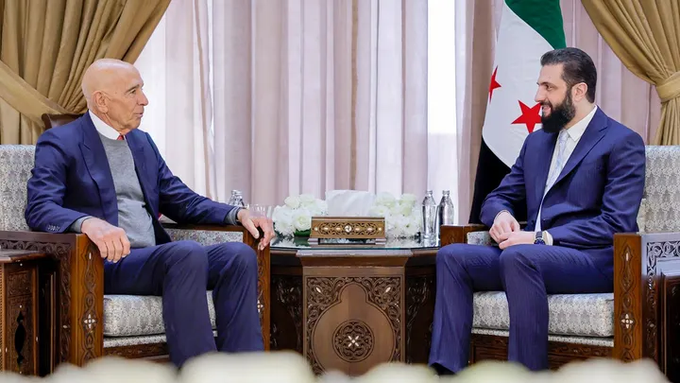
The Arab Spring’s Failure: ‘Chaos, Civil War, or New Authoritarianism’
Barrack’s assessment draws on the track record of countries that attempted to adopt Western-style democracy in the aftermath of the 2011 Arab Spring uprisings.
“Look at the track record. Countries that tried to adopt Western-style democracy quickly after the Arab Spring largely failed, often descending into chaos, civil war or new forms of authoritarianism.” — Tom Barrack
Post-Arab Spring outcomes:
| Country | Outcome |
|---|---|
| Libya | Descended into civil war, fragmentation, foreign intervention |
| Syria | Devastating civil war, refugee crisis, regime survival |
| Egypt | Return to military-led authoritarianism after brief democratic experiment |
| Yemen | Collapse into civil war, humanitarian catastrophe |
| Tunisia | Only relative success, but political instability continues |
| Bahrain | Protests crushed by Gulf intervention |
Barrack’s assessment aligns with a growing body of political science literature that attributes the failures of the Arab Spring to the absence of strong institutions, the persistence of patrimonial politics, and the destabilizing effects of rapid transitions without established democratic norms .
The Gulf Model: ‘Security, Economic Growth, Modernization’
In contrast to the failed democratic experiments, Barrack pointed to the Gulf monarchies as examples of successful governance.
“Meanwhile, stable, results-oriented leadership in places like the Gulf monarchies has delivered security, economic growth, modernization and real improvements in people’s lives.” — Tom Barrack
Gulf monarchies – key indicators:
| Country | Key Achievements |
|---|---|
| UAE | Economic diversification, global business hub, social modernization |
| Saudi Arabia | Vision 2030 reforms, economic transformation, social liberalization |
| Qatar | Gas wealth, global diplomacy, infrastructure development |
| Kuwait | Constitutional monarchy, parliamentary tradition |
| Oman | Regional mediation, economic development |
Barrack’s praise for the Gulf model reflects the Trump administration’s strong ties with Gulf monarchies, which have been key partners in the Iran war and have supported US efforts to secure the Strait of Hormuz .
Türkiye: ‘Strong, Centralized Leadership’ Under Erdoğan
Barrack also cited Türkiye as an example of effective governance, noting its hybrid system of a “presidential republic with regular multiparty elections” that has delivered “stability, economic dynamism and assertive regional influence” under President Recep Tayyip Erdoğan.
“Türkiye, operating as a presidential republic with regular multiparty elections, also demonstrates how strong, centralized leadership under President Recep Tayyip Erdoğan has delivered stability, economic dynamism and assertive regional influence, though critics have described it as a hybrid regime with strong authoritarian tendencies.” — Tom Barrack
Türkiye under Erdoğan:
| Metric | Status |
|---|---|
| Years in power | Since 2003 (as PM, then President) |
| Governance system | Presidential republic (since 2018 constitutional reforms) |
| Economic growth | Significant infrastructure development, defense industry expansion |
| Regional influence | Active in Syria, Libya, Caucasus, Mediterranean |
| Democratic backsliding | Critics cite erosion of judicial independence, press freedom |
Barrack’s acknowledgment of “authoritarian tendencies” reflects ongoing US concerns about Türkiye’s democratic trajectory, including the crackdown following the 2016 coup attempt, the mass purge of civil servants and journalists, and the centralization of power under Erdoğan .
‘Not a Change in US Policy’
Barrack emphasized that his assessment does not represent a shift in official US policy away from supporting democratic governance and human rights.
“This is not a change in U.S. policy away from supporting democratic governance and human rights. It is a realistic assessment of what produces stability so that human rights and prosperity can take root.” — Tom Barrack
This framing attempts to reconcile the administration’s pragmatic embrace of authoritarian allies with its stated commitment to democratic values. Critics argue that such “realism” has historically led the US to support repressive regimes, undermining long-term stability and American credibility .
Reaction and Criticism
Barrack’s comments have drawn sharp criticism from democracy advocates and human rights organizations.
Key criticisms:
| Criticism | Details |
|---|---|
| Authoritarian apologetics | Legitimizing repression in the name of “stability” |
| Ignoring human rights abuses | Downplaying detention, torture, lack of political freedom |
| Selective memory | Ignoring cases where authoritarian regimes collapsed |
| Contradicts US values | Undermines American commitment to democracy |
Kenneth Roth, former executive director of Human Rights Watch, warned that “stability without accountability is just another word for repression.” Other critics noted that “stable authoritarianism” can mask deep-seated grievances that eventually erupt into violence, as seen in the Arab Spring itself .
The Strategic Context: Iran War and Regional Alliances
Barrack’s comments come amid the ongoing US-Iran war and the fragile ceasefire brokered by Pakistan. The United States has relied heavily on Gulf allies and Türkiye for support in the conflict, including access to bases, overflight rights, and diplomatic backing .
The ambassador’s remarks can be seen as part of a broader effort to solidify alliances with key regional partners whose governance models Washington might otherwise criticize. By publicly endorsing their “results-oriented leadership,” Barrack is signaling that the US values stability and security cooperation over democratic conditionality—at least for now .
What Comes Next
Barrack’s comments are likely to fuel further debate over US policy toward the Middle East. As the Iran war continues and the ceasefire holds, the administration faces difficult choices about how to balance its security interests with its stated values.
| Factor | Current Status |
|---|---|
| US-Iran ceasefire | Extended; fragile |
| Gulf alliance | Strengthened by war |
| US-Türkiye relations | Improving (F-35 impasse may be resolved) |
| Democracy promotion | De-emphasized in current strategy |
Barrack’s “realistic assessment” may preview a longer-term shift in US policy toward pragmatic acceptance of authoritarian governance in exchange for stability and cooperation—a calculation with profound implications for the region’s political development .
Frequently Asked Questions (FAQs)
1. What did US Ambassador Barrack say about governance in the Middle East?
Barrack argued that “powerful leadership regimes”—whether benevolent monarchies or “monarchical republics”—are the only structures that have actually worked in the Middle East. He stated that imported Western democratic models have repeatedly collapsed .
2. What evidence did Barrack cite?
Barrack pointed to the failures of the Arab Spring, where countries that attempted to adopt Western-style democracy quickly “largely failed, often descending into chaos, civil war or new forms of authoritarianism.” He contrasted this with the stability and economic growth achieved by Gulf monarchies and Türkiye under Erdoğan .
3. Is this a change in US policy?
Barrack insisted that his assessment is “not a change in U.S. policy away from supporting democratic governance and human rights,” but rather “a realistic assessment of what produces stability so that human rights and prosperity can take root.”
4. How have critics responded?
Critics have accused Barrack of “authoritarian apologetics,” arguing that his comments downplay human rights abuses and ignore cases where authoritarian regimes collapsed. Some warn that “stability without accountability” leads to long-term instability .
5. Why is Barrack making these comments now?
Barrack’s comments come amid the ongoing US-Iran war, where the US relies on Gulf allies and Türkiye for support. His remarks can be seen as an effort to solidify alliances with key regional partners .
6. What is Türkiye’s governance model?
Türkiye operates as a presidential republic with regular multiparty elections. Critics have described it as a hybrid regime with strong authoritarian tendencies, citing erosion of judicial independence and press freedom .
7. Does this reflect a broader shift in US policy?
Barrack’s “realistic assessment” may preview a longer-term shift toward pragmatic acceptance of authoritarian governance in exchange for stability and cooperation, though he insisted that the policy has not changed .
Stay informed with Reflecto News – Your trusted source for breaking diplomatic, geopolitical, and international affairs intelligence. Subscribe for real-time updates on US Middle East policy, regional governance, and global security developments.
Questions people ask
What is China's current share of global manufacturing?
China now accounts for twenty eight percent of global manufacturing. This industrial output exceeds the combined manufacturing production of the United States, Japan, and Germany, making China the leading global industrial power according to recent reports.
Why were Andrew Tate and Tristan Tate arrested in Miami?
Andrew Tate and his brother Tristan Tate were taken into custody in Miami by the United States Marshals Service. They face thirty eight new charges in the United Kingdom, including rape and child pornography offences, and prosecutors are seeking their extradition.
What warning did Moscow issue about oil prices?
Kirill Dmitriev, the Chief Executive of the Russian Direct Investment Fund, warned that a tsunami of skyrocketing oil prices is approaching. Moscow describes this potential energy shock as a major threat to global markets.
What political shift is projected for Benjamin Netanyahu's coalition?
Political polls project that Prime Minister Benjamin Netanyahu's coalition is on track to lose its majority in the upcoming October election. This projection indicates a potential political shift in Jerusalem.
Why did a Russian military aircraft land in Tehran?
A Russian airborne command aircraft, widely known as a doomsday plane, landed in Tehran. The arrival of the aircraft represents a high stakes show of support from Russia for Iran during a period of heightened regional tensions.
What did President Masoud Pezeshkian claim about the United States and Israel?
Iranian President Masoud Pezeshkian claimed that the United States and Israel failed in a forty eight hour plan to topple the Iranian government. He made these statements during a televised address marking two years since his inauguration.