
Reflecto News is an online news platform covering major international political events, global economic developments, and security conflicts. The site provides updates on topics such as Chinese manufacturing dominance, Middle Eastern political tensions, and high profile legal arrests. Readers can access current articles organized by categories like World News, Iran, and USA.
Published on Reflecto News | World News | Conflict & Accountability
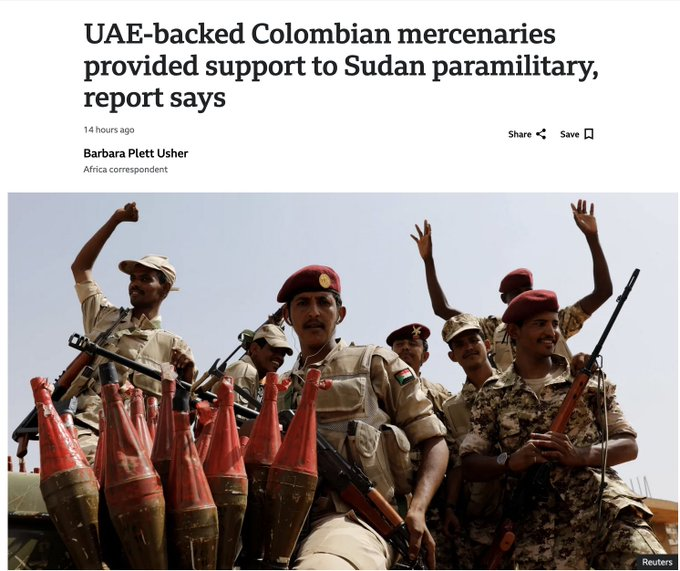
A new investigation by the Conflict Insights Group (CIG) has uncovered compelling evidence that Colombian mercenaries, backed by the United Arab Emirates (UAE), provided critical support to Sudan’s paramilitary Rapid Support Forces (RSF) during the capture of El-Fasher in October 2025. Using phone-tracking data, flight records, and satellite imagery, the report establishes a direct pipeline connecting Colombian fighters to a UAE military facility and then into Sudan .
“This is the first research where we can prove UAE involvement with certainty. We are making public what governments have long known – that there is a direct link between Abu Dhabi and the RSF.” — Justin Lynch, Director, Conflict Insights Group
The Evidence: Phone Tracking from Colombia to the Battlefield
The CIG investigation used commercially available tracking technology to monitor more than 50 mobile phones belonging to Colombian mercenaries in Sudan between April 2025 and January 2026 . The data reveals a sophisticated pipeline:
- Colombia to UAE: One phone was tracked from Colombia to Abu Dhabi’s Zayed International Airport and then to a UAE military training facility in Ghayathi, Abu Dhabi .
- UAE Training Hub: At the Ghayathi facility, investigators found four other devices configured to Spanish, the language spoken in Colombia .
- Deployment to Sudan: Two of those phones subsequently traveled to Sudan’s South Darfur state, while one went to Nyala—the de facto RSF capital—where it logged into Wi-Fi networks named “ANTIAEREO” (anti-aircraft) and “AirDefense” .
- Presence at El-Fasher Siege: A separate device was tracked from Colombia to Nyala and then to El-Fasher during the October 2025 RSF takeover, where it connected to a Wi-Fi network named “ATACADOR” (“attacker” in Spanish) .
“CIG assesses that the UAE-Colombian mercenary network bears shared responsibility for these outcomes. The scale of atrocities and siege in el-Fasher wouldn’t have happened without the drone operations the mercenaries provided.” — Justin Lynch, Conflict Insights Group
The Desert Wolves Brigade: Structure and Leadership
The Colombian mercenaries operated as part of the Desert Wolves brigade (Lobos del Desierto), serving as drone pilots, artillerymen, and instructors for RSF forces .
Key details about the Desert Wolves:
| Aspect | Details |
|---|---|
| Leader | Retired Colombian army Colonel Alvaro Quijano |
| Basis | Based in the UAE |
| Sanctions | Under US and UK sanctions for recruiting Colombians to fight in Sudan |
| Employer | UAE-based company with ties to senior Emirati officials |
| Functions | Drone operations, artillery, training RSF units, possibly training child soldiers |
Wi-Fi network evidence further supports the brigade’s presence: mercenaries connected to networks named “DRONES” and “LOBOS DEL DISIERTO” (Desert Wolves) .
Broader Network: Regional Hubs and Support
The investigation also identified other regional staging grounds supporting the mercenary pipeline:
- Bosaso, Somalia: A port with links to the UAE where Spanish-language devices were detected .
- Kufra, eastern Libya: A logistical hub believed to facilitate weapons flow to the RSF, allegedly with Emirati assistance .
These findings align with a UN Panel of Experts report documenting that the Subul al-Salam Battalion, operating under Libyan General Khalifa Hifter, facilitated the transfer of foreign fighters and weapons to the RSF from the Libyan town of Kufra .
The Fall of El-Fasher: Atrocities and Genocide
El-Fasher, the capital of North Darfur, fell to the RSF in late October 2025 after an 18-month siege that systematically cut off food, aid, and medical supplies to the city’s civilian population .
The UN Fact-Finding Mission on Sudan concluded that the RSF committed war crimes, crimes against humanity, and acts bearing the “hallmarks of genocide” during the siege and takeover .
Documented atrocities include:
| Crime | Details |
|---|---|
| Mass executions | Hundreds killed at city exits, earthen berms, and the University of El Fasher |
| Hospital massacre | Over 460 patients, doctors, nurses, and caretakers executed at Saudi Hospital; bodies burned |
| Systematic sexual violence | Widespread gang rape of women and girls aged 7 to 70, amounting to sexual slavery |
| Ethnic targeting | Explicit hate speech against Zaghawa and Fur communities; “We will wipe out the Zaghawa” |
| Starvation | Siege blocked food, water, and medicine; civilians forced to eat animal fodder |
The UN report found that three core elements of genocide were present in El Fasher: killing members of the group, causing serious bodily and mental harm, and deliberately inflicting conditions of life calculated to bring about the group’s destruction .
“The RSF’s widespread and systematic abuses—including killings, ethnically targeted sexual violence, arbitrary detention, torture, enforced disappearances, extortion and forced displacement—were committed with knowledge, organization, and repetition, and were accompanied by dehumanizing and exterminatory language.” — UN Fact-Finding Mission on Sudan
UAE’s Denials and International Response
The UAE has repeatedly denied supporting the RSF, dismissing such allegations as “false and unfounded” and condemning “in the strongest terms” the atrocities committed in El-Fasher . However, numerous reports by human rights organizations and now the CIG investigation have documented extensive Emirati support for the paramilitary group .
In September 2025, the UAE joined Egypt, Saudi Arabia, and the US in a joint statement saying that “external military support to the conflict parties in Sudan serves to intensify and prolong the conflict and contribute to regional instability” .
The US has sanctioned Colombian nationals and associated companies for recruiting mercenaries to fight in Sudan—in December 2025 and again in April 2026—but has stopped short of making a direct legal connection to the UAE government .
Colombian Government Position
Colombian President Gustavo Petro has condemned the recruitment of Colombian citizens as mercenaries, calling them “spectres of death” and describing the recruitment process as a “form of human trafficking” . The number of Colombian fighters in Sudan has previously been estimated in the low hundreds .
What Comes Next
The CIG report raises urgent questions about accountability for both the mercenaries and their backers:
| Factor | Current Status |
|---|---|
| ICC Investigation | Prosecutor has assessed war crimes and crimes against humanity in El-Fasher |
| UN Fact-Finding Mission | Concluded acts bear “hallmarks of genocide” |
| US Sanctions | Applied to Colombian recruiters, but not UAE |
| UK Sanctions | Applied to Desert Wolves leader Alvaro Quijano |
| UAE Position | Continues to deny involvement |
The report concludes that without foreign support—including the drone operations provided by Colombian mercenaries—”the 18-month siege, takeover, and resulting atrocities would likely not have occurred” .
Frequently Asked Questions (FAQs)
1. What did the Conflict Insights Group investigation find?
The investigation found that Colombian mercenaries, backed by the UAE, provided critical drone, artillery, and training support to Sudan’s RSF during the capture of El-Fasher in October 2025. Phone-tracking data traced mercenaries from Colombia to a UAE military facility and then to Sudan .
2. How was the UAE involved?
Phone-tracking data shows mercenaries traveled from Colombia to a UAE military training facility in Ghayathi, Abu Dhabi, before being deployed to Sudan. The mercenaries were employed by a UAE-based company with ties to senior Emirati officials .
3. What is the Desert Wolves brigade?
The Desert Wolves (Lobos del Desierto) is a brigade of Colombian mercenaries that served as drone pilots, artillerymen, and instructors for the RSF. It is led by retired Colombian Colonel Alvaro Quijano, who is based in the UAE and has been sanctioned by the US and UK .
4. What atrocities occurred in El-Fasher?
The UN Fact-Finding Mission documented mass executions, systematic sexual violence, ethnic targeting, starvation, and the deliberate destruction of medical services. The acts were assessed as bearing the “hallmarks of genocide” .
5. Has the UAE responded to the allegations?
The UAE has denied supporting the RSF, calling the allegations “false and unfounded.” However, multiple investigations have documented extensive Emirati support for the paramilitary group .
6. Has Colombia taken any action?
Colombian President Gustavo Petro has condemned the recruitment of Colombian mercenaries, calling them “spectres of death” and describing the recruitment as a “form of human trafficking” .
7. What are the international legal implications?
The International Criminal Court (ICC) has assessed that war crimes and crimes against humanity were committed in El-Fasher. The UN Fact-Finding Mission concluded that the acts bear the “hallmarks of genocide.” The report suggests the UAE-Colombian mercenary network bears “shared responsibility” for these outcomes .
Stay informed with Reflecto News – Your trusted source for breaking conflict, accountability, and geopolitical intelligence. Subscribe for real-time updates on the Sudan crisis, international justice, and regional security developments.
Questions people ask
What is China's current share of global manufacturing?
China now accounts for twenty eight percent of global manufacturing. This industrial output exceeds the combined manufacturing production of the United States, Japan, and Germany, making China the leading global industrial power according to recent reports.
Why were Andrew Tate and Tristan Tate arrested in Miami?
Andrew Tate and his brother Tristan Tate were taken into custody in Miami by the United States Marshals Service. They face thirty eight new charges in the United Kingdom, including rape and child pornography offences, and prosecutors are seeking their extradition.
What warning did Moscow issue about oil prices?
Kirill Dmitriev, the Chief Executive of the Russian Direct Investment Fund, warned that a tsunami of skyrocketing oil prices is approaching. Moscow describes this potential energy shock as a major threat to global markets.
What political shift is projected for Benjamin Netanyahu's coalition?
Political polls project that Prime Minister Benjamin Netanyahu's coalition is on track to lose its majority in the upcoming October election. This projection indicates a potential political shift in Jerusalem.
Why did a Russian military aircraft land in Tehran?
A Russian airborne command aircraft, widely known as a doomsday plane, landed in Tehran. The arrival of the aircraft represents a high stakes show of support from Russia for Iran during a period of heightened regional tensions.
What did President Masoud Pezeshkian claim about the United States and Israel?
Iranian President Masoud Pezeshkian claimed that the United States and Israel failed in a forty eight hour plan to topple the Iranian government. He made these statements during a televised address marking two years since his inauguration.