Reflecto News is an online news platform covering major international political events, global economic developments, and security conflicts. The site provides updates on topics such as Chinese manufacturing dominance, Middle Eastern political tensions, and high profile legal arrests. Readers can access current articles organized by categories like World News, Iran, and USA.
The move marks a major shift in US-Syria relations, following a November 2025 White House meeting and Syria’s reintegration into the Arab and international community after the fall of Bashar al-Assad.
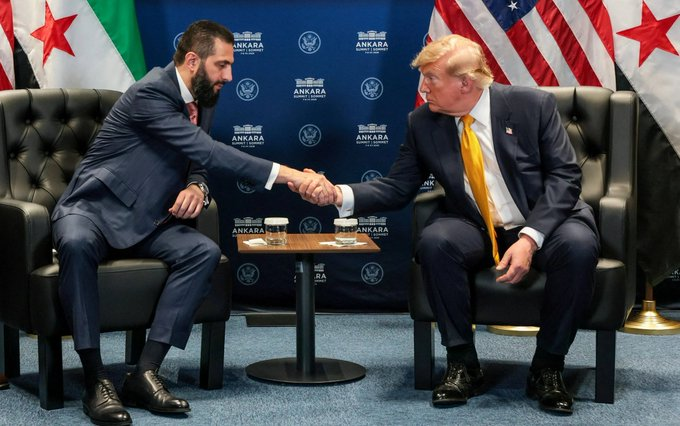
ANKARA / WASHINGTON — President Donald Trump has officially removed Syria from the United States’ list of state sponsors of terrorism, a landmark decision that completes a dramatic policy reversal following the collapse of the Assad regime and Syria’s reintegration into regional and international diplomacy .
“I think I will,” Trump told reporters when asked about the potential change ahead of a meeting with Syrian President Ahmed al-Sharaa in Turkey . The president also confirmed that he had previously released sanctions on Syria, describing the country as having “become very stable” and suggesting it “could help with Hezbollah, Lebanon” .
The State Sponsor of Terrorism Designation
Syria had been designated a state sponsor of terrorism by the United States since December 1979 . The designation carries significant restrictions, including:
- Limitations on U.S. foreign assistance
- Restrictions on defense exports
- Prohibitions on certain financial transactions
- Arms embargoes and economic sanctions
The move to remove Syria from the list had been under review by the Trump administration for months. In June 2025, Trump signed an executive order terminating the Syria sanctions program, while directing the State Department to “review the designations of Syria as a State Sponsor of Terrorism” . A 180-day sanctions waiver was also issued to allow for humanitarian aid and initial reconstruction efforts .
A Historic Diplomatic Reset
The removal follows a series of unprecedented diplomatic steps between Washington and Damascus. In November 2025, al-Sharaa became the first Syrian leader to visit the White House since Syria’s independence in 1946 . During that meeting, Syria formally confirmed it would join the U.S.-led global coalition against the Islamic State (IS) group .
Key milestones in the U.S.-Syria reset include:
| Date | Event |
|---|---|
| December 2024 | Bashar al-Assad overthrown; rebel forces led by al-Sharaa establish interim government |
| May 2025 | Trump and al-Sharaa first meet in Riyadh; Trump announces plan to lift sanctions |
| June 2025 | Trump signs executive order terminating most Syria sanctions |
| November 2025 | U.S. and UN remove al-Sharaa from terrorist blacklists; al-Sharaa visits White House |
| July 2026 | Trump officially removes Syria from State Sponsors of Terrorism list |
In November 2025, the United Nations Security Council voted to remove al-Sharaa and Syrian Interior Minister Anas Khattab from the IS and al-Qaeda sanctions list . The U.S. followed suit the next day, delisting both officials .
The delisting was justified “in recognition of the progress demonstrated by the Syrian leadership after the departure of Bashar al-Assad and more than 50 years of repression under the Assad regime,” according to a State Department statement . The department noted that the new Syrian government was “working to locate missing Americans, fulfil its commitments on countering terrorism and narcotics, and eliminate any remnants of chemical weapons” .
Broader Context and Reactions
The removal from the terrorism list follows a broader regional realignment. Regional powers including Saudi Arabia, Turkiye, and Qatar have backed renewed engagement with Syria, offering to fund public salaries, rebuild energy infrastructure, and help Syria meet its obligations to international financial institutions .
The move to lift sanctions and remove Syria from the terrorism list had also drawn international support. Pakistan welcomed the initial decision to lift sanctions, calling it a “pivotal step towards regional stability” and commending “the commitment of all countries, in particular the US, Turkiye, Saudi Arabia, and Qatar, working constructively towards a peaceful Syria” .
Some restrictions remain in place. Sanctions on ousted former president Bashar al-Assad, his associates, human rights abusers, drug traffickers, persons linked to chemical weapons activities, ISIS and their affiliates, and Iranian proxies will remain . The U.S. also continues to monitor Syria’s progress on “key priorities” including steps toward normalizing ties with Israel and preventing a resurgence of ISIS .
The White House said it would continue to monitor Syria’s progress on key priorities, including “taking concrete steps toward normalizing ties with Israel” and helping the U.S. prevent a resurgence of ISIS .
Frequently Asked Questions (FAQs)
Q1: What does it mean to be removed from the State Sponsors of Terrorism list?
A: Removal lifts a range of restrictions, including bans on U.S. foreign assistance, defense exports, and certain financial transactions. It allows for normalized economic engagement and removes Syria from the U.S. government’s list of countries deemed to be supporting international terrorism .
Q2: Is Syria still subject to any sanctions?
A: Yes. While the Trump administration has terminated most sanctions, restrictions remain in place on ousted former president Bashar al-Assad, his associates, human rights abusers, drug traffickers, persons linked to chemical weapons, ISIS and their affiliates, and Iranian proxies. The U.S. also continues to monitor progress on key priorities such as normalizing ties with Israel .
Q3: What progress has Syria made to warrant this change?
A: The new Syrian government, led by President Ahmed al-Sharaa, has been recognized for working to locate missing Americans, fulfilling commitments on counterterrorism and narcotics, eliminating remnants of chemical weapons, and promoting regional security and stability. Syria has also formally joined the U.S.-led coalition against the Islamic State .
This is a developing story. Reflecto News will continue to provide updates on U.S.-Syria relations and the implementation of sanctions relief.
Questions people ask
What is China's current share of global manufacturing?
China now accounts for twenty eight percent of global manufacturing. This industrial output exceeds the combined manufacturing production of the United States, Japan, and Germany, making China the leading global industrial power according to recent reports.
Why were Andrew Tate and Tristan Tate arrested in Miami?
Andrew Tate and his brother Tristan Tate were taken into custody in Miami by the United States Marshals Service. They face thirty eight new charges in the United Kingdom, including rape and child pornography offences, and prosecutors are seeking their extradition.
What warning did Moscow issue about oil prices?
Kirill Dmitriev, the Chief Executive of the Russian Direct Investment Fund, warned that a tsunami of skyrocketing oil prices is approaching. Moscow describes this potential energy shock as a major threat to global markets.
What political shift is projected for Benjamin Netanyahu's coalition?
Political polls project that Prime Minister Benjamin Netanyahu's coalition is on track to lose its majority in the upcoming October election. This projection indicates a potential political shift in Jerusalem.
Why did a Russian military aircraft land in Tehran?
A Russian airborne command aircraft, widely known as a doomsday plane, landed in Tehran. The arrival of the aircraft represents a high stakes show of support from Russia for Iran during a period of heightened regional tensions.
What did President Masoud Pezeshkian claim about the United States and Israel?
Iranian President Masoud Pezeshkian claimed that the United States and Israel failed in a forty eight hour plan to topple the Iranian government. He made these statements during a televised address marking two years since his inauguration.