Reflecto News is an online news platform covering major international political events, global economic developments, and security conflicts. The site provides updates on topics such as Chinese manufacturing dominance, Middle Eastern political tensions, and high profile legal arrests. Readers can access current articles organized by categories like World News, Iran, and USA.
Published on Reflecto News | World News | Diplomacy & Conflict
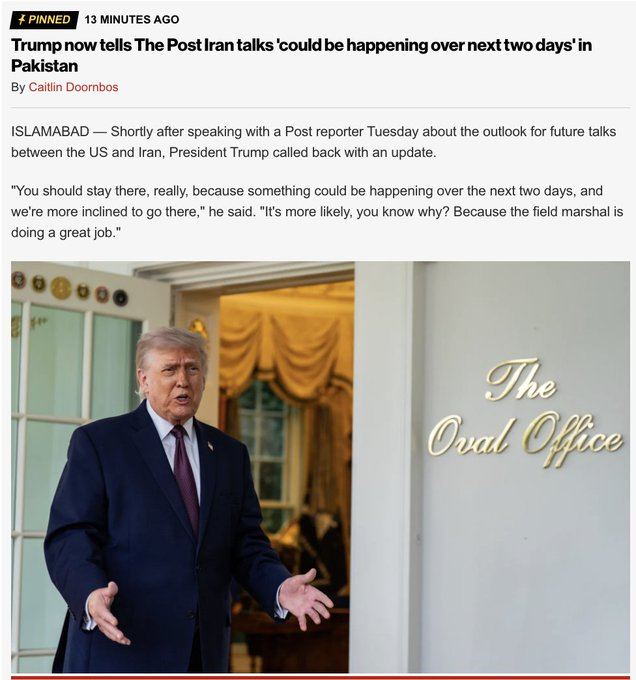
President Donald Trump has signaled that a second round of high-stakes negotiations with Iran could resume “over the next two days” and that he is “more inclined” to hold the talks in Pakistan, citing the “fantastic” work of the country’s army chief. In an interview with the New York Post, Trump confirmed that diplomatic efforts are accelerating, just days after the first round of direct talks in Islamabad ended without a deal .
“You should stay there, really, because something could be happening over the next two days, and we’re more inclined to go there.” — President Donald Trump
Trump’s remarks signal a significant shift in venue preference. While other locations like Geneva had been floated, the president made clear that the United States is leaning heavily toward returning to Islamabad.
Why Pakistan? The ‘Fantastic’ Field Marshal
When asked why the administration prefers Pakistan over other potential neutral venues, Trump pointed directly to the leadership of Field Marshal Asim Munir, the Chief of Army Staff of the Pakistan Army.
“It’s more likely, you know why? Because the Field Marshal is doing a great job. He’s fantastic, and therefore it’s more likely that we go back there. Why should we go to some country that has nothing to do with it?” — President Donald Trump
Field Marshal Munir has been a pivotal figure in the backchannel diplomacy that led to the fragile two-week ceasefire currently in effect. Reports indicate that the White House leaned heavily on Pakistan to serve as a primary channel to Tehran, with Munir coordinating closely with senior US officials, including Trump, Vice President JD Vance, and special envoy Steve Witkoff .
Islamabad’s unique position as a Muslim-majority nation with ties to both Washington and Tehran has made it an indispensable mediator. The first round of talks, held over the weekend, marked the highest-level direct engagement between the US and Iran since 1979, with delegations led by Vice President Vance and Iranian Parliament Speaker Mohammad Bagher Ghalibaf .
Talks ‘Not Yet Broken’
Despite the first round of talks concluding without a final agreement, Trump indicated that the process is far from over. The initial discussions, which spanned nearly 21 hours and included technical committees exchanging written texts, failed to bridge gaps on key issues such as the Strait of Hormuz and Iran’s nuclear program .
“Something could be happening over the next two days.” — President Donald Trump
The president’s optimistic timeline suggests that back-channel communications may have yielded progress on the sticking points that prevented a deal during the first round. However, the administration has maintained a tough stance, demanding that Iran end its uranium enrichment program, dismantle nuclear facilities, and surrender its stockpile of enriched uranium as preconditions for any lasting peace .
The Ceasefire Clock
The urgency for a second round stems from the impending expiration of the two-week ceasefire on April 22. Brokered by Pakistan and announced on April 7, the truce was explicitly conditioned on Iran’s agreement to the “complete, immediate, and safe opening” of the Strait of Hormuz — a condition that remains unmet .
Field Marshal Munir is reportedly working to not only arrange the next round of talks but also to extend the ceasefire deadline to allow more time for diplomacy .
What Comes Next
As the potential Thursday or Friday timeframe approaches, several questions remain:
| Question | Implication |
|---|---|
| Will the talks be in Islamabad or Geneva? | Trump has indicated a strong preference for Pakistan. |
| Will the ceasefire be extended? | Likely necessary to allow talks to conclude successfully. |
| Can the nuclear gap be bridged? | Iran has offered a 5-year pause; the US demands 20 years. |
Trump’s praise for Field Marshal Munir underscores the evolving strategic partnership between Washington and Islamabad. As the world watches, Pakistan is solidifying its role as an indispensable peace broker, with the “fantastic” Field Marshal at the center of the effort to pull the US and Iran back from the brink of war.
Frequently Asked Questions (FAQs)
1. When could the next round of US-Iran talks happen?
President Trump told the New York Post that talks could resume “over the next two days,” suggesting a possible Thursday or Friday timeline.
2. Where will the talks be held?
Trump indicated he is “more inclined” to return to Islamabad, Pakistan, citing the leadership of Field Marshal Asim Munir.
3. Why does Trump prefer Pakistan for the talks?
Trump praised Pakistan’s Army Chief, Field Marshal Asim Munir, calling him “fantastic.” Pakistan has served as a key mediator due to its unique ties to both the US and Iran.
4. Did the first round of talks fail?
The first round did not produce a final agreement, but sources described the talks as “cautiously positive” and a “foundation for a diplomatic process.”
5. Is the ceasefire still in effect?
Yes, the two-week ceasefire is currently holding, but it is set to expire on April 22. Mediators are working to extend it.
Questions people ask
What is China's current share of global manufacturing?
China now accounts for twenty eight percent of global manufacturing. This industrial output exceeds the combined manufacturing production of the United States, Japan, and Germany, making China the leading global industrial power according to recent reports.
Why were Andrew Tate and Tristan Tate arrested in Miami?
Andrew Tate and his brother Tristan Tate were taken into custody in Miami by the United States Marshals Service. They face thirty eight new charges in the United Kingdom, including rape and child pornography offences, and prosecutors are seeking their extradition.
What warning did Moscow issue about oil prices?
Kirill Dmitriev, the Chief Executive of the Russian Direct Investment Fund, warned that a tsunami of skyrocketing oil prices is approaching. Moscow describes this potential energy shock as a major threat to global markets.
What political shift is projected for Benjamin Netanyahu's coalition?
Political polls project that Prime Minister Benjamin Netanyahu's coalition is on track to lose its majority in the upcoming October election. This projection indicates a potential political shift in Jerusalem.
Why did a Russian military aircraft land in Tehran?
A Russian airborne command aircraft, widely known as a doomsday plane, landed in Tehran. The arrival of the aircraft represents a high stakes show of support from Russia for Iran during a period of heightened regional tensions.
What did President Masoud Pezeshkian claim about the United States and Israel?
Iranian President Masoud Pezeshkian claimed that the United States and Israel failed in a forty eight hour plan to topple the Iranian government. He made these statements during a televised address marking two years since his inauguration.