Reflecto News is an online news platform covering major international political events, global economic developments, and security conflicts. The site provides updates on topics such as Chinese manufacturing dominance, Middle Eastern political tensions, and high profile legal arrests. Readers can access current articles organized by categories like World News, Iran, and USA.
Reflecto News
April 15, 2026
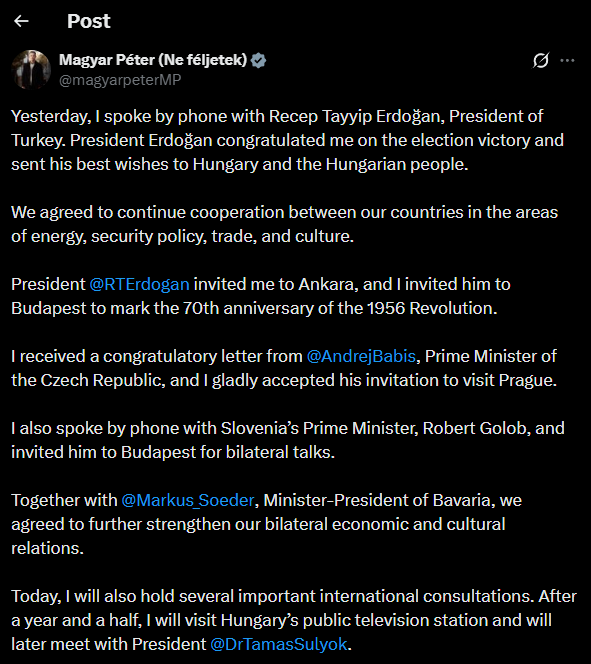
Péter Magyar, leader of the Tisza party and Hungary’s prime minister-elect after his landslide victory over Viktor Orbán in Sunday’s parliamentary elections, revealed details of a phone conversation he held on Tuesday with Turkish President Recep Tayyip Erdoğan.
In a public statement, Magyar said: “Yesterday, I spoke by phone with Recep Tayyip Erdoğan, President of Türkiye. President Erdoğan congratulated me on the election victory and sent his best wishes to Hungary and the Hungarian people. We agreed to continue cooperation between our countries in the areas of energy, security policy, trade, and culture. President Erdoğan invited me to Ankara, and I invited him to Budapest to mark the 70th anniversary of the 1956 Revolution.”
The call underscores the new Hungarian government’s intention to maintain and potentially deepen bilateral ties with Türkiye, a fellow NATO member, despite differing positions on several regional and international issues.
Péter Magyar, whose Tisza party secured a supermajority in the April 2026 elections, is set to become Hungary’s next prime minister.
Context of the Conversation
Erdoğan’s congratulations and the mutual invitations reflect standard diplomatic protocol following a change of government. Both leaders emphasized strengthening strategic partnership within NATO and exploring practical cooperation in energy security, trade, and cultural exchanges.
Magyar’s invitation to Erdoğan for the 70th anniversary of the 1956 Hungarian Revolution carries symbolic weight. The 1956 uprising against Soviet rule remains a cornerstone of modern Hungarian national identity. Hosting the Turkish president for the commemoration could signal continuity in Hungary’s foreign policy outreach beyond the EU while balancing relations with key non-Western partners.
Broader Implications for Hungarian Foreign Policy
Magyar’s Tisza party campaigned on a pro-European, anti-corruption platform while promising pragmatic engagement with international partners. The early outreach to Erdoğan suggests the incoming government intends to maintain Hungary’s traditionally balanced — and sometimes independent — foreign policy line, including ties with Türkiye on energy diversification and security matters.
Türkiye and Hungary have cooperated in recent years on issues such as migration, energy projects, and defense industry ties. The phone call indicates that these areas will remain priorities under the new leadership.
Turkish presidential sources confirmed the conversation, noting Erdoğan’s belief that bilateral relations would progress further and that the two NATO allies should deepen their strategic partnership.
Reactions
- Hungarian opposition figures and civil society groups have welcomed the tone of constructive international engagement.
- Analysts note that the call fits a pattern of early diplomatic outreach by Magyar to major regional players following his decisive electoral win.
- No immediate comments from the outgoing Orbán administration or Fidesz party have been reported on this specific conversation.
Magyar is expected to assume office in the coming weeks once the new parliament convenes and the government is formally installed.
Reflecto News will continue to follow developments in Hungarian foreign policy, the formation of the new government, and any follow-up visits between Budapest and Ankara.
Frequently Asked Questions (FAQs)
What did Péter Magyar and President Erdoğan discuss?
The leaders discussed future bilateral cooperation in energy, security policy, trade, and culture. Erdoğan congratulated Magyar on his election victory and extended best wishes to Hungary.
Did they exchange invitations?
Yes — Erdoğan invited Magyar to Ankara, and Magyar invited Erdoğan to Budapest for events marking the 70th anniversary of the 1956 Hungarian Revolution.
When did the phone call take place?
The conversation occurred on Tuesday, April 14, 2026, one day after preliminary results confirmed Magyar’s landslide victory.
What is the significance of the 1956 Revolution anniversary?
The 1956 uprising against Soviet occupation is a foundational event in modern Hungarian history, symbolizing national independence and resistance. Hosting a foreign leader for its 70th anniversary carries strong symbolic and diplomatic meaning.
How does this fit into Magyar’s emerging foreign policy?
The call signals continuity in pragmatic engagement with key NATO partners like Türkiye while aligning with Magyar’s broader pro-European but independent-minded approach to international relations.
For ongoing coverage of Hungarian politics, the new government’s formation, and international diplomacy, stay with Reflecto News.
Questions people ask
What is China's current share of global manufacturing?
China now accounts for twenty eight percent of global manufacturing. This industrial output exceeds the combined manufacturing production of the United States, Japan, and Germany, making China the leading global industrial power according to recent reports.
Why were Andrew Tate and Tristan Tate arrested in Miami?
Andrew Tate and his brother Tristan Tate were taken into custody in Miami by the United States Marshals Service. They face thirty eight new charges in the United Kingdom, including rape and child pornography offences, and prosecutors are seeking their extradition.
What warning did Moscow issue about oil prices?
Kirill Dmitriev, the Chief Executive of the Russian Direct Investment Fund, warned that a tsunami of skyrocketing oil prices is approaching. Moscow describes this potential energy shock as a major threat to global markets.
What political shift is projected for Benjamin Netanyahu's coalition?
Political polls project that Prime Minister Benjamin Netanyahu's coalition is on track to lose its majority in the upcoming October election. This projection indicates a potential political shift in Jerusalem.
Why did a Russian military aircraft land in Tehran?
A Russian airborne command aircraft, widely known as a doomsday plane, landed in Tehran. The arrival of the aircraft represents a high stakes show of support from Russia for Iran during a period of heightened regional tensions.
What did President Masoud Pezeshkian claim about the United States and Israel?
Iranian President Masoud Pezeshkian claimed that the United States and Israel failed in a forty eight hour plan to topple the Iranian government. He made these statements during a televised address marking two years since his inauguration.