Reflecto News is an online news platform covering major international political events, global economic developments, and security conflicts. The site provides updates on topics such as Chinese manufacturing dominance, Middle Eastern political tensions, and high profile legal arrests. Readers can access current articles organized by categories like World News, Iran, and USA.
Reflecto News – April 16, 2026
In a significant escalation of naval operations amid the fragile US-Iran ceasefire, the US military has directed the USS Abraham Lincoln (CVN-72) and its Carrier Strike Group to play a central role in enforcing the ongoing blockade targeting Iranian ports and maritime activities in the Strait of Hormuz area. The nuclear-powered supercarrier, already positioned in the Arabian Sea and Gulf of Oman, is providing critical air cover, surveillance, and command capabilities as the blockade enters its most intensive phase.
US Central Command (CENTCOM) has described the operation as “fully implemented,” with the Abraham Lincoln’s advanced aircraft and escort vessels helping ensure no unauthorized ships reach or depart Iranian ports, effectively cutting off a substantial portion of Iran’s seaborne trade.
USS Abraham Lincoln and Carrier Air Wing 9 operating in the Arabian Sea near the Strait of Hormuz region. (Image: US Navy archive)
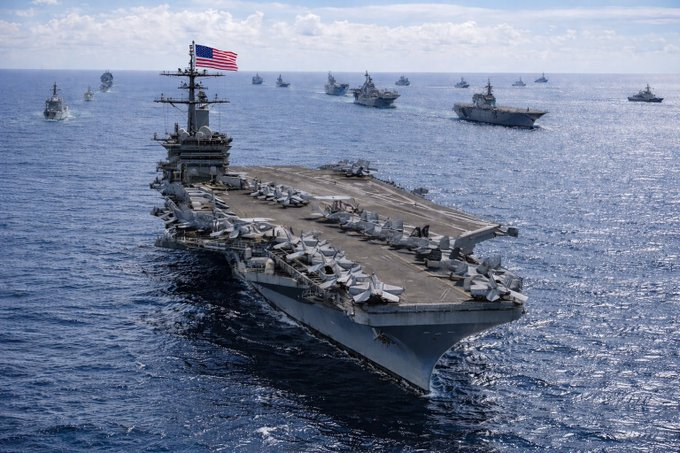
Background: The US Naval Blockade and the Abraham Lincoln’s Role
The blockade, which began on April 13, 2026, targets all vessels entering or exiting Iranian ports in the Persian Gulf, Strait of Hormuz, and Gulf of Oman. It was imposed after the collapse of mediated talks in Islamabad and serves as leverage to pressure Iran on key issues, including nuclear activities, safe passage through the strait, and regional de-escalation.
The USS Abraham Lincoln, homeported in San Diego and part of Carrier Strike Group 3, has been heavily involved since earlier phases of Operation Epic Fury. Satellite imagery and reports place the carrier approximately 200 km south of the Iranian coast in the Gulf of Oman — its closest positioning to the Gulf since the conflict intensified. It operates alongside destroyers and other assets, launching E-2D Hawkeye surveillance aircraft and F/A-18 fighter jets for continuous combat air patrols and real-time monitoring.
CENTCOM reports that more than a dozen warships, over 100 aircraft, and thousands of personnel are now supporting the effort, with the Abraham Lincoln serving as a floating command hub.
Map showing the US blockade zone along Iran’s Gulf coast, including the Strait of Hormuz. (Image: BBC/illustrative graphic)
Current Developments and Enforcement Details
Recent updates indicate the blockade has already turned back multiple merchant vessels attempting to approach Iranian ports. US forces emphasize that the measure is “impartial” and does not close the Strait of Hormuz to international traffic destined for non-Iranian ports, preserving freedom of navigation for global shipping where possible.
The Abraham Lincoln’s involvement strengthens the multi-layered approach:
- Air superiority and surveillance: Providing overhead intelligence to track vessels across a wide area.
- Deterrence: Its presence discourages potential Iranian attempts to challenge the blockade with fast-attack craft or swarming tactics.
- Command and control: Coordinating with other US Navy assets already in theater.
This development comes just days after Iran’s Foreign Ministry condemned the blockade as illegal and a potential ceasefire violation, while warning of retaliatory actions that could disrupt shipping in the Persian Gulf, Gulf of Oman, or even the Red Sea.
Iran’s Response and Risks of Escalation
Iranian officials have rejected the legitimacy of the US actions, insisting Tehran retains sovereign rights over its territorial waters. The Islamic Revolutionary Guard Corps (IRGC) Navy has been placed on high alert, with threats to use asymmetric tactics, including speedboats and anti-ship missiles, if Iranian vessels face interference.
Despite the heightened military posture, both sides continue indirect communication through Pakistani mediators, with discussions ongoing about possibly extending the two-week ceasefire — originally set to expire around April 22 — by another two weeks.
Iranian naval and IRGC vessels conducting operations in the Persian Gulf. (Image: Illustrative)
Strategic and Global Implications
The Strait of Hormuz handles roughly 20% of the world’s oil supply. While the blockade is designed to isolate Iranian ports without fully sealing the strait, any miscalculation could lead to disruptions, higher energy prices, and broader regional instability. Oil markets have already shown volatility in response to the naval buildup.
The deployment also signals US determination to maintain pressure while keeping a diplomatic off-ramp open. President Trump has previously described the situation as one where the war is “very close to over,” provided Iran meets core demands.
Additional carrier strike groups, including elements from the USS George H.W. Bush, are reportedly en route or positioning to support operations, further concentrating US naval power in the CENTCOM area.
FAQs on the USS Abraham Lincoln and the Hormuz Blockade
Q1: What is the specific role of the USS Abraham Lincoln in the blockade?
The carrier provides air cover, surveillance via E-2D Hawkeyes, fighter jet patrols, and serves as a command center for coordinating naval enforcement in the Strait of Hormuz region and Gulf of Oman.
Q2: Does the blockade completely close the Strait of Hormuz?
No. The US states the blockade targets only vessels going to or from Iranian ports. International shipping to non-Iranian destinations is permitted to transit the strait under monitored conditions.
Q3: How close is the USS Abraham Lincoln to Iranian waters?
Satellite imagery shows the carrier operating roughly 200 km south of the Iranian coast in the Gulf of Oman, supported by escort destroyers.
Q4: Has the blockade been effective so far?
CENTCOM reports it is “fully implemented,” with no ships successfully reaching Iranian ports on the first full day and several vessels turned back.
Q5: What is Iran’s reaction to the increased US naval presence?
Iran has called the blockade illegal and a ceasefire violation, threatening retaliatory disruptions to shipping if its vessels or interests are harmed.
Q6: Could this affect the ceasefire extension talks?
Yes. While the naval pressure continues, mediators are still discussing a possible two-week extension of the current truce to allow more time for negotiations on nuclear issues, sanctions, and regional security.
Q7: What are the broader risks to global energy markets?
Any escalation could disrupt oil flows through the Strait of Hormuz, leading to higher prices and supply concerns worldwide. A stable diplomatic resolution would help ease these pressures.
Reflecto News will continue monitoring developments involving the USS Abraham Lincoln, CENTCOM operations, Iranian responses, and diplomatic efforts. This high-stakes naval situation remains fluid, with potential consequences for regional stability and global trade. The story is developing rapidly.
Questions people ask
What is China's current share of global manufacturing?
China now accounts for twenty eight percent of global manufacturing. This industrial output exceeds the combined manufacturing production of the United States, Japan, and Germany, making China the leading global industrial power according to recent reports.
Why were Andrew Tate and Tristan Tate arrested in Miami?
Andrew Tate and his brother Tristan Tate were taken into custody in Miami by the United States Marshals Service. They face thirty eight new charges in the United Kingdom, including rape and child pornography offences, and prosecutors are seeking their extradition.
What warning did Moscow issue about oil prices?
Kirill Dmitriev, the Chief Executive of the Russian Direct Investment Fund, warned that a tsunami of skyrocketing oil prices is approaching. Moscow describes this potential energy shock as a major threat to global markets.
What political shift is projected for Benjamin Netanyahu's coalition?
Political polls project that Prime Minister Benjamin Netanyahu's coalition is on track to lose its majority in the upcoming October election. This projection indicates a potential political shift in Jerusalem.
Why did a Russian military aircraft land in Tehran?
A Russian airborne command aircraft, widely known as a doomsday plane, landed in Tehran. The arrival of the aircraft represents a high stakes show of support from Russia for Iran during a period of heightened regional tensions.
What did President Masoud Pezeshkian claim about the United States and Israel?
Iranian President Masoud Pezeshkian claimed that the United States and Israel failed in a forty eight hour plan to topple the Iranian government. He made these statements during a televised address marking two years since his inauguration.