U.S. President Hails Temporary Truce Brokered by Washington, Urges Hezbollah to “Act Nicely” Amid Hopes for Longer-Term Peace
By Reflecto News Staff
April 17, 2026
U.S. President Donald Trump has enthusiastically described the start of a 10-day ceasefire between Israel and Lebanon as a potential “historic day” for the country, posting on Truth Social: “May have been a historic day for Lebanon. Good things are happening!!!”
The ceasefire, which went into effect at 5 p.m. ET (midnight Beirut time) on April 16, 2026, follows intensive U.S.-brokered diplomacy and comes amid broader regional tensions linked to the recent U.S.-Iran conflict. Trump also expressed hope that Hezbollah would “act nicely and well during this important period of time.”
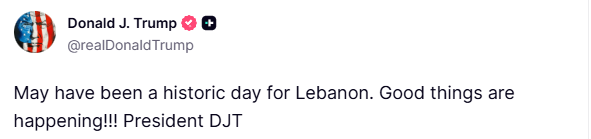
Screenshot of President Trump’s Truth Social post announcing the ceasefire agreement.
Trump’s Optimistic Statement and Diplomatic Push
In a flurry of posts, Trump highlighted phone conversations with Lebanese President Joseph Aoun and Israeli Prime Minister Benjamin Netanyahu. He announced plans to invite both leaders to the White House for what he described as the “first meaningful talks” between Israel and Lebanon since 1983.
Trump framed the truce as part of his administration’s broader peacemaking efforts, claiming it could be his “10th” war resolved. He directed Vice President JD Vance, Secretary of State Marco Rubio, and Joint Chiefs Chairman Dan Caine to work toward a lasting agreement, stating that “both sides want to see PEACE, and I believe that will happen, quickly!”
Earlier, Trump noted that Lebanon had agreed to “take care of Hezbollah,” the Iran-backed group whose cross-border activities have long fueled conflict with Israel.
President Trump’s additional Truth Social post inviting Israeli and Lebanese leaders to Washington.
Background: The Israel-Lebanon Ceasefire
The 10-day truce halts active hostilities that escalated in recent weeks, including Israeli strikes on Hezbollah targets in southern Lebanon and beyond. It follows rare direct diplomatic talks between Israeli and Lebanese officials in Washington earlier in the week — the first such engagement in over three decades.
Lebanese officials and Hezbollah have indicated conditional adherence to the ceasefire, provided Israel halts its operations. Israel has confirmed the agreement but stated that its forces would remain in certain positions in southern Lebanon for security reasons.
Map showing key areas in southern Lebanon and Israeli positions near the border.
Reactions Across the Region
- Lebanon: Reports of celebrations in Beirut and other areas as residents welcomed the pause in violence after weeks of intense strikes. Thousands have begun attempting to return to homes in affected regions.
- Israel: The government confirmed the ceasefire while maintaining high alert status. Officials emphasized that any violations would prompt a strong response.
- Hezbollah: A senior official stated the group would abide by the truce if Israeli attacks cease, though the organization has not issued a formal endorsement.
- International: Several European countries and the United Nations welcomed the development, urging all parties to respect the agreement and work toward a permanent resolution.
Lebanese civilians celebrating in the streets as the ceasefire takes hold.
Strategic Context and Challenges Ahead
The ceasefire occurs against the backdrop of the wider U.S.-Iran confrontation, including disruptions in the Strait of Hormuz. Analysts see the Lebanon truce as a potential step toward de-escalation in the region, but significant hurdles remain:
- Disarmament or containment of Hezbollah
- Israeli withdrawal from southern Lebanon
- Implementation of UN Security Council Resolution 1701, which calls for Hezbollah to stay north of the Litani River
- Broader Israel-Lebanon peace talks
Trump has linked progress in Lebanon to ongoing efforts regarding Iran, suggesting interconnected diplomatic gains.
Illustration of U.S.-mediated diplomatic engagement between Israeli and Lebanese representatives.
What Happens Next?
The 10-day window is viewed as a test of commitment. Success could pave the way for extended talks in Washington and a more durable arrangement. Failure, however, risks rapid resumption of hostilities.
Trump’s upbeat tone reflects confidence in U.S. mediation, but regional experts caution that deep-seated issues — including Hezbollah’s role in Lebanese politics and Iran’s influence — will require sustained effort.
Frequently Asked Questions (FAQs)
Q1: What exactly did President Trump say?
A: On April 17, 2026, Trump posted on Truth Social: “May have been a historic day for Lebanon. Good things are happening!!!” He had earlier announced the 10-day ceasefire and expressed hope that Hezbollah would comply.
Q2: When did the ceasefire begin and how long will it last?
A: The truce took effect at 5 p.m. ET on April 16, 2026 (midnight in Beirut) and is scheduled to last 10 days, unless extended or violated.
Q3: Does the ceasefire include Hezbollah?
A: Trump stated that Lebanon agreed to “take care of Hezbollah.” Hezbollah has indicated it would respect the truce if Israel stops attacks, though formal commitment details remain fluid.
Q4: Will Israeli forces withdraw from southern Lebanon?
A: Israel has indicated it will maintain positions in certain strategic areas during the ceasefire for security reasons.
Q5: What are the next steps for peace talks?
A: Trump plans to host Lebanese President Joseph Aoun and Israeli Prime Minister Benjamin Netanyahu at the White House for direct discussions.
Q6: How does this relate to the broader U.S.-Iran situation?
A: The Lebanon ceasefire is seen as part of regional de-escalation efforts amid the recent U.S.-Iran conflict and concerns over maritime security in areas like the Strait of Hormuz.
Reflecto News Analysis
President Trump’s declaration of a “historic day” for Lebanon underscores his administration’s aggressive diplomatic approach in a volatile region. The 10-day ceasefire offers a critical breathing space after intense fighting, but its fragility is evident given the complex web of actors involved, particularly Hezbollah’s entrenched presence.
While celebrations in Lebanon signal public relief, long-term success will depend on verifiable implementation, addressing root causes, and building trust between historic adversaries. As Washington prepares to host high-level talks, the coming days will test whether this temporary pause can evolve into a genuine pathway toward lasting peace.
For the latest updates on Middle East developments, Israel-Lebanon relations, and U.S. foreign policy, stay tuned to Reflecto News — delivering accurate, timely international coverage.
Related Coverage:
- Israel-Lebanon Ceasefire: Timeline and Key Terms
- Hezbollah’s Role in Lebanese Politics and Regional Security
- Trump Administration’s Peacemaking Efforts in the Middle East
Images used for illustrative purposes from public and news sources.