Reflecto News is an online news platform covering major international political events, global economic developments, and security conflicts. The site provides updates on topics such as Chinese manufacturing dominance, Middle Eastern political tensions, and high profile legal arrests. Readers can access current articles organized by categories like World News, Iran, and USA.
Reflecto News – U.S. President Donald Trump stated on Truth Social that China is “very happy” he is “permanently opening” the Strait of Hormuz, claiming the move benefits Beijing, the world, and prevents future disruptions. He added that China has agreed not to send weapons to Iran and predicted that President Xi Jinping will give him a “big, fat hug” during an upcoming summit in Beijing.
The remarks come amid ongoing U.S. naval operations enforcing a blockade of Iranian ports and efforts to secure the critical waterway following a fragile ceasefire in the 2026 U.S.-Iran conflict.
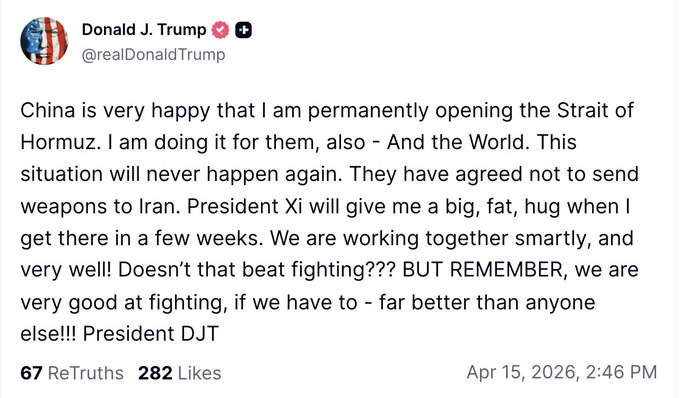
Trump’s Full Statement
In the post, Trump wrote:
“China is very happy that I am permanently opening the Strait of Hormuz. I am doing it for them, also – and the World. This situation will never happen again. They have agreed not to send weapons to Iran. President Xi will give me a big, fat hug when I get there in a few weeks. We are working together smartly and very well. Doesn’t that beat fighting? But remember, we are very good at fighting if we have to, far better than anyone else.”
Trump is scheduled to meet Xi in China in the coming weeks, a summit previously delayed due to the Iran conflict.
Context: The Strait of Hormuz and U.S. Blockade
The Strait of Hormuz, a narrow chokepoint between the Persian Gulf and the Gulf of Oman, handles roughly 20-30% of global seaborne oil trade. During the recent escalation, Iran restricted shipping, prompting U.S. military action—including a naval blockade of Iranian ports and coastline—to restore freedom of navigation.
U.S. forces, including the USS Abraham Lincoln carrier strike group and supporting warships, have been positioned to enforce the operation. Trump has described the effort as ensuring the strait remains permanently open and secure.
Claims on China-Iran Arms and Diplomacy
Trump asserted that China has agreed not to supply weapons to Iran, following exchanges including a letter from the U.S. president. China is Iran’s largest oil customer, and disruptions in the strait have economic implications for Beijing.
China’s Foreign Ministry has previously described the U.S. blockade as “dangerous and irresponsible” and has denied providing military assistance to Iran amid the conflict. No immediate confirmation or denial from Beijing has been reported on Trump’s latest claims about the arms agreement.
The president framed the development as smart cooperation that avoids conflict while emphasizing U.S. military superiority if needed.
Broader Implications
- Energy Markets and Global Trade: Reopening the strait could ease pressure on oil prices and shipping routes, benefiting major importers like China, Japan, South Korea, and Europe.
- U.S.-China Relations: The comments suggest an attempt to align interests ahead of the Xi summit, though tensions over trade, technology, and regional issues persist.
- Iran Ceasefire: The fragile truce, mediated indirectly with Pakistani involvement, remains in place but faces challenges. U.S. troop deployments to the region continue as leverage in negotiations over Iran’s nuclear program and regional de-escalation.
- Diplomatic Tone: Trump contrasted cooperation (“Doesn’t that beat fighting?”) with a reminder of U.S. strength, consistent with his negotiating style.
Analysts note that while Trump presents the Hormuz operation as a success benefiting all parties, the situation involves complex enforcement challenges, risks of escalation, and differing interpretations from Iran and its partners.
This remains a fast-moving story with potential impacts on global energy security, U.S.-China ties, and Middle East stability.
FAQs
Q1: What did President Trump claim about the Strait of Hormuz?
Trump stated he is “permanently opening” the strait for global benefit, including for China, and that this situation will never recur.
Q2: What did he say about China and weapons to Iran?
He claimed China has “agreed not to send weapons to Iran” following communications, including a letter exchange.
Q3: What is the planned meeting with Xi Jinping?
Trump is scheduled to visit Beijing in the coming weeks (reportedly early May) for a summit that was previously delayed due to the Iran conflict.
Q4: Has China confirmed the arms agreement or the “hug”?
No official confirmation from China has been reported. Beijing has criticized the U.S. blockade as dangerous but has denied supplying arms to Iran.
Q5: Why is the Strait of Hormuz strategically important?
It is a vital chokepoint for oil and gas shipments. Disruptions can spike global energy prices and affect economies worldwide.
Q6: What is the current status of U.S. operations in the region?
U.S. naval forces are enforcing a blockade of Iranian ports to restore navigation. Thousands of additional troops have been deployed, and the fragile ceasefire continues.
Q7: How can I stay updated?
Follow Reflecto News for balanced, verified coverage of U.S. foreign policy, the Iran situation, U.S.-China relations, and developments in the Strait of Hormuz.
This is a developing story. Reflecto News will monitor official statements from Washington, Beijing, and Tehran as well as any reactions from international partners.
Reflecto News provides accurate, timely reporting on global diplomacy, Middle East security, and U.S.-China affairs. For more on the Iran conflict, energy markets, and international summits, explore our dedicated sections. Share your respectful comments below.
Questions people ask
What is China's current share of global manufacturing?
China now accounts for twenty eight percent of global manufacturing. This industrial output exceeds the combined manufacturing production of the United States, Japan, and Germany, making China the leading global industrial power according to recent reports.
Why were Andrew Tate and Tristan Tate arrested in Miami?
Andrew Tate and his brother Tristan Tate were taken into custody in Miami by the United States Marshals Service. They face thirty eight new charges in the United Kingdom, including rape and child pornography offences, and prosecutors are seeking their extradition.
What warning did Moscow issue about oil prices?
Kirill Dmitriev, the Chief Executive of the Russian Direct Investment Fund, warned that a tsunami of skyrocketing oil prices is approaching. Moscow describes this potential energy shock as a major threat to global markets.
What political shift is projected for Benjamin Netanyahu's coalition?
Political polls project that Prime Minister Benjamin Netanyahu's coalition is on track to lose its majority in the upcoming October election. This projection indicates a potential political shift in Jerusalem.
Why did a Russian military aircraft land in Tehran?
A Russian airborne command aircraft, widely known as a doomsday plane, landed in Tehran. The arrival of the aircraft represents a high stakes show of support from Russia for Iran during a period of heightened regional tensions.
What did President Masoud Pezeshkian claim about the United States and Israel?
Iranian President Masoud Pezeshkian claimed that the United States and Israel failed in a forty eight hour plan to topple the Iranian government. He made these statements during a televised address marking two years since his inauguration.