Reflecto News is an online news platform covering major international political events, global economic developments, and security conflicts. The site provides updates on topics such as Chinese manufacturing dominance, Middle Eastern political tensions, and high profile legal arrests. Readers can access current articles organized by categories like World News, Iran, and USA.
Reflecto News Desk
Breaking diplomatic update from Washington, Jerusalem, and Beirut – April 16, 2026
In a surprise announcement late Wednesday, U.S. President Donald Trump revealed that leaders of Israel and Lebanon will hold direct talks on Thursday, marking the first such high-level communication between the two countries in 34 years. The development comes amid intense regional tensions involving Hezbollah, a fragile regional ceasefire framework, and parallel U.S. mediation efforts in the broader Middle East crisis.
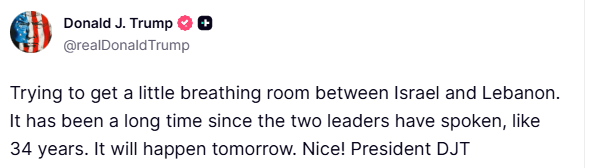
Trump shared the news on Truth Social, writing: “Trying to get a little breathing room between Israel and Lebanon. It has been a long time since the two leaders have spoken, like 34 years. It will happen tomorrow. Nice!”
This breakthrough follows rare trilateral discussions in Washington earlier this week between U.S., Israeli, and Lebanese officials—the most significant direct engagement since the early 1990s.
Background: Decades of Hostility and Recent Escalation
Israel and Lebanon have maintained no formal diplomatic relations and have been technically at war since the 1948 Arab-Israeli conflict. Direct leader-level contact has been virtually nonexistent for over three decades, with the last notable high-level interactions occurring around 1993 during earlier peace process attempts.
The current flare-up intensified after the collapse of a previous ceasefire, leading to over six weeks of conflict primarily between Israel and Hezbollah, the Iran-backed militant group operating in Lebanon. Israeli strikes have caused significant casualties and displacement in southern Lebanon, while Hezbollah has continued rocket fire into northern Israel.
The recent U.S.-brokered trilateral meeting in Washington on Tuesday marked a historic first step, with both sides agreeing to explore direct negotiations aimed at de-escalation, potential ceasefire extensions, and addressing core security concerns, including Hezbollah’s role and border stability.
Details of Trump’s Announcement and Thursday’s Expected Talks
President Trump’s post did not specify the exact format—whether a direct phone call, virtual meeting, or in-person discussions—nor the precise participants (likely Israeli Prime Minister Benjamin Netanyahu and Lebanese President Joseph Aoun or senior representatives). However, it signals a major U.S. push to create immediate de-escalation space.
The announcement builds directly on Tuesday’s productive trilateral session, which U.S. officials described as a foundation for launching formal bilateral talks between Jerusalem and Beirut.
Key issues expected on the table include:
- Extending or solidifying a ceasefire to halt ongoing exchanges of fire
- Security arrangements along the Israel-Lebanon border (Blue Line)
- Hezbollah’s disarmament or withdrawal from southern Lebanon
- Humanitarian access and reconstruction in war-affected areas
- Broader regional stability linkages, including ties to U.S.-Iran dynamics
Strategic Context: U.S. Mediation in a Volatile Region
This move aligns with the Trump administration’s broader diplomatic offensive in the Middle East, including efforts to stabilize energy routes and prevent wider escalation involving Iran. The Israel-Lebanon channel is seen as critical, given Hezbollah’s status as a key Iranian proxy.
Experts view the U.S. role as pivotal: Washington maintains strong ties with Israel while holding some leverage with Lebanese factions and international partners. Success here could create positive momentum for stalled U.S.-Iran negotiations and reduce risks to global energy markets.
Potential Implications for Regional Peace and Global Stability
Positive Outcomes Possible:
- Reduced cross-border violence and relief for displaced civilians (over a million reported displaced in Lebanon)
- Momentum toward a more permanent border agreement
- Lower risk of full-scale war that could draw in other actors
- Boost to international diplomatic efforts in West Asia
Challenges Ahead:
- Deep mutual distrust after decades of conflict
- Hezbollah’s influence within Lebanese politics and its refusal to fully disarm
- Ongoing Israeli security demands versus Lebanese sovereignty concerns
- Linkages to the larger Iran-Israel shadow war
Lebanese officials have reportedly expressed caution, with some sources indicating they were not immediately aware of Thursday’s specific contact details, highlighting the delicate nature of these back-channel efforts.
Why This Matters: A Rare Diplomatic Window
The 34-year gap underscores how extraordinary this moment is. If sustained, direct leader-level dialogue could open a new chapter in Israel-Lebanon relations, potentially leading to normalized channels or even a formal peace framework—long considered one of the most intractable conflicts in the region.
Analysts note that U.S. pressure and timing, amid the wider Iran-related tensions, appear to be key drivers behind this opening.
FAQs on Israel-Lebanon Talks and Trump’s Announcement
Q1: When exactly will the Israel-Lebanon leaders’ talks happen?
A: According to President Trump, the talks are scheduled for Thursday, April 17, 2026—the first direct leader-level communication in 34 years.
Q2: What triggered this sudden diplomatic breakthrough?
A: It follows a trilateral U.S.-Israel-Lebanon meeting in Washington earlier this week, the first major high-level engagement since 1993, aimed at paving the way for direct negotiations amid ongoing conflict with Hezbollah.
Q3: Who will participate in the talks?
A: Details remain limited, but likely senior leaders or their direct representatives from both sides, facilitated or supported by the United States.
Q4: Will this lead to an immediate ceasefire?
A: While the goal is to create “breathing room” and de-escalate, no immediate full ceasefire has been announced. Discussions are expected to focus on steps toward stabilization.
Q5: How does this connect to broader U.S.-Iran and regional efforts?
A: The Israel-Lebanon track is viewed as interconnected with efforts to stabilize the region, including parallel U.S.-Iran mediation, potentially reducing proxy conflicts.
Q6: What is the historical significance?
A: This represents the highest-level direct engagement between Israel and Lebanon in over three decades, offering a rare chance to address long-standing border and security issues.
Looking Forward: Monitoring a Pivotal Moment
As Thursday’s talks approach, all eyes are on whether this historic outreach can translate into tangible de-escalation. Reflecto News will provide continuous updates, analysis, and expert insights as developments unfold in this fast-evolving situation.
This latest U.S. diplomatic initiative highlights renewed efforts to resolve long-frozen Middle East conflicts through direct engagement and high-level mediation.
Stay tuned to Reflecto News for real-time coverage, in-depth analysis, and exclusive updates on Middle East peace efforts.
This article is compiled from verified international reports and official statements as of April 16, 2026. Information is cross-checked for accuracy.
Questions people ask
What is China's current share of global manufacturing?
China now accounts for twenty eight percent of global manufacturing. This industrial output exceeds the combined manufacturing production of the United States, Japan, and Germany, making China the leading global industrial power according to recent reports.
Why were Andrew Tate and Tristan Tate arrested in Miami?
Andrew Tate and his brother Tristan Tate were taken into custody in Miami by the United States Marshals Service. They face thirty eight new charges in the United Kingdom, including rape and child pornography offences, and prosecutors are seeking their extradition.
What warning did Moscow issue about oil prices?
Kirill Dmitriev, the Chief Executive of the Russian Direct Investment Fund, warned that a tsunami of skyrocketing oil prices is approaching. Moscow describes this potential energy shock as a major threat to global markets.
What political shift is projected for Benjamin Netanyahu's coalition?
Political polls project that Prime Minister Benjamin Netanyahu's coalition is on track to lose its majority in the upcoming October election. This projection indicates a potential political shift in Jerusalem.
Why did a Russian military aircraft land in Tehran?
A Russian airborne command aircraft, widely known as a doomsday plane, landed in Tehran. The arrival of the aircraft represents a high stakes show of support from Russia for Iran during a period of heightened regional tensions.
What did President Masoud Pezeshkian claim about the United States and Israel?
Iranian President Masoud Pezeshkian claimed that the United States and Israel failed in a forty eight hour plan to topple the Iranian government. He made these statements during a televised address marking two years since his inauguration.