Reflecto News is an online news platform covering major international political events, global economic developments, and security conflicts. The site provides updates on topics such as Chinese manufacturing dominance, Middle Eastern political tensions, and high profile legal arrests. Readers can access current articles organized by categories like World News, Iran, and USA.
Spanish Prime Minister Pedro Sánchez has called for Lebanon to be explicitly included in the current 2-week Iran–U.S. ceasefire, stating that “Lebanon must be included in the ceasefire.” The demand builds on his earlier strong criticism of Israeli actions and comes as mutual accusations of ceasefire violations intensify between Iran and the U.S.-Israel side.
By Reflecto News Desk
April 8, 2026 | Madrid / Beirut / Tehran / Washington
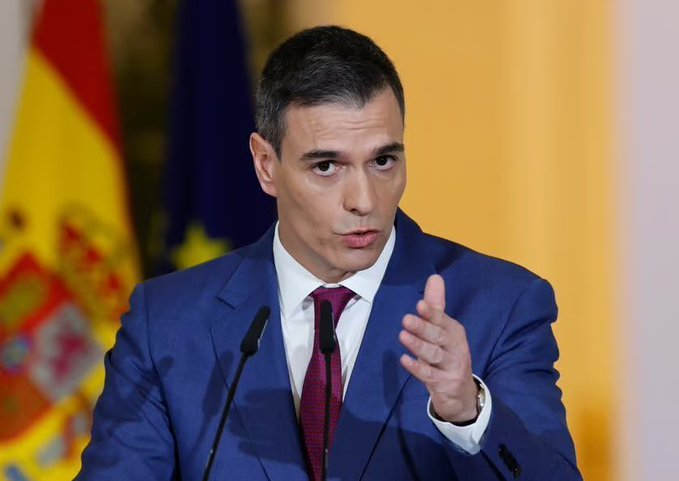
Sánchez’s latest statement underscores growing European concern that the fragile truce risks becoming meaningless if Israeli operations in Lebanon continue unchecked. He previously urged the European Union to suspend its Association Agreement with Israel over what he described as “criminal acts,” arguing there must be “no impunity.”
By insisting on Lebanon’s inclusion, Sánchez is pushing for a broader, more comprehensive halt to hostilities that encompasses not only direct Iran–U.S. exchanges but also proxy and regional fronts involving Hezbollah and Israeli forces.
This development arrives amid a rapidly evolving situation:
- Iran’s Parliament Speaker accused the U.S. and Israel of violating the ceasefire, declaring that “in such a situation, a bilateral ceasefire or negotiations is unreasonable.”
- Iranian Foreign Minister Abbas Araghchi warned that Washington must choose between a genuine ceasefire or “continued war via Israel,” citing actions in Lebanon.
- Israeli Prime Minister Benjamin Netanyahu has insisted that Iran’s enriched uranium must be removed “by agreement or by war,” viewing the pause as temporary.
Pressure on Upcoming Pakistan Talks
Sánchez’s call adds another layer of complexity to the high-level U.S. delegation led by Vice President JD Vance and Steve Witkoff, who are scheduled to meet Iranian representatives in Pakistan this weekend. The agenda is already heavy with issues including:
- Enforcement of the existing ceasefire
- Selective Iranian control over the Strait of Hormuz
- Removal of Iran’s enriched uranium stockpile
- Broader regional de-escalation
European pressure for Lebanon’s inclusion could influence how the U.S. approaches these talks, particularly if it seeks to maintain transatlantic unity.
Ongoing Conflict Dynamics and Humanitarian Concerns
The push for a wider ceasefire highlights persistent challenges:
- Recent U.S.-Israeli strikes targeted Iranian sites including IRALCO (aluminum producer), IRGC-linked railways and bridges, Kharg Island, and Mehrabad Airport.
- Iran launched missiles toward Israel shortly after the ceasefire announcement.
- Civilian efforts inside Iran, such as human chains on Ahvaz’s White Bridge to protect infrastructure, reflect public fears of renewed escalation.
- Italian Prime Minister Giorgia Meloni has emphasized that ordinary Iranians should not “pay for the sins of their rulers.”
The recent France-Iran prisoner exchange (freeing Cécile Kohler and Jacques Paris) demonstrated that limited diplomatic progress remains possible on humanitarian issues.
Reflecto News will continue monitoring the EU’s and U.S. responses to Sánchez’s demands, any Israeli reaction, updates from the Vance-Witkoff Pakistan mission, and the overall stability of the 2-week ceasefire.
FAQs: Spanish PM Sánchez Calls for Lebanon’s Inclusion in Iran–U.S. Ceasefire
Q1: What did Pedro Sánchez specifically demand?
He stated that “Lebanon must be included in the ceasefire,” calling for the truce to cover Israeli actions in Lebanon as well.
Q2: How does this connect to his previous statements?
It builds directly on his call for the EU to suspend its Association Agreement with Israel over alleged “criminal acts,” showing consistent European criticism of the scope of the conflict.
Q3: Why is Lebanon’s inclusion important?
Iranian officials have repeatedly linked Israeli operations in Lebanon to a continuation of the war, making it a key point of contention in ceasefire enforcement.
Q4: Will this affect the Pakistan talks?
It likely will, as the Vance-Witkoff delegation may face added pressure to address regional de-escalation, including Lebanon, to keep the truce viable.
Q5: What are the broader risks if Lebanon is not addressed?
Continued strikes, potential Iranian retaliation through proxies, further erosion of the ceasefire, and complications for nuclear and maritime negotiations.
Sources: Statements by Spanish Prime Minister Pedro Sánchez, cross-referenced reporting from European, U.S., Iranian, and Israeli sources as of April 8, 2026. Proposals to expand ceasefires during active regional conflicts often face significant political and military hurdles; the situation remains highly volatile.
Questions people ask
What is China's current share of global manufacturing?
China now accounts for twenty eight percent of global manufacturing. This industrial output exceeds the combined manufacturing production of the United States, Japan, and Germany, making China the leading global industrial power according to recent reports.
Why were Andrew Tate and Tristan Tate arrested in Miami?
Andrew Tate and his brother Tristan Tate were taken into custody in Miami by the United States Marshals Service. They face thirty eight new charges in the United Kingdom, including rape and child pornography offences, and prosecutors are seeking their extradition.
What warning did Moscow issue about oil prices?
Kirill Dmitriev, the Chief Executive of the Russian Direct Investment Fund, warned that a tsunami of skyrocketing oil prices is approaching. Moscow describes this potential energy shock as a major threat to global markets.
What political shift is projected for Benjamin Netanyahu's coalition?
Political polls project that Prime Minister Benjamin Netanyahu's coalition is on track to lose its majority in the upcoming October election. This projection indicates a potential political shift in Jerusalem.
Why did a Russian military aircraft land in Tehran?
A Russian airborne command aircraft, widely known as a doomsday plane, landed in Tehran. The arrival of the aircraft represents a high stakes show of support from Russia for Iran during a period of heightened regional tensions.
What did President Masoud Pezeshkian claim about the United States and Israel?
Iranian President Masoud Pezeshkian claimed that the United States and Israel failed in a forty eight hour plan to topple the Iranian government. He made these statements during a televised address marking two years since his inauguration.