Reflecto News is an online news platform covering major international political events, global economic developments, and security conflicts. The site provides updates on topics such as Chinese manufacturing dominance, Middle Eastern political tensions, and high profile legal arrests. Readers can access current articles organized by categories like World News, Iran, and USA.
Reflecto News – U.S. President Donald Trump announced that the Strait of Hormuz is now “completely open and ready for business and full passage,” while emphasizing that the U.S. naval blockade targeting Iranian ports and vessels will remain in full force and effect until a final agreement with Iran is “100% complete.”
Trump’s statement, posted on Truth Social and echoed in public comments, directly follows Iran’s declaration that commercial shipping through the critical waterway is fully open for the remainder of the current ceasefire period.
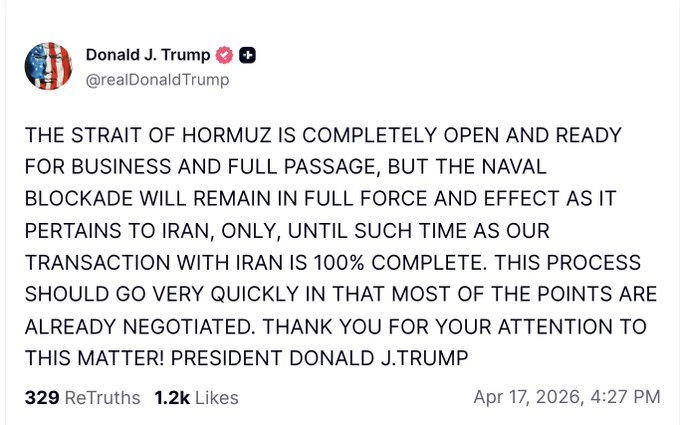
Trump’s Full Statement
“The Strait of Hormuz is completely open and ready for business and full passage, but the naval blockade will remain in full force and effect as it pertains to Iran only, until our transaction with Iran is 100% complete!”
He welcomed the Iranian move as a positive development benefiting global trade but made clear that U.S. pressure on Iranian ports continues as leverage in ongoing negotiations.
Iran’s Announcement
Iranian Foreign Minister Abbas Araghchi stated that passage for all commercial vessels through the Strait of Hormuz is “declared completely open” in line with the ceasefire in Lebanon. Ships are to follow coordinated routes set by Iran’s Ports and Maritime Organization for the remaining duration of the truce.
This marks a significant de-escalatory step after weeks of Iranian restrictions and U.S. enforcement actions that had disrupted shipping and contributed to elevated oil prices.
U.S. Naval Blockade Continues
Despite the strait’s reopening for general commercial transit:
- The U.S. blockade specifically targets vessels entering or leaving Iranian ports and Iranian-linked ships.
- U.S. Central Command (CENTCOM) has confirmed the operation remains active, with warships and aircraft monitoring and intercepting non-compliant vessels.
- The blockade was imposed to exert economic pressure on Iran while keeping the strait itself open for international shipping not destined for Iranian ports.
Trump has repeatedly linked the lifting of the blockade to a comprehensive deal covering Iran’s nuclear program and other issues.
Market and Strategic Impact
- Oil Prices: Global benchmarks (Brent and WTI) dropped sharply following the announcements, easing some of the war premium that had built up during recent tensions. The Strait of Hormuz accounts for a substantial share of global seaborne oil trade.
- Energy Security: The reopening provides relief to major importers, though full normalization depends on sustained compliance and diplomatic progress.
- Ceasefire Dynamics: The development is tied to the fragile U.S.-Iran truce (including the Lebanon component) and comes as mediators from Pakistan, Egypt, and Türkiye push for progress before the April 21 deadline.
Ongoing Negotiations
Backchannel talks continue, with recent involvement from Pakistani Army Chief Asim Munir in Tehran. Key issues under discussion include Iran’s enriched uranium stockpiles (“nuclear dust”), enrichment limits, sanctions relief, and long-term maritime security guarantees.
While the strait’s reopening is a tangible positive signal, the continued U.S. blockade and mutual threats keep the situation fragile and subject to rapid change.
This remains a fast-moving story with direct implications for global energy markets and Middle East stability.
FAQs
Q1: What did President Trump announce about the Strait of Hormuz?
Trump stated the strait is “completely open and ready for business and full passage” but confirmed the U.S. naval blockade on Iranian ports and vessels will remain fully in effect until a final deal is reached.
Q2: Did Iran confirm the reopening?
Yes. Foreign Minister Abbas Araghchi declared the strait “completely open” for all commercial vessels during the remaining ceasefire period, with coordinated shipping routes.
Q3: Does the U.S. blockade affect all shipping through the strait?
No. The blockade targets Iranian ports and Iranian-linked vessels specifically. General commercial transit through the strait for non-Iranian destinations is now declared open.
Q4: Why is the Strait of Hormuz strategically vital?
It serves as a critical chokepoint for roughly 20–30% of global seaborne oil and gas trade. Disruptions can cause major volatility in energy prices worldwide.
Q5: How does this relate to the current ceasefire?
The reopening is linked to the fragile truce, including the Lebanon ceasefire component, and occurs amid mediated efforts to extend or solidify the agreement before April 21.
Q6: What are the next steps in U.S.-Iran talks?
Mediators from Pakistan, Egypt, and Türkiye continue facilitating backchannels. Discussions focus on nuclear issues, uranium stockpiles, sanctions relief, and maritime security.
Q7: Where can I follow the latest developments?
Stay with Reflecto News for balanced, verified coverage of the Strait of Hormuz situation, U.S.-Iran diplomacy, and global energy market reactions. We monitor official statements and shipping activity.
This is a developing story. Reflecto News will provide updates as commercial shipping volumes are confirmed, diplomatic progress is made, or any new restrictions or responses are announced.
Reflecto News delivers accurate, timely reporting on global energy security, Middle East diplomacy, and international maritime affairs. For more on the Strait of Hormuz, the U.S.-Iran ceasefire, and related naval operations, explore our dedicated sections. Share your respectful comments below.
Questions people ask
What is China's current share of global manufacturing?
China now accounts for twenty eight percent of global manufacturing. This industrial output exceeds the combined manufacturing production of the United States, Japan, and Germany, making China the leading global industrial power according to recent reports.
Why were Andrew Tate and Tristan Tate arrested in Miami?
Andrew Tate and his brother Tristan Tate were taken into custody in Miami by the United States Marshals Service. They face thirty eight new charges in the United Kingdom, including rape and child pornography offences, and prosecutors are seeking their extradition.
What warning did Moscow issue about oil prices?
Kirill Dmitriev, the Chief Executive of the Russian Direct Investment Fund, warned that a tsunami of skyrocketing oil prices is approaching. Moscow describes this potential energy shock as a major threat to global markets.
What political shift is projected for Benjamin Netanyahu's coalition?
Political polls project that Prime Minister Benjamin Netanyahu's coalition is on track to lose its majority in the upcoming October election. This projection indicates a potential political shift in Jerusalem.
Why did a Russian military aircraft land in Tehran?
A Russian airborne command aircraft, widely known as a doomsday plane, landed in Tehran. The arrival of the aircraft represents a high stakes show of support from Russia for Iran during a period of heightened regional tensions.
What did President Masoud Pezeshkian claim about the United States and Israel?
Iranian President Masoud Pezeshkian claimed that the United States and Israel failed in a forty eight hour plan to topple the Iranian government. He made these statements during a televised address marking two years since his inauguration.