Reflecto News is an online news platform covering major international political events, global economic developments, and security conflicts. The site provides updates on topics such as Chinese manufacturing dominance, Middle Eastern political tensions, and high profile legal arrests. Readers can access current articles organized by categories like World News, Iran, and USA.
Reflecto News – U.S. President Donald Trump announced that Iran has agreed to never close the Strait of Hormuz again, declaring the critical waterway “will no longer be used as a weapon against the World.”
Trump made the claim in a Truth Social post on April 17, 2026, framing it as a major diplomatic victory following Iran’s recent declaration that the strait is fully open for commercial shipping during the current fragile ceasefire.
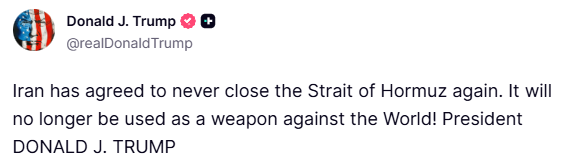
Trump’s Statement
“Iran has agreed to never close the Strait of Hormuz again. It will no longer be used as a weapon against the World!”
He presented the commitment as a direct result of U.S. pressure and ongoing negotiations, adding that the agreement ensures long-term stability for global energy flows. Trump has repeatedly welcomed the reopening of the strait while maintaining that the U.S. naval blockade on Iranian ports remains in effect until a final “100% complete” deal is reached.
Context of the Announcement
- Strait Reopening: Iran’s Foreign Minister Abbas Araghchi recently declared the strait “completely open” for commercial vessels, coordinated with the Lebanon ceasefire component of the broader truce.
- Mine Removal: Trump has stated that Iran, with U.S. help, has removed or is removing all sea mines from the waterway.
- Ongoing Negotiations: Mediators from Pakistan, Egypt, and Türkiye continue backchannel efforts ahead of the April 21 ceasefire deadline. Key issues include removal of Iran’s enriched uranium stockpiles (“nuclear dust”), enrichment limits, and sanctions relief.
- U.S. Blockade: The targeted naval blockade on Iranian ports and vessels persists as leverage, even as general commercial transit through the strait is now open.
The commitment to never close the strait again would represent a significant long-term de-escalation if formalized, addressing one of the world’s most sensitive energy chokepoints.
Broader Implications
- Energy Security: Permanent assurance of open passage would reduce volatility in global oil and gas markets, benefiting major importers including India, Europe, China, Japan, and South Korea.
- Diplomatic Momentum: The claim adds to Trump’s narrative of progress in U.S.-Iran talks, though critics note that verbal commitments during fragile ceasefires require robust verification mechanisms.
- Regional Dynamics: The statement separates the Hormuz issue from the Lebanon ceasefire, consistent with Trump’s earlier insistence that the Iran nuclear deal is “not tied, in any way, to Lebanon.”
No immediate official confirmation or detailed response from Iranian officials on the specific “never close again” commitment has been reported. Iranian statements have so far focused on the temporary opening tied to the ceasefire period.
This remains a fast-moving development with direct implications for global energy markets and the broader U.S.-Iran diplomatic track.
FAQs
Q1: What exactly did President Trump claim about the Strait of Hormuz?
Trump stated that Iran has agreed to never close the Strait of Hormuz again and that it “will no longer be used as a weapon against the World.”
Q2: Has Iran officially confirmed this commitment?
Iran has announced the strait is open for commercial shipping during the ceasefire, but no public confirmation of a permanent “never close again” agreement has been reported yet.
Q3: Does this mean the U.S. naval blockade is lifted?
No. Trump has repeatedly clarified that the targeted U.S. blockade on Iranian ports and vessels remains in full effect until a final deal is completed.
Q4: Why is the Strait of Hormuz so important?
It is a vital chokepoint carrying roughly 20–30% of global seaborne oil and gas trade. Any closure can cause sharp spikes in energy prices and disrupt supply chains worldwide.
Q5: How does this fit into the current ceasefire?
The reopening and claimed long-term commitment are linked to the fragile U.S.-Iran truce and ongoing mediated talks ahead of the April 21 deadline.
Q6: What are the next steps in U.S.-Iran negotiations?
Backchannel efforts mediated by Pakistan, Egypt, and Türkiye continue, focusing on nuclear issues, uranium stockpiles, sanctions relief, and maritime security guarantees.
Q7: Where can I follow verified updates?
Stay with Reflecto News for balanced coverage based on official statements from Washington, Tehran, and international mediators. We monitor shipping activity, diplomatic progress, and market reactions.
This is a developing story. Reflecto News will provide updates as any formal Iranian confirmation emerges, commercial shipping volumes increase, or further details on the nuclear deal are released.
Reflecto News delivers accurate, timely reporting on U.S.-Iran diplomacy, global energy security, and Middle East developments. For more on the Strait of Hormuz, the fragile ceasefire, and ongoing negotiations, explore our dedicated international section. Share your respectful comments below.
Questions people ask
What is China's current share of global manufacturing?
China now accounts for twenty eight percent of global manufacturing. This industrial output exceeds the combined manufacturing production of the United States, Japan, and Germany, making China the leading global industrial power according to recent reports.
Why were Andrew Tate and Tristan Tate arrested in Miami?
Andrew Tate and his brother Tristan Tate were taken into custody in Miami by the United States Marshals Service. They face thirty eight new charges in the United Kingdom, including rape and child pornography offences, and prosecutors are seeking their extradition.
What warning did Moscow issue about oil prices?
Kirill Dmitriev, the Chief Executive of the Russian Direct Investment Fund, warned that a tsunami of skyrocketing oil prices is approaching. Moscow describes this potential energy shock as a major threat to global markets.
What political shift is projected for Benjamin Netanyahu's coalition?
Political polls project that Prime Minister Benjamin Netanyahu's coalition is on track to lose its majority in the upcoming October election. This projection indicates a potential political shift in Jerusalem.
Why did a Russian military aircraft land in Tehran?
A Russian airborne command aircraft, widely known as a doomsday plane, landed in Tehran. The arrival of the aircraft represents a high stakes show of support from Russia for Iran during a period of heightened regional tensions.
What did President Masoud Pezeshkian claim about the United States and Israel?
Iranian President Masoud Pezeshkian claimed that the United States and Israel failed in a forty eight hour plan to topple the Iranian government. He made these statements during a televised address marking two years since his inauguration.