Reflecto News is an online news platform covering major international political events, global economic developments, and security conflicts. The site provides updates on topics such as Chinese manufacturing dominance, Middle Eastern political tensions, and high profile legal arrests. Readers can access current articles organized by categories like World News, Iran, and USA.
Reflecto News Desk
Pyongyang / Seoul – April 16, 2026
North Korean leader Kim Jong Un personally supervised the test-firing of upgraded short-range ballistic missiles (SRBMs) designed to carry cluster munitions and fragmentation warheads, according to North Korean state media. The tests are the latest demonstration of North Korea’s advancing missile capabilities amid heightened global tensions.
State media KCNA reported that the newly developed missiles showed improved accuracy, range, and destructive power during the drills, which Kim described as a key step in strengthening the country’s tactical nuclear and conventional strike capabilities.
Details of the Missile Tests
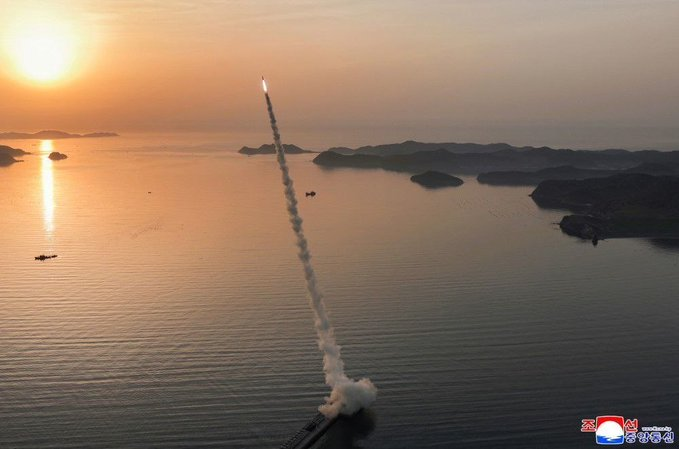
The tests involved multiple launches of the upgraded SRBMs, which state media claimed successfully hit designated targets with high precision. The missiles are specifically designed to deliver cluster warheads — capable of dispersing submunitions over a wide area — and fragmentation warheads optimized for maximum damage against troop concentrations, armored vehicles, and infrastructure.
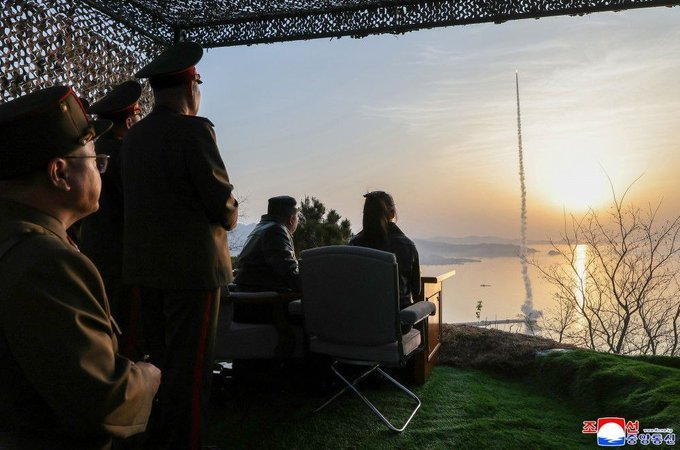
Kim Jong Un reportedly praised the performance of the weapons system and called for continued mass production to equip North Korean frontline units. Photos released by state media showed Kim observing the launches from a command post.
Background: North Korea’s Accelerating Missile Program
North Korea has significantly expanded and modernized its missile arsenal in recent years, conducting frequent tests of short, medium, and intercontinental-range systems. The focus on short-range ballistic missiles with cluster and fragmentation warheads indicates an emphasis on developing weapons suited for battlefield use on the Korean Peninsula, particularly against South Korean and U.S. forces.
This development comes as North Korea continues to deepen military cooperation with Russia, including alleged supplies of artillery shells and missiles for the war in Ukraine.
Strategic Implications
- For the Korean Peninsula: The new missiles increase the threat level to South Korea, where U.S. troops are stationed, and could complicate future diplomatic efforts.
- For Regional Security: Japan and South Korea are expected to express strong concern, with possible calls for stronger trilateral cooperation with the United States.
- For Global Stability: The tests add to the growing list of simultaneous international crises, including the U.S.-Iran naval clashes in the Persian Gulf, the Israel-Lebanon ceasefire, and Ukrainian strikes on Russian energy infrastructure.
Connection to Broader Global Crises
While the North Korean tests appear separate from the Middle East turmoil, they contribute to a worldwide sense of instability. Multiple major conflicts and provocations occurring simultaneously — from the Strait of Hormuz to the Black Sea and now heightened activity on the Korean Peninsula — are straining international attention and resources.
FAQs on North Korea’s Upgraded Short-Range Ballistic Missile Tests
Q1: What type of missiles were tested?
A: Upgraded short-range ballistic missiles (SRBMs) capable of carrying cluster munitions and fragmentation warheads.
Q2: Who oversaw the tests?
A: North Korean leader Kim Jong Un personally supervised the launches.
Q3: What is the significance of cluster and fragmentation warheads?
A: Cluster warheads spread multiple submunitions over a large area, while fragmentation warheads maximize damage through explosive shrapnel — both highly effective against ground forces and soft targets.
Q4: How does this affect South Korea and the United States?
A: The missiles are designed for tactical use on the Korean Peninsula, posing a direct threat to South Korean and U.S. military positions.
Q5: Is this related to North Korea’s cooperation with Russia?
A: North Korea has been strengthening military ties with Russia, though no direct link to today’s tests has been confirmed.
Q6: Will this trigger new UN or international sanctions?
A: North Korea is already under heavy sanctions. The tests are likely to draw strong condemnation from the U.S., South Korea, Japan, and the UN Security Council.
Looking Ahead
Kim Jong Un’s direct involvement in the tests signals continued prioritization of North Korea’s missile program. As the international community grapples with simultaneous crises in the Middle East and Europe, the latest North Korean provocation adds another layer of complexity to global security challenges.
Reflecto News will continue monitoring developments on the Korean Peninsula, reactions from Seoul, Washington, and Tokyo, and any potential impact on regional stability.
Stay tuned to Reflecto News for real-time updates, expert analysis, and comprehensive coverage of global security developments.
This article is based on official North Korean state media reports and cross-verified international monitoring as of April 16, 2026.
Questions people ask
What is China's current share of global manufacturing?
China now accounts for twenty eight percent of global manufacturing. This industrial output exceeds the combined manufacturing production of the United States, Japan, and Germany, making China the leading global industrial power according to recent reports.
Why were Andrew Tate and Tristan Tate arrested in Miami?
Andrew Tate and his brother Tristan Tate were taken into custody in Miami by the United States Marshals Service. They face thirty eight new charges in the United Kingdom, including rape and child pornography offences, and prosecutors are seeking their extradition.
What warning did Moscow issue about oil prices?
Kirill Dmitriev, the Chief Executive of the Russian Direct Investment Fund, warned that a tsunami of skyrocketing oil prices is approaching. Moscow describes this potential energy shock as a major threat to global markets.
What political shift is projected for Benjamin Netanyahu's coalition?
Political polls project that Prime Minister Benjamin Netanyahu's coalition is on track to lose its majority in the upcoming October election. This projection indicates a potential political shift in Jerusalem.
Why did a Russian military aircraft land in Tehran?
A Russian airborne command aircraft, widely known as a doomsday plane, landed in Tehran. The arrival of the aircraft represents a high stakes show of support from Russia for Iran during a period of heightened regional tensions.
What did President Masoud Pezeshkian claim about the United States and Israel?
Iranian President Masoud Pezeshkian claimed that the United States and Israel failed in a forty eight hour plan to topple the Iranian government. He made these statements during a televised address marking two years since his inauguration.