Reflecto News is an online news platform covering major international political events, global economic developments, and security conflicts. The site provides updates on topics such as Chinese manufacturing dominance, Middle Eastern political tensions, and high profile legal arrests. Readers can access current articles organized by categories like World News, Iran, and USA.
Published on Reflecto News | World News | Intelligence & Geopolitics
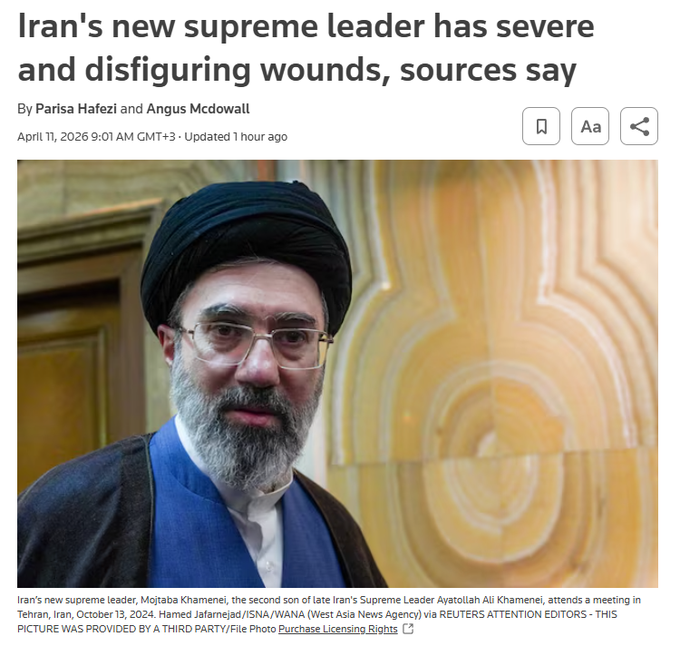
In a major revelation that reshapes understanding of Iran’s power structure, three sources close to the inner circle of Supreme Leader Ayatollah Mojtaba Khamenei have disclosed that the 56-year-old leader suffered catastrophic injuries in the February 28 airstrike that killed his father, former Supreme Leader Ali Khamenei. According to a Reuters investigation published Saturday, the new Iranian leader’s face was severely disfigured in the attack on the supreme leader’s compound in central Tehran, and he suffered significant damage to one or both legs—with a source familiar with U.S. intelligence assessments telling Reuters he is believed to have lost one leg .
Despite the devastating physical toll, the sources emphasized that Khamenei remains “mentally sharp” and continues to govern—participating in high-level meetings via audio conference and playing a direct role in decisions on the war and negotiations with Washington . The revelation comes as Iran prepares for high-stakes peace talks with the United States in Islamabad, raising urgent questions about who truly holds power in Tehran.
The February 28 Strike: A Decapitation Attack
The airstrike that changed the course of the war occurred on February 28, the first day of the US-Israeli military campaign against Iran . The attack targeted the supreme leader’s compound in central Tehran, killing Ayatollah Ali Khamenei—who had ruled Iran since 1989—along with several members of Mojtaba’s family, including his wife, brother-in-law, and sister-in-law .
Mojtaba Khamenei was present at the compound during the strike and suffered catastrophic injuries. According to the three sources who spoke to Reuters, he sustained:
- Severe facial wounds leaving him “disfigured”
- Significant damage to one or both legs
- Possible loss of one leg, according to a source familiar with U.S. intelligence assessments
Iran has never formally acknowledged the extent of his injuries. However, a state television announcer, after he was named supreme leader, referred to him using the term “janbaz” —a Persian word reserved for those seriously wounded in war .
U.S. Secretary of Defense Pete Hegseth publicly stated on March 13 that Khamenei was “wounded and likely disfigured,” aligning with the accounts provided to Reuters .
‘Mentally Sharp’ but ‘Severely Disfigured’
| Aspect | Details |
|---|---|
| Age | 56 years |
| Injuries | Severe facial disfigurement; significant leg damage; possible leg loss |
| Cognitive status | “Mentally sharp” per sources |
| Current governance method | Remote participation via audio conference |
| Role in decisions | Involved in war policy and negotiations with Washington |
| Public appearances | None since February 28 strike |
| Family killed | Wife, brother-in-law, sister-in-law |
Sources: Reuters, sources close to Khamenei’s inner circle
Despite the physical devastation, the three sources described Khamenei as “mentally sharp” and actively engaged in state affairs . Two of the sources confirmed that he is participating in meetings with senior officials via audio conference calls and continues to play a role in decision-making on major issues—including the ongoing war and the high-stakes negotiations with the United States set to begin in Islamabad .
However, the gap between remote participation and visible leadership is significant. Since the strike and his appointment as supreme leader on March 8, no photograph, video, or audio recording of Khamenei has been released publicly—a silence that has fueled widespread speculation and a popular “Where is Mojtaba?” meme featuring an empty chair under a spotlight .
Who Is Really Running Iran? The Rise of the IRGC
Perhaps the most significant implication of Khamenei’s injuries is the question of who actually governs Iran. The sources’ accounts align with assessments from analysts who argue that the new, inexperienced, and physically incapacitated leader cannot wield the absolute authority his father commanded.
“Mojtaba will be one voice but it will not be the decisive one. He needs to prove himself as the credible, powerful, overriding voice. The regime as a whole has to make a decision in terms of where they are going to go.” — Alex Vatanka, Senior Fellow, Middle East Institute
The Islamic Revolutionary Guard Corps (IRGC)—which helped steer Mojtaba into the role after his father’s assassination—has reportedly emerged as the dominant voice on strategic decisions during the war . While Khamenei had spent years building ties with senior Guard figures through his father’s office, his personal worldview remains largely unknown even to analysts who follow Iran closely .
In Iran’s theocratic system, ultimate power rests with the supreme leader, who oversees the elected president while directly commanding parallel institutions including the Revolutionary Guards. But the first supreme leader, Ayatollah Ruhollah Khomeini, wielded unquestioned authority as the charismatic figurehead of the revolution. His successor, Ali Khamenei, spent decades consolidating his authority after 1989. Mojtaba has had no such opportunity .
| Supreme Leader | Tenure | Authority |
|---|---|---|
| Ayatollah Ruhollah Khomeini | 1979-1989 | Unquestioned; charismatic revolutionary founder |
| Ayatollah Ali Khamenei | 1989-2026 | Consolidated over decades; strengthened IRGC ties |
| Ayatollah Mojtaba Khamenei | 2026-present | Severely wounded; unclear authority; IRGC dominant |
‘Where Is Mojtaba?’: The Propaganda Battle
Khamenei’s total absence from public view has become a significant liability for the regime. On Iranian social media and messaging applications—when the country’s heavily restricted internet allows access—conspiracy theories about his condition and about who is actually running the country are widespread .
One of the most popular “memes” circulating online shows an empty chair under a spotlight with the slogan “Where is Mojtaba?” . The meme has become a symbol of public skepticism about the regime’s transparency and the new leader’s viability.
Some government supporters have pushed back. A senior member of the Basij militia—the volunteer paramilitary force run by the Revolutionary Guards—said it was important for Khamenei to keep a low profile given the threat posed by continued US and Israeli airstrikes, which have already eliminated much of the country’s senior leadership .
“Why should he appear in public? To become a target for these criminals?” — Mohammad Hosseini, Basij member, Qom
The regime’s official messaging has offered only cryptic clues. A state television announcer’s use of the term “janbaz” was the first acknowledgment of his condition . Since then, his office has issued only a handful of short written messages, including a Nowruz greeting on March 20 in which he called the new year the “year of resistance” . Major policy statements on the war, diplomacy, Iran’s neighbors, and domestic unrest have been delivered by other senior officials—a striking departure from the norm .
What This Means for the Islamabad Talks
The revelation about Khamenei’s condition carries immediate and significant implications for the high-stakes peace talks set to begin in Islamabad between US and Iranian delegations .
| Factor | Implication for Talks |
|---|---|
| Khamenei’s injuries | May limit his ability to make or communicate rapid decisions |
| IRGC dominance | Military commanders at table may have final say; delegation includes 4 senior IRGC commanders |
| Regime instability | Potential power vacuum could make long-term agreements difficult to enforce |
| Leadership visibility | Delegation led by Parliament Speaker Ghalibaf, not Khamenei—signaling shift in authority |
The Iranian delegation arriving in Islamabad includes four senior IRGC commanders alongside Parliament Speaker Mohammad Bagher Ghalibaf and Foreign Minister Abbas Araghchi . This composition—heavy with military leadership—aligns with assessments that the Guards have become the “real power” in Tehran while the supreme leader remains hidden from view .
If Khamenei is governing via audio conference, the delegation in Islamabad may have limited authority to make binding decisions without real-time consultation with a physically incapacitated leader. Conversely, if the IRGC is truly the dominant voice, the commanders at the table may have more authority than their official positions suggest.
One of the sources close to Khamenei’s circle told Reuters that images of the supreme leader could be released within one or two months, and that he might even appear in public at that point—but only when his health and the security situation permit . For now, the “invisible leader” remains just that—governing from the shadows, his face unseen, his voice unheard, his ultimate authority uncertain.
Frequently Asked Questions (FAQs)
1. What happened to Iran’s Supreme Leader Mojtaba Khamenei?
According to Reuters and sources close to his inner circle, Khamenei suffered severe facial disfigurement and significant leg injuries—possibly losing one leg—in the February 28 airstrike that killed his father, former Supreme Leader Ali Khamenei .
2. Is Khamenei still governing Iran?
Yes. The sources told Reuters that despite his physical injuries, Khamenei remains “mentally sharp” and participates in meetings with senior officials via audio conference. He continues to be involved in decisions on the war and negotiations with Washington .
3. Why hasn’t Khamenei appeared in public?
Since the strike and his appointment as supreme leader on March 8, no photo, video, or audio recording of Khamenei has been released. One source said images could be released within one to two months, but he will only appear when his health and security permit. Regime supporters argue he is staying hidden to avoid becoming a target for US or Israeli airstrikes .
4. Who is really running Iran if Khamenei is incapacitated?
Analysts and sources suggest the Islamic Revolutionary Guard Corps (IRGC) has emerged as the dominant voice in strategic decisions during the war. The Guards helped steer Khamenei into power after his father’s assassination and reportedly hold significant influence over current decision-making .
5. What is the “janbaz” term used for Khamenei?
“Janbaz” is a Persian word used in Iran for someone seriously wounded in war. A state television announcer used this term to describe Khamenei after he was named supreme leader—the only official acknowledgment of his injuries .
6. How does this affect the Islamabad peace talks?
The Iranian delegation in Islamabad includes four senior IRGC commanders—reflecting the military’s dominance in decision-making. Khamenei’s physical absence and reliance on remote communication may complicate rapid decision-making, while the delegation’s authority to make binding commitments remains unclear .
7. What does Khamenei’s first statement as supreme leader say?
His first written message, read aloud by a television presenter on March 12, stated that the Strait of Hormuz should remain closed and warned regional countries to shut US bases on their territory. On March 20, he named the new Persian year the “year of resistance” .
Stay informed with Reflecto News – Your trusted source for breaking intelligence and geopolitical analysis. Subscribe for real-time updates on the Islamabad peace talks and the evolving power structure in Tehran.
Questions people ask
What is China's current share of global manufacturing?
China now accounts for twenty eight percent of global manufacturing. This industrial output exceeds the combined manufacturing production of the United States, Japan, and Germany, making China the leading global industrial power according to recent reports.
Why were Andrew Tate and Tristan Tate arrested in Miami?
Andrew Tate and his brother Tristan Tate were taken into custody in Miami by the United States Marshals Service. They face thirty eight new charges in the United Kingdom, including rape and child pornography offences, and prosecutors are seeking their extradition.
What warning did Moscow issue about oil prices?
Kirill Dmitriev, the Chief Executive of the Russian Direct Investment Fund, warned that a tsunami of skyrocketing oil prices is approaching. Moscow describes this potential energy shock as a major threat to global markets.
What political shift is projected for Benjamin Netanyahu's coalition?
Political polls project that Prime Minister Benjamin Netanyahu's coalition is on track to lose its majority in the upcoming October election. This projection indicates a potential political shift in Jerusalem.
Why did a Russian military aircraft land in Tehran?
A Russian airborne command aircraft, widely known as a doomsday plane, landed in Tehran. The arrival of the aircraft represents a high stakes show of support from Russia for Iran during a period of heightened regional tensions.
What did President Masoud Pezeshkian claim about the United States and Israel?
Iranian President Masoud Pezeshkian claimed that the United States and Israel failed in a forty eight hour plan to topple the Iranian government. He made these statements during a televised address marking two years since his inauguration.