Reflecto News is an online news platform covering major international political events, global economic developments, and security conflicts. The site provides updates on topics such as Chinese manufacturing dominance, Middle Eastern political tensions, and high profile legal arrests. Readers can access current articles organized by categories like World News, Iran, and USA.
By Reflecto News Staff
April 17, 2026
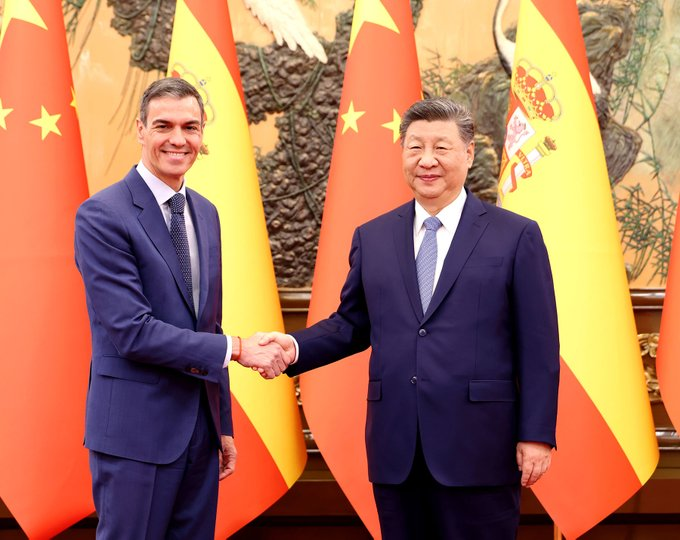
China is actively lobbying Spain to help block new European Union proposals designed to strengthen European companies through greater domestic preferences in public procurement and strategic sectors. During a high-level meeting in Beijing on April 14, 2026, President Xi Jinping and Spanish Prime Minister Pedro Sánchez discussed trade issues, with Chinese officials warning that the EU is becoming “too protectionist,” potentially harming bilateral and EU-China trade as well as broader political ties.
The pressure comes amid ongoing EU efforts to reduce reliance on Chinese imports in key industries through measures often described as “Made in Europe” or “European Preference” initiatives.
Chinese President Xi Jinping meets with Spanish Prime Minister Pedro Sánchez at the Great Hall of the People in Beijing on April 14, 2026.
Details from the Beijing Meeting
According to Bloomberg, citing a person familiar with the matter, Chinese officials complained during the Sánchez visit that emerging EU policies favoring domestic companies would damage economic relations. The proposals in question include elements of the EU Industrial Accelerator Act (IAA) and related strategies that introduce local content requirements, “European Preference” in public procurement, and restrictions aimed at boosting competitiveness in sectors such as electric vehicles, batteries, solar, critical raw materials, steel, cement, and aluminum.
Xi and Sánchez held talks focused on strengthening bilateral cooperation, with both sides publicly emphasizing multilateralism, opposition to “decoupling,” and addressing “trade protectionism.” However, behind the scenes, China sought Spain’s support to push back against the EU measures. Spain, as an EU member state, holds influence in Brussels decision-making processes.
Sánchez, for his part, highlighted Spain’s large trade deficit with China (nearly $50 billion) and called for more balanced and reciprocal trade, including greater market access for Spanish agricultural and other exports.
Background: EU’s Push to Strengthen Domestic Industry
The EU has been advancing several initiatives to enhance the bloc’s industrial resilience and reduce dependencies, particularly on China, in strategic and green technologies. Key elements include:
- Local content thresholds (e.g., high “Made in EU” requirements for public funding or procurement in electric vehicles, renewables, and infrastructure).
- Tighter screening of foreign investments and subsidies.
- Measures under the Foreign Subsidies Regulation and efforts to favor European suppliers in critical sectors.
China has repeatedly criticized these steps as protectionist and discriminatory, arguing they disrupt global supply chains and undermine fair competition. Beijing views them as barriers that could limit Chinese companies’ access to the European market.
Symbolic image of EU and Chinese flags, representing the complex trade and diplomatic relationship between the two sides.
China-Spain Relations and Broader Context
Despite the lobbying on EU policy, the meeting yielded positive outcomes for bilateral ties. The two leaders agreed to elevate dialogue mechanisms, signed multiple agreements (including on agricultural exports, transport, and infrastructure), and pledged closer cooperation in new energy, innovation, and people-to-people exchanges.
Spain has positioned itself as a bridge between China and Europe, with Sánchez stressing that stronger EU-China relations serve mutual interests and contribute to global stability. China considers Spain an important partner within the EU, being its largest trading partner outside the bloc in certain contexts.
The discussions occurred against a backdrop of global tensions, including conflicts in the Middle East, with both leaders warning against a “retrogression to the law of the jungle” and calling for genuine multilateralism.
Potential Implications
If successful, China’s outreach to Spain could influence EU decision-making, given that member states must reach consensus or qualified majorities on many trade and industrial policies. However, several EU countries support de-risking strategies to protect domestic industries from subsidized foreign competition.
For Spain, balancing closer economic ties with China while addressing its trade imbalance and aligning with broader EU goals remains a delicate challenge.
Reflecto News will continue to follow developments in EU-China trade relations, the progress of the Industrial Accelerator Act, and any further reactions from Brussels or other member states.
Frequently Asked Questions (FAQs)
What specific EU measures is China opposing?
China is pushing back against proposals in the EU Industrial Accelerator Act and related “European Preference” or “Made in Europe” initiatives that introduce local content requirements and favor European companies in public procurement and subsidies for strategic sectors like EVs, batteries, solar, and critical materials.
When and where did Xi Jinping meet Pedro Sánchez?
The meeting took place on April 14, 2026, at the Great Hall of the People in Beijing during Sánchez’s official visit to China.
What was the public tone of the meeting?
Both leaders emphasized strengthening cooperation, opposing decoupling, supporting multilateralism, and addressing global challenges like trade protectionism and climate change. They signed several bilateral agreements.
Why is Spain seen as an important target for Chinese lobbying?
Spain maintains relatively pragmatic and positive relations with China compared to some other EU members and can advocate positions within EU institutions.
How has Sánchez responded to the trade imbalance?
Sánchez described the EU-Spain trade deficit with China as “unsustainable” and pushed for greater reciprocity and market access for European exports.
What are the broader stakes for EU-China relations?
The dispute highlights tensions between Europe’s desire to protect and strengthen its industrial base and China’s preference for open market access without additional barriers.
For ongoing coverage of international trade, EU-China relations, and global economic policy, stay with Reflecto News.
This report is based on Bloomberg and other verified sources, including official readouts from the Chinese and Spanish sides as of April 17, 2026.
Questions people ask
What is China's current share of global manufacturing?
China now accounts for twenty eight percent of global manufacturing. This industrial output exceeds the combined manufacturing production of the United States, Japan, and Germany, making China the leading global industrial power according to recent reports.
Why were Andrew Tate and Tristan Tate arrested in Miami?
Andrew Tate and his brother Tristan Tate were taken into custody in Miami by the United States Marshals Service. They face thirty eight new charges in the United Kingdom, including rape and child pornography offences, and prosecutors are seeking their extradition.
What warning did Moscow issue about oil prices?
Kirill Dmitriev, the Chief Executive of the Russian Direct Investment Fund, warned that a tsunami of skyrocketing oil prices is approaching. Moscow describes this potential energy shock as a major threat to global markets.
What political shift is projected for Benjamin Netanyahu's coalition?
Political polls project that Prime Minister Benjamin Netanyahu's coalition is on track to lose its majority in the upcoming October election. This projection indicates a potential political shift in Jerusalem.
Why did a Russian military aircraft land in Tehran?
A Russian airborne command aircraft, widely known as a doomsday plane, landed in Tehran. The arrival of the aircraft represents a high stakes show of support from Russia for Iran during a period of heightened regional tensions.
What did President Masoud Pezeshkian claim about the United States and Israel?
Iranian President Masoud Pezeshkian claimed that the United States and Israel failed in a forty eight hour plan to topple the Iranian government. He made these statements during a televised address marking two years since his inauguration.