Reflecto News is an online news platform covering major international political events, global economic developments, and security conflicts. The site provides updates on topics such as Chinese manufacturing dominance, Middle Eastern political tensions, and high profile legal arrests. Readers can access current articles organized by categories like World News, Iran, and USA.
By Reflecto News Staff
April 17, 2026
China has stated it will commission and bring online 7 nuclear reactors this year as part of its aggressive expansion of nuclear power capacity. The announcement underscores Beijing’s commitment to nuclear energy as a cornerstone of its clean energy transition, carbon neutrality goals, and efforts to meet surging electricity demand from industrialization and electrification.
This move positions China as the global leader in nuclear new-build, with dozens of reactors under construction and a long-term target to significantly scale up its fleet.
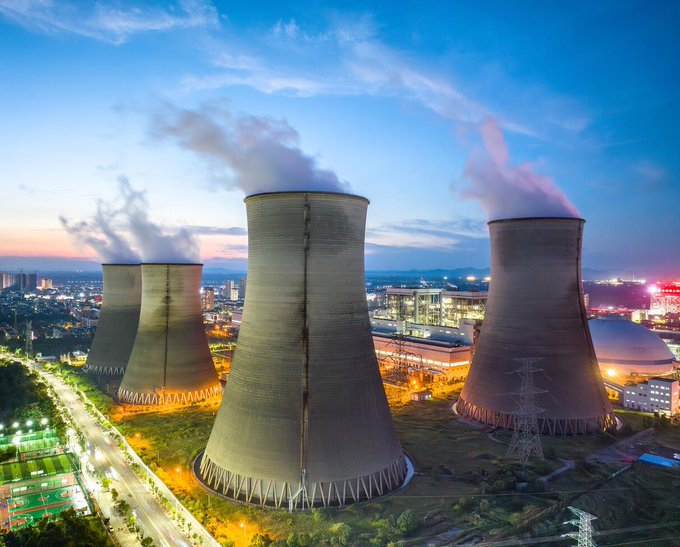
Aerial view of a Hualong One nuclear power plant under construction in China, showcasing the scale of ongoing projects.
Details of the Announcement
Chinese officials and state media have highlighted plans to commission multiple units in 2026, including large Generation III+ pressurized water reactors (PWRs) such as Hualong One (HPR1000) designs, advanced CAP1400 variants, Russian-designed VVER-1200 units, and innovative projects like the ACP100 (Linglong One) small modular reactor (SMR).
Key expected 2026 milestones include:
- Several Hualong One units reaching commercial operation.
- The Changjiang SMR-1 (ACP100/Linglong One), China’s first commercial onshore small modular reactor.
- Potential grid connection for units like Taipingling-2, Changjiang-3, Tianwan-7, and others at various coastal sites.
While exact counts can vary with project timelines, the focus on seven reactors aligns with China’s steady progress toward adding substantial new capacity in a single year.
Construction site of the Linglong One (ACP100) small modular reactor project in Changjiang, Hainan Province.
Current Status of China’s Nuclear Program
As of early 2026, China operates approximately 58–62 GW of nuclear capacity across dozens of reactors, making it the second-largest nuclear power producer after the United States. It has around 38 units under construction, adding roughly 44 GW of new capacity — more than any other country.
China aims to reach 110–120 GW by the early 2030s and has set ambitious longer-term targets of up to 200 GW by 2035. The government approves 8–10 new reactor constructions annually and emphasizes indigenous technologies like the Hualong One, which has become a flagship export design.
Map showing the distribution of nuclear power stations and related facilities across China.
Types of Reactors and Technological Advancements
The 2026 commissions will feature a mix of technologies:
- Hualong One (HPR1000): China’s third-generation indigenous PWR, offering enhanced safety and efficiency (around 1,100–1,200 MW per unit).
- CAP1400: An upgraded, larger version of the Westinghouse AP1000 design.
- VVER-1200: Russian-supplied units at sites like Tianwan.
- ACP100 (Linglong One): A 125 MW small modular reactor designed for flexible deployment, including in areas with weaker grids.
- CFR-600: A sodium-cooled fast neutron reactor at Xiapu, supporting China’s closed fuel cycle ambitions.
These projects reflect China’s “three-step” nuclear strategy: thermal reactors, fast reactors, and eventual fusion.
Satellite view of the Xiapu site hosting CFR-600 fast neutron reactors.
Strategic Importance and Global Context
Nuclear power plays a vital role in China’s energy security, reducing reliance on coal while supporting its 2060 carbon neutrality pledge. New reactors provide reliable baseload power, complementing variable renewables like solar and wind.
Globally, China accounts for the majority of reactors under construction worldwide. Its rapid build times (often 5–7 years) contrast with longer timelines in many Western countries. The program also drives technological innovation and potential exports.
Infographic highlighting China’s leading role in global nuclear reactor construction.
Challenges and Safety Considerations
While expansion is rapid, China maintains strict oversight through the National Nuclear Safety Administration. Projects incorporate lessons from past incidents worldwide, with emphasis on Generation III+ passive safety features. Public acceptance and waste management remain long-term priorities.
Why This Matters
Commissioning seven reactors in 2026 would add several gigawatts of low-carbon electricity, helping power economic growth, electric vehicles, data centers, and industrial electrification. It signals continued momentum in China’s nuclear renaissance amid global energy transitions.
Reflecto News will track progress on these projects, including any official commissioning dates and grid connections.
Frequently Asked Questions (FAQs)
How many nuclear reactors is China planning to commission in 2026?
China has indicated plans to commission and launch approximately 7 nuclear reactors this year, including large PWRs and the first commercial SMR.
What types of reactors are involved?
The lineup includes Hualong One (HPR1000), CAP1400, VVER-1200, and the ACP100 Linglong One small modular reactor, among others.
What is China’s current nuclear capacity?
China operates around 58–62 GW from its existing fleet, with 38+ units under construction adding significant new capacity.
How does this fit into China’s long-term energy goals?
Nuclear expansion supports carbon neutrality by 2060, energy security, and meeting rising electricity demand while reducing coal dependence.
Is the Linglong One SMR part of the 2026 plans?
Yes, commercial operation of the Linglong One (ACP100) is targeted for the first half of 2026, marking a milestone for small modular reactor technology.
Reflecto News provides accurate, timely coverage of global energy developments, including nuclear power, renewables, and geopolitical impacts.
All information is based on official Chinese statements, industry reports from the World Nuclear Association, and verified sources as of April 17, 2026.
Stay tuned for updates on China’s nuclear program and its role in the global energy landscape.
Questions people ask
What is China's current share of global manufacturing?
China now accounts for twenty eight percent of global manufacturing. This industrial output exceeds the combined manufacturing production of the United States, Japan, and Germany, making China the leading global industrial power according to recent reports.
Why were Andrew Tate and Tristan Tate arrested in Miami?
Andrew Tate and his brother Tristan Tate were taken into custody in Miami by the United States Marshals Service. They face thirty eight new charges in the United Kingdom, including rape and child pornography offences, and prosecutors are seeking their extradition.
What warning did Moscow issue about oil prices?
Kirill Dmitriev, the Chief Executive of the Russian Direct Investment Fund, warned that a tsunami of skyrocketing oil prices is approaching. Moscow describes this potential energy shock as a major threat to global markets.
What political shift is projected for Benjamin Netanyahu's coalition?
Political polls project that Prime Minister Benjamin Netanyahu's coalition is on track to lose its majority in the upcoming October election. This projection indicates a potential political shift in Jerusalem.
Why did a Russian military aircraft land in Tehran?
A Russian airborne command aircraft, widely known as a doomsday plane, landed in Tehran. The arrival of the aircraft represents a high stakes show of support from Russia for Iran during a period of heightened regional tensions.
What did President Masoud Pezeshkian claim about the United States and Israel?
Iranian President Masoud Pezeshkian claimed that the United States and Israel failed in a forty eight hour plan to topple the Iranian government. He made these statements during a televised address marking two years since his inauguration.