Reflecto News is an online news platform covering major international political events, global economic developments, and security conflicts. The site provides updates on topics such as Chinese manufacturing dominance, Middle Eastern political tensions, and high profile legal arrests. Readers can access current articles organized by categories like World News, Iran, and USA.
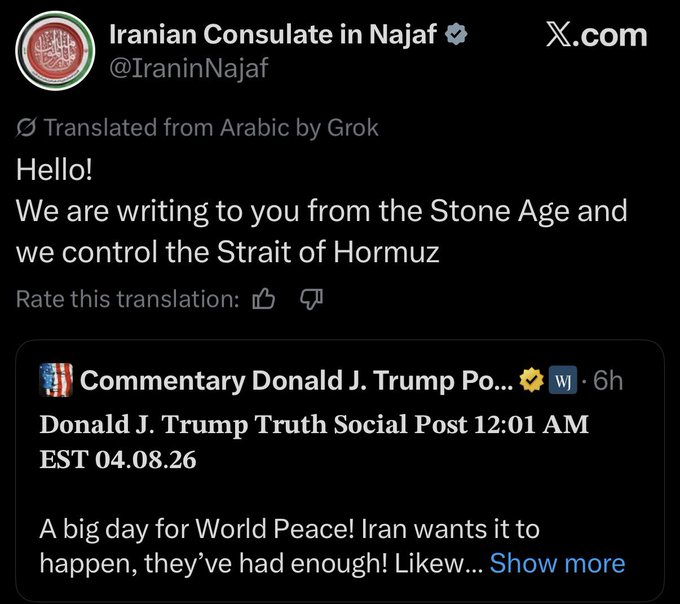
Reflecto News – Iranian officials and state-affiliated accounts have delivered a sharp, sarcastic response to President Donald Trump’s repeated threats to bomb Iran “back to the Stone Age,” claiming in a pointed statement: “We are writing to you from the Stone Age and we control the Strait of Hormuz.”
The remark, widely circulated on Iranian social media and echoed by state media, directly counters Trump’s earlier rhetoric in which he warned that failure to reopen the vital waterway would result in devastating strikes that could send Iran “back to the Stone Ages where they belong.”
Background: Trump’s Escalating Rhetoric
During the lead-up to the two-week ceasefire, Trump issued multiple strong warnings tied to Iran’s disruption of shipping through the Strait of Hormuz. In profanity-laced posts and public statements, he threatened to target Iranian power plants, bridges, and other infrastructure, vowing to bring the country “back to the Stone Age” if demands were not met.
Trump later described the military campaign as a “complete victory” and announced the temporary truce, conditional on Iran ensuring safe passage through the strait. Despite the pause, Iranian messaging continues to project defiance and control over the strategic chokepoint, through which roughly 20% of global oil passes.
Iran’s Sarcastic Counter
The Iranian response plays on Trump’s language by sarcastically embracing the “Stone Age” label while asserting continued dominance over the Strait of Hormuz. Officials have emphasized that any reopening of the waterway during the two-week ceasefire will occur under Iranian military coordination and with “regulated passage,” potentially including fees or technical oversight.
Foreign Minister Abbas Araghchi and other spokespeople have framed the ceasefire as a result of Iranian strength rather than submission, highlighting that Tehran maintains leverage over one of the world’s most critical energy arteries.
Map of the Strait of Hormuz, the strategically vital waterway at the center of the U.S.-Iran tensions and ceasefire conditions.
Context Within the Fragile Ceasefire
The mocking statement comes as:
- Kuwait reports an “intense wave of attacks” and the UAE warns of a continuing “missile threat” from Iran.
- An explosion was reported earlier today at Iran’s Lavan oil refinery, with the cause still unknown.
- High-level talks are scheduled for Friday, April 10, 2026, in Islamabad, Pakistan, to negotiate a more permanent agreement.
Despite the temporary truce, these incidents and rhetorical exchanges illustrate the deep mistrust and competing narratives between the two sides. Iran’s 10-point proposal, which includes demands related to sanctions relief and nuclear issues, continues to be a point of contention, with discrepancies noted between its Farsi and English versions.
What’s Next?
The Islamabad talks will test whether the two-week window can translate into lasting de-escalation. Key issues include the exact terms of Strait of Hormuz management, sanctions, nuclear assurances, and regional proxy conflicts (particularly Lebanon, which Israel has excluded from the agreement).
Reflecto News will continue providing updates on diplomatic developments, security incidents in the Gulf, and reactions from all parties involved.
Frequently Asked Questions (FAQs)
Q1: What did Iran say to mock Trump?
Iranian messaging stated: “We are writing to you from the Stone Age and we control the Strait of Hormuz,” sarcastically referencing Trump’s threats to send Iran “back to the Stone Age.”
Q2: Why is the Strait of Hormuz so important?
It is a narrow chokepoint through which about 20% of the world’s oil supply passes. Control over it gives Iran significant leverage in any conflict or negotiation.
Q3: Has the ceasefire changed Iran’s position on the strait?
Under the two-week truce, Iran has agreed to allow safe passage, but it insists this will be managed under Iranian military coordination with possible “regulated” terms.
Q4: What was Trump’s original threat?
Trump warned of massive strikes on Iranian infrastructure, including power plants and bridges, if the strait was not reopened, repeatedly using “Stone Age” language.
Q5: How does this fit with the broader talks?
The rhetorical exchange highlights ongoing tensions ahead of Friday’s high-level negotiations in Islamabad, where core issues like sanctions, nuclear matters, and regional security will be discussed.
Q6: Are there other incidents affecting the ceasefire?
Yes. Recent reports include attacks on Kuwait, missile threats against the UAE, and an explosion at Iran’s Lavan refinery, raising questions about the truce’s stability.
For the latest accurate coverage of the U.S.-Iran ceasefire, Strait of Hormuz developments, and regional diplomacy, follow Reflecto News — your source for professional, in-depth reporting.
Questions people ask
What is China's current share of global manufacturing?
China now accounts for twenty eight percent of global manufacturing. This industrial output exceeds the combined manufacturing production of the United States, Japan, and Germany, making China the leading global industrial power according to recent reports.
Why were Andrew Tate and Tristan Tate arrested in Miami?
Andrew Tate and his brother Tristan Tate were taken into custody in Miami by the United States Marshals Service. They face thirty eight new charges in the United Kingdom, including rape and child pornography offences, and prosecutors are seeking their extradition.
What warning did Moscow issue about oil prices?
Kirill Dmitriev, the Chief Executive of the Russian Direct Investment Fund, warned that a tsunami of skyrocketing oil prices is approaching. Moscow describes this potential energy shock as a major threat to global markets.
What political shift is projected for Benjamin Netanyahu's coalition?
Political polls project that Prime Minister Benjamin Netanyahu's coalition is on track to lose its majority in the upcoming October election. This projection indicates a potential political shift in Jerusalem.
Why did a Russian military aircraft land in Tehran?
A Russian airborne command aircraft, widely known as a doomsday plane, landed in Tehran. The arrival of the aircraft represents a high stakes show of support from Russia for Iran during a period of heightened regional tensions.
What did President Masoud Pezeshkian claim about the United States and Israel?
Iranian President Masoud Pezeshkian claimed that the United States and Israel failed in a forty eight hour plan to topple the Iranian government. He made these statements during a televised address marking two years since his inauguration.