Reflecto News is an online news platform covering major international political events, global economic developments, and security conflicts. The site provides updates on topics such as Chinese manufacturing dominance, Middle Eastern political tensions, and high profile legal arrests. Readers can access current articles organized by categories like World News, Iran, and USA.
The decision will replace the alliance’s aging fleet of 14 Boeing E-3A Sentry (AWACS) aircraft, which have been in service for over four decades and are primarily stationed at NATO Air Base Geilenkirchen in Germany. The E-3As, based on the Boeing 707 airframe, are slated for retirement by 2035.
This shift is driven by a combination of programmatic failure and a growing political push for “European strategic autonomy,” particularly following the U.S. withdrawal from previous procurement plans.
Boeing E-7A Wedgetail: The Deal That Fell Apart
As recently as November 2023, NATO appeared poised to select the Boeing E-7A Wedgetail, a militarized Boeing 737 variant, to serve as the successor to the E-3. The plan called for an initial procurement of six aircraft.
However, the deal collapsed after the United States Air Force (USAF) unexpectedly withdrew from the program in June 2025. Citing high costs—which had swelled from an estimated $588 million to $724 million per aircraft—the Pentagon decided to pivot toward space-based surveillance capabilities like the “Golden Dome” project, rather than buy a new generation of manned jets.
By November 2025, the Netherlands confirmed that the remaining partner countries had decided to abandon the E-7A acquisition, with officials noting that the U.S. exit had removed both the “strategic and financial basis” of the program. Crucially, the Dutch also highlighted “the importance of investing as much as possible in European industry,” a sentiment that strongly boosted the rival Saab-Bombardier bid.
Saab & Bombardier’s GlobalEye: A European Alternative
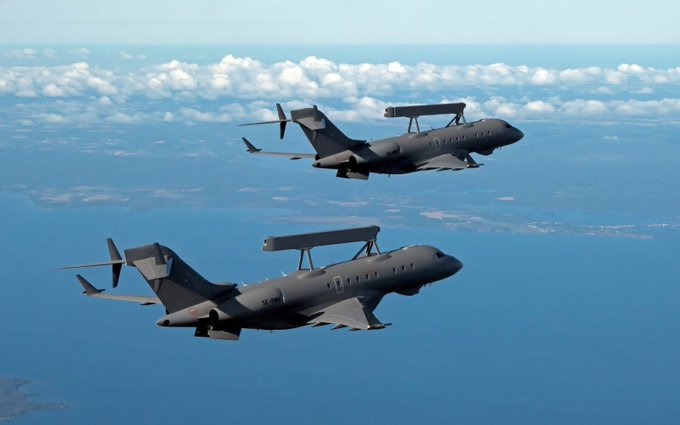
The winning platform is the GlobalEye, a system offered by a partnership between Swedish defense giant Saab (which makes the advanced radar) and Canadian manufacturer Bombardier (which provides the Global 6000/6500 business jet airframe).
Specifications and Performance
- Radar System: The GlobalEye is equipped with Saab’s Erieye Extended Range (ER) radar. Unlike the mechanically rotating “mushroom” dome on the old AWACS, the Erieye uses a fixed, dual-sided Active Electronically Scanned Array (AESA) radar mounted on top of the fuselage.
- Detection Range: It is capable of detecting and identifying airborne, maritime, and land targets at ranges exceeding 550 km.
- Airframe Efficiency: Based on the Global 6000/6500 business jet, the GlobalEye offers significantly better fuel efficiency, reduced maintenance costs, and the ability to operate from shorter runways compared to the heavy 707 or 737 airframes. The aircraft has an endurance of over 13 hours.
The Numbers and Timeline
NATO is expected to order between 10 and 14 of the new aircraft, with contracts coordinated through the NATO Support and Procurement Agency (NSPA).
- Value: The program is estimated to be worth between €5 billion and €6 billion ($5.4bn – $6.5bn).
- Entry into Service: Deliveries are targeted to begin before 2030, with the goal of the fleet being fully operational in the early 2030s.
The Strategic Message: “Strategic Autonomy”
The decision to snub Boeing is deeply political. The E-7A Wedgetail had effectively won the contract on technical merit, but the US withdrawal shattered the alliance required to fund it, forcing NATO members to look elsewhere.
By embracing the GlobalEye—a platform shared by Sweden, France, and possibly Poland and Germany—NATO is accelerating its long-term goal of reducing reliance on U.S. hardware for battlefield surveillance. This move aligns with the push by European leaders for a more sovereign defense industrial base, particularly given the uncertainty of future American support under a potential second Trump administration.
Questions people ask
What is China's current share of global manufacturing?
China now accounts for twenty eight percent of global manufacturing. This industrial output exceeds the combined manufacturing production of the United States, Japan, and Germany, making China the leading global industrial power according to recent reports.
Why were Andrew Tate and Tristan Tate arrested in Miami?
Andrew Tate and his brother Tristan Tate were taken into custody in Miami by the United States Marshals Service. They face thirty eight new charges in the United Kingdom, including rape and child pornography offences, and prosecutors are seeking their extradition.
What warning did Moscow issue about oil prices?
Kirill Dmitriev, the Chief Executive of the Russian Direct Investment Fund, warned that a tsunami of skyrocketing oil prices is approaching. Moscow describes this potential energy shock as a major threat to global markets.
What political shift is projected for Benjamin Netanyahu's coalition?
Political polls project that Prime Minister Benjamin Netanyahu's coalition is on track to lose its majority in the upcoming October election. This projection indicates a potential political shift in Jerusalem.
Why did a Russian military aircraft land in Tehran?
A Russian airborne command aircraft, widely known as a doomsday plane, landed in Tehran. The arrival of the aircraft represents a high stakes show of support from Russia for Iran during a period of heightened regional tensions.
What did President Masoud Pezeshkian claim about the United States and Israel?
Iranian President Masoud Pezeshkian claimed that the United States and Israel failed in a forty eight hour plan to topple the Iranian government. He made these statements during a televised address marking two years since his inauguration.