Reflecto News is an online news platform covering major international political events, global economic developments, and security conflicts. The site provides updates on topics such as Chinese manufacturing dominance, Middle Eastern political tensions, and high profile legal arrests. Readers can access current articles organized by categories like World News, Iran, and USA.
Published on Reflecto News | World News | Defense & Geopolitics
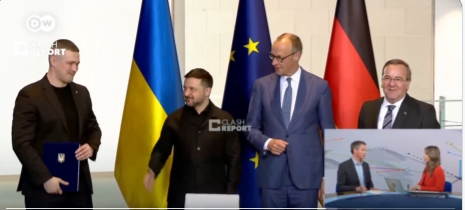
German Chancellor Friedrich Merz and Ukrainian President Volodymyr Zelenskyy have signed a sweeping defense cooperation agreement in Berlin, marking the first full German-Ukrainian government consultations in two decades and solidifying Germany’s position as Ukraine’s largest European backer following the withdrawal of US support .
The agreement, signed on April 14, 2026, encompasses a wide range of military-industrial collaboration initiatives, including joint drone production, expanded air defense systems, and unprecedented combat data sharing between the two nations. The deal represents a major strategic shift in European security architecture as Germany steps into a leadership role supporting Ukraine against Russian aggression .
A New Era of Military Cooperation
The signing ceremony took place at the Chancellery in Berlin, where Merz welcomed Zelenskyy with full military honors, including a Bundeswehr honor guard and the inspection of drone systems displayed on the grand entrance staircase . Zelenskyy arrived with a full cabinet delegation, signaling the comprehensive nature of the consultations.
The agreement focuses on several key areas of cooperation:
| Area of Cooperation | Details |
|---|---|
| Drone Production | Joint manufacturing facilities; German companies to produce Ukrainian-designed drones under license |
| Air Defense | Significant strengthening of air defense systems; PAC-3 missile supply |
| Deep-Strike Capabilities | Additional funding for deep-strike and medium-range strike drones |
| Technology Development | Joint solutions including laser weapon systems |
| Combat Data Exchange | Ukraine to share unique battlefield data in exchange for German technology |
“This marks the beginning of a new form of military-industrial cooperation between our countries — one with great potential.” — Chancellor Friedrich Merz
Drone Partnership: A Centerpiece of the Deal
A key component of the agreement involves the expansion of German-Ukrainian drone cooperation. German company Quantum Systems announced the establishment of a joint venture with Ukrainian manufacturers to produce 10,000 multi-purpose quadcopters for the Ukrainian Armed Forces .
Ukraine has gained extensive combat experience with drone warfare over four years of conflict, developing tactics and technologies that are now highly sought after by European militaries. The Bundeswehr plans to significantly expand its own drone capabilities, and cooperation with Kyiv is seen as a logical next step .
Under the arrangement, German companies will produce Ukrainian-designed drones under license and supply them to Ukraine, while Ukrainian experts will contribute their operational experience to German forces. A joint drone production facility by German defense firm Rheinmetall is already being established in Ukraine .
Air Defense and Deep-Strike Capabilities
The agreement significantly expands German support for Ukraine’s air defense. Germany has already supplied PAC-3 missiles that were critical to protecting Ukrainian skies during the winter period . Additional funding will support the development of deep-strike and medium-range strike drone capabilities, allowing Ukraine to hit military targets deeper behind Russian lines .
Defense Minister Mykhailo Fedorov, who held preparatory talks with his German counterpart Boris Pistorius ahead of the signing, emphasized that Germany remains one of Ukraine’s key partners .
“I am grateful for the systemic support, especially during the winter, for the contribution to the ‘Czech initiative’ and the supply of PAC-3 missiles — this decision was of critical importance for protecting Ukrainian skies.” — Mykhailo Fedorov, Ukrainian Defense Minister
Combat Data Exchange: Ukraine’s Unique Asset
A notable aspect of the agreement involves the exchange of combat data. Ukraine possesses a unique dataset from four years of high-intensity warfare, including real-time information on countering Shahed-type drones and other Russian systems .
This data is invaluable for German defense technology development. Under the new cooperation framework, Ukraine will share battlefield data in exchange for access to German technology and production capabilities. Fedorov described this as a “mutually beneficial model of cooperation” under which allies gain access to combat data and Ukrainian-made systems .
Strategic Context: Germany Steps Up as US Support Wavers
The agreement comes at a critical juncture for Ukraine. Germany has become Ukraine’s largest backer since the United States, under the Trump administration, withdrew its support last year . As a next step, Berlin is pushing to unlock a €90 billion ($106 billion) EU credit line for Ukraine, which could happen as early as mid-May once Hungary’s new EU-friendly government lifts its resistance .
The timing is also significant following the electoral defeat of Hungarian Prime Minister Viktor Orbán, who had previously blocked EU funding for Ukraine . Kyiv is expected to invest around two-thirds of that credit directly in its armed forces to maintain battle-readiness until at least 2027 .
Ramstein-Format Meeting on April 15
The Berlin agreement sets the stage for the upcoming Ukraine Defense Contact Group (Ramstein-format) meeting scheduled for April 15, 2026 . At that meeting, Ukraine will present an update on the implementation of its War Plan aimed at bringing Russia to peace. Priority areas include strengthening air defense, developing unmanned systems, and enhancing data and technology exchange .
NATO Secretary General Mark Rutte and UK Defense Secretary John Healey are expected to attend the Ramstein meeting .
Laser Technology Development
Beyond drones and air defense, the agreement also includes cooperation on innovative laser weapon systems. Both nations are exploring the development of directed-energy weapons, representing a cutting-edge area of military technology that could revolutionize air defense capabilities .
Broader European Security Implications
The deepening German-Ukrainian defense relationship has significant implications for European security. Berlin is keen to underline that Ukraine remains Germany’s top foreign-policy priority, even as the Middle East conflict has diverted international attention .
Germany’s commitment to Ukraine also reflects broader European efforts to build self-sufficient defense capabilities, particularly as the reliability of US security guarantees has come into question. The drone partnership, in particular, positions Europe to develop indigenous manufacturing capacity for critical battlefield technologies.
Next Steps
Following the Berlin consultations, President Zelenskyy is scheduled to travel to Norway for talks with Prime Minister Jonas Gahr Støre . The Ramstein-format meeting on April 15 will provide an opportunity to secure additional commitments from the broader coalition of Ukraine’s allies.
Implementation of the bilateral defense agreement will proceed through working-level consultations, with joint projects expected to begin in the coming months. The Rheinmetall drone production facility in Ukraine is already under development, and additional manufacturing partnerships are anticipated.
Frequently Asked Questions (FAQs)
1. What specific defense cooperation measures were signed between Germany and Ukraine?
The agreement includes joint drone production (with German companies producing Ukrainian-designed drones under license), significant expansion of air defense systems, additional funding for deep-strike and medium-range drones, joint technology development including laser systems, and combat data exchange between the two nations .
2. What is the significance of this agreement for Ukraine?
Germany has become Ukraine’s largest backer since the United States withdrew its support. The agreement provides critical military-industrial cooperation, including drone manufacturing facilities in Ukraine and access to German technology, while Ukraine contributes its unique combat experience and battlefield data .
3. When was the agreement signed?
The agreement was signed on April 14, 2026, during the first full German-Ukrainian government consultations in two decades .
4. What is the €90 billion EU credit line mentioned?
Germany is pushing to unlock a €90 billion ($106 billion) EU credit line for Ukraine, which could be approved as early as mid-May after Hungary’s new government lifts its resistance. Ukraine plans to invest about two-thirds of this directly in its armed forces .
5. What is the Ramstein-format meeting on April 15?
The Ukraine Defense Contact Group (Ramstein-format) meeting is scheduled for April 15, where Ukraine will present its War Plan and seek additional commitments for air defense, drone development, and technology exchange .
6. Is Germany sending Taurus missiles to Ukraine?
While not specifically confirmed in this agreement, Chancellor Merz previously stated that there are “no more range limitations for weapons delivered to Ukraine” and that Ukraine has the right to hit military infrastructure on Russian territory, potentially paving the way for Taurus deliveries .
Stay informed with Reflecto News – Your trusted source for breaking defense and geopolitical intelligence. Subscribe for real-time updates on the Ukraine war, European security architecture, and global military cooperation.
Questions people ask
What is China's current share of global manufacturing?
China now accounts for twenty eight percent of global manufacturing. This industrial output exceeds the combined manufacturing production of the United States, Japan, and Germany, making China the leading global industrial power according to recent reports.
Why were Andrew Tate and Tristan Tate arrested in Miami?
Andrew Tate and his brother Tristan Tate were taken into custody in Miami by the United States Marshals Service. They face thirty eight new charges in the United Kingdom, including rape and child pornography offences, and prosecutors are seeking their extradition.
What warning did Moscow issue about oil prices?
Kirill Dmitriev, the Chief Executive of the Russian Direct Investment Fund, warned that a tsunami of skyrocketing oil prices is approaching. Moscow describes this potential energy shock as a major threat to global markets.
What political shift is projected for Benjamin Netanyahu's coalition?
Political polls project that Prime Minister Benjamin Netanyahu's coalition is on track to lose its majority in the upcoming October election. This projection indicates a potential political shift in Jerusalem.
Why did a Russian military aircraft land in Tehran?
A Russian airborne command aircraft, widely known as a doomsday plane, landed in Tehran. The arrival of the aircraft represents a high stakes show of support from Russia for Iran during a period of heightened regional tensions.
What did President Masoud Pezeshkian claim about the United States and Israel?
Iranian President Masoud Pezeshkian claimed that the United States and Israel failed in a forty eight hour plan to topple the Iranian government. He made these statements during a televised address marking two years since his inauguration.