Reflecto News is an online news platform covering major international political events, global economic developments, and security conflicts. The site provides updates on topics such as Chinese manufacturing dominance, Middle Eastern political tensions, and high profile legal arrests. Readers can access current articles organized by categories like World News, Iran, and USA.
President ties reopening of vital waterway to global benefits and upcoming meeting with Xi; statement comes amid Iranian warnings about U.S. blockade and ongoing indirect talks
By Reflecto News Staff
April 18, 2026
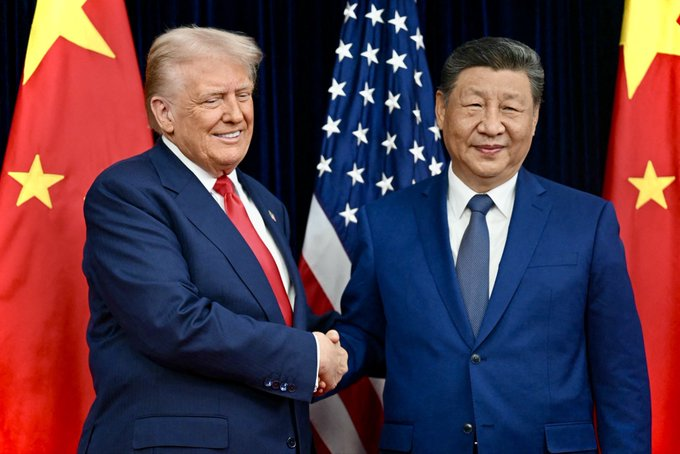
President Donald Trump stated that Chinese President Xi Jinping is “very happy” about the status of the Strait of Hormuz, describing the critical waterway as “open and/or rapidly opening.”
In a Truth Social post, Trump wrote: “President Xi is very happy that the Strait of Hormuz is open and/or rapidly opening. Our meeting in China will be a special one and, potentially, Historic. I look forward to being with President Xi — Much will be accomplished!”
Trump has repeatedly framed the reopening of the strait — a chokepoint carrying roughly one-fifth of global oil trade — as a major achievement benefiting China, the world, and U.S. interests. He has suggested Beijing agreed not to send weapons to Iran as part of broader understandings and even predicted Xi would give him a “big, fat hug” during an upcoming visit to China.
Contrasting Views on the Strait’s Status
The claim comes amid mixed signals from the region. Iran has declared the Strait of Hormuz “completely open” to commercial vessels for the remainder of the current ceasefire period. However, Iranian Parliament Speaker Mohammad Bagher Ghalibaf warned that the waterway “will not remain open” if the United States continues its naval blockade on Iranian ports, insisting any passage must follow Iranian-designated routes and authorization.
Actual shipping traffic remains significantly below normal levels, with some tankers reportedly turning back due to the ongoing U.S. naval presence and uncertainty.
Trump has maintained that the U.S. blockade on Iranian ports and vessels will stay in force until a comprehensive permanent deal is reached.
Broader Diplomatic Context
Trump has explicitly decoupled any Iran deal from the situation in Lebanon, stating the two are “not tied” while promising reconstruction support for Lebanon with the phrase “We will make Lebanon great again.” He previously prohibited Israeli Prime Minister Benjamin Netanyahu from further bombing in Lebanon, enforcing a 10-day ceasefire.
On the nuclear front, Trump continues to assert that Iran has “agreed to everything,” including cooperation on its enriched uranium stockpile. Iranian officials reject this characterization, insisting the material will not be transferred abroad.
China has offered a potential compromise by signaling willingness to take custody of or down-blend Iran’s near-weapons-grade enriched uranium as a neutral third-party option.
Pakistan remains actively engaged in mediation, vowing to “go to all lengths” for a lasting US-Iran peace agreement.
Military and Regional Posture
The arrival of the world’s largest aircraft carrier, USS Gerald R. Ford, in the Middle East has strengthened U.S. naval capabilities near the strait.
Kuwait continues its overnight stay-home advisory as a precautionary measure amid fears of Iranian retaliation against Gulf civilian infrastructure.
Secretary of State Marco Rubio has condemned Iranian actions in the Strait of Hormuz as “terrorist activity” by a state sponsor of terrorism. The White House has categorically denied considering nuclear weapons.
A recent Channel 12 poll in Israel shows 56% of Israelis do not want Benjamin Netanyahu to continue as Prime Minister.
International Reactions
Belarus President Alexander Lukashenko earlier claimed Trump had shown the world that the United States is “not that powerful,” warning that if America “couldn’t handle Iran,” it “should not mess with China.”
Implications
Trump’s positive framing of China’s stance on the Strait of Hormuz highlights Beijing’s stake in stable global energy flows as a major importer. However, persistent disagreements over the blockade, enriched uranium, and ceasefire terms suggest negotiations remain complex.
Any sustained reopening of the strait could ease pressure on energy markets, while renewed disruptions would carry significant global economic risks.
Reflecto News will continue providing real-time, balanced updates on the US-Iran situation, diplomatic efforts, and regional developments.
FAQs on Trump’s Statement About Xi and the Strait of Hormuz
Q: What exactly did President Trump say about Xi Jinping and the Strait of Hormuz?
A: Trump posted that “President Xi is very happy that the Strait of Hormuz is open and/or rapidly opening,” linking it to a potentially “historic” upcoming meeting in China and broader accomplishments.
Q: What is the current status of the Strait of Hormuz?
A: Iran has declared it open to commercial vessels during the ceasefire, but actual traffic is limited. Parliament Speaker Ghalibaf warned it will not remain open if the U.S. maintains its blockade on Iranian ports.
Q: Has Trump linked the Iran deal to Lebanon?
A: No. Trump stated the Iran deal is “not tied” to Lebanon and promised “We will make Lebanon great again” while enforcing a ceasefire there.
Q: What is China’s role in the nuclear discussions?
A: China has offered to take custody of or down-blend Iran’s enriched uranium stockpile as a potential neutral compromise.
Q: What military assets has the U.S. deployed?
A: The USS Gerald R. Ford, the world’s largest aircraft carrier, has arrived in the Middle East to bolster naval presence.
Q: How can I stay updated?
A: Follow Reflecto News for accurate, timely coverage of the US-Iran negotiations, the Strait of Hormuz situation, international reactions, and related regional developments.
This article is based on verified statements from President Trump’s Truth Social post, Iranian officials, and reporting from Reuters, AP, The Wall Street Journal, and other credible sources as of April 18, 2026. All quotes are accurately attributed.
Questions people ask
What is China's current share of global manufacturing?
China now accounts for twenty eight percent of global manufacturing. This industrial output exceeds the combined manufacturing production of the United States, Japan, and Germany, making China the leading global industrial power according to recent reports.
Why were Andrew Tate and Tristan Tate arrested in Miami?
Andrew Tate and his brother Tristan Tate were taken into custody in Miami by the United States Marshals Service. They face thirty eight new charges in the United Kingdom, including rape and child pornography offences, and prosecutors are seeking their extradition.
What warning did Moscow issue about oil prices?
Kirill Dmitriev, the Chief Executive of the Russian Direct Investment Fund, warned that a tsunami of skyrocketing oil prices is approaching. Moscow describes this potential energy shock as a major threat to global markets.
What political shift is projected for Benjamin Netanyahu's coalition?
Political polls project that Prime Minister Benjamin Netanyahu's coalition is on track to lose its majority in the upcoming October election. This projection indicates a potential political shift in Jerusalem.
Why did a Russian military aircraft land in Tehran?
A Russian airborne command aircraft, widely known as a doomsday plane, landed in Tehran. The arrival of the aircraft represents a high stakes show of support from Russia for Iran during a period of heightened regional tensions.
What did President Masoud Pezeshkian claim about the United States and Israel?
Iranian President Masoud Pezeshkian claimed that the United States and Israel failed in a forty eight hour plan to topple the Iranian government. He made these statements during a televised address marking two years since his inauguration.