🚨 JUST IN: President Trump Renews Sharp Criticism of NATO – “NATO Wasn’t There for Us, and They Won’t Be There for Us in the Future!”
By Reflecto News Desk
April 15, 2026
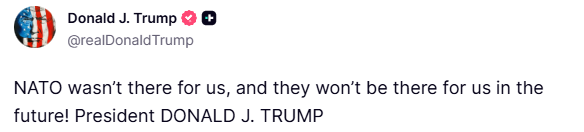
US President Donald Trump launched a fresh attack on the North Atlantic Treaty Organization (NATO) on Truth Social, declaring that the alliance failed to support the United States during the recent conflict with Iran and will not do so in the future.
“NATO wasn’t there for us, and they won’t be there for us in the future!” Trump posted late Tuesday, part of a rapid-fire series of messages that also targeted Pope Leo XIV over Iran’s internal crackdown on protesters.
The remarks reflect Trump’s long-standing frustration with NATO allies over burden-sharing and, more recently, their limited or absent support for US-led military operations against Iran that began in February 2026.
Trump’s Growing Frustration with NATO
Trump has repeatedly accused European NATO members of relying too heavily on American military and financial contributions while offering insufficient backing during the five-week US-Israeli campaign against Iranian targets. Several key NATO allies, including some European nations, expressed reservations about the operations, refused basing rights for certain strikes (as seen with Spain), or called for de-escalation and diplomacy.
In earlier posts and statements, Trump has complained that NATO “treated us very badly” and questioned the alliance’s reliability, even musing about potential US withdrawal or major restructuring if allies do not meet higher defense spending commitments.
The latest outburst comes amid:
- The fragile short-term US-Iran ceasefire following failed talks in Islamabad.
- The ongoing US naval blockade in the Strait of Hormuz targeting Iranian-linked shipping.
- Broader transatlantic tensions over the Middle East conflict, energy security, and global leadership.
NATO’s Response and Broader Context
NATO Secretary-General Mark Rutte has held recent closed-door meetings with Trump aimed at addressing concerns, but the alliance has not provided direct military support for the Iran operations. Many European leaders have prioritized diplomatic solutions and humanitarian concerns, with some criticizing the scale of military action.
Trump’s criticism also ties into his “America First” approach, emphasizing that the US should not bear disproportionate costs or risks without reciprocal support from allies. He has long pushed for NATO members to increase defense spending to at least 2% (and ideally higher) of GDP.
The comments arrive as Russia and China deepen coordination on the Middle East — with Russian Foreign Minister Sergey Lavrov in Beijing today offering energy alternatives to China amid Hormuz disruptions — highlighting shifting global alignments.
Reflecto News will monitor any official NATO or allied responses, further statements from the White House, and potential implications for transatlantic relations ahead of the Trump-Xi summit in May.
Frequently Asked Questions (FAQs)
Q1: What exactly did President Trump say about NATO?
Trump posted: “NATO wasn’t there for us, and they won’t be there for us in the future!” referring to the alliance’s lack of support during the US operations against Iran.
Q2: Why is Trump criticizing NATO now?
The criticism stems from NATO allies’ limited involvement or public reservations regarding the recent US-Israeli military actions in Iran. Trump has long complained about unequal burden-sharing within the alliance.
Q3: Has NATO provided any support in the Iran conflict?
NATO as an organization did not participate militarily. Some individual allies expressed concerns, refused certain basing requests, or advocated for diplomacy rather than escalation.
Q4: What is the current state of US-NATO relations?
Tensions have risen over the Iran war, defense spending, and perceived lack of reciprocity. Trump has repeatedly questioned NATO’s future usefulness to the US.
Q5: How does this fit into the broader Middle East situation?
It highlights transatlantic divisions over the US approach to Iran, the fragile ceasefire, the Hormuz blockade, and shifting global power dynamics involving Russia and China.
Q6: Could this lead to US withdrawal from NATO?
Trump has previously floated the idea or major reforms, but no concrete steps toward withdrawal have been announced. Pressure on allies to increase spending remains a core theme.
For continuing coverage of US-NATO relations, the Iran ceasefire, the Hormuz blockade, and global diplomacy, stay with Reflecto News — your trusted source for accurate, timely, and balanced international reporting.