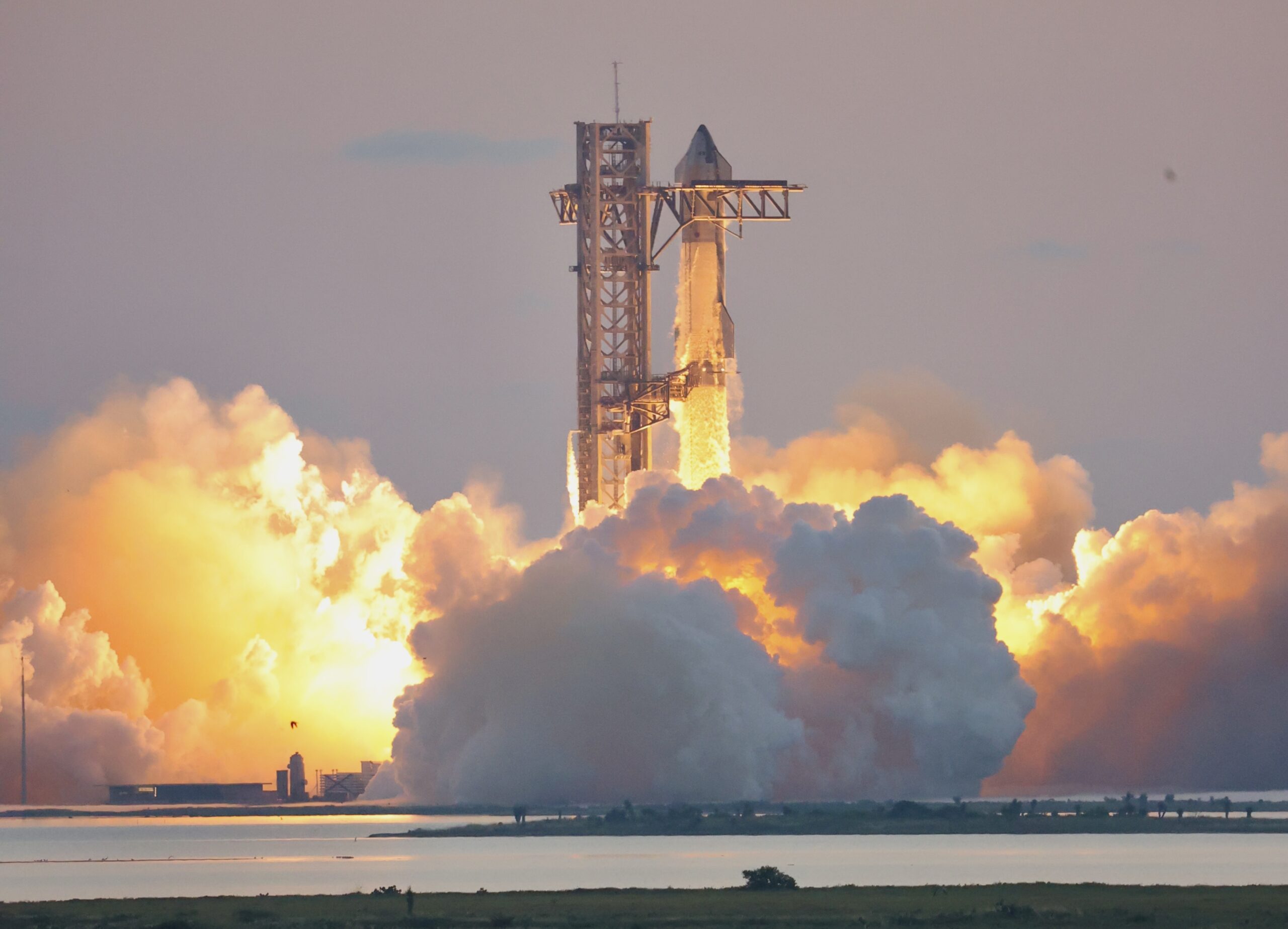
The SpaceX Starship spacecraft has been caught by giant mechanical arms at its Texas launch site, completing the first-ever recovery of the rocket’s upper stage after a flight in orbit. The 52-metre ship returned on Saturday, November 14, 2026, about 22 hours after lifting off, in a milestone SpaceX says brings fully reusable rockets closer.
The spacecraft slipped between the mechanical “chopstick” arms of the launch tower at Starbase, Texas, after circling Earth 14 times at an altitude of about 265 kilometres (165 miles), according to AP. It had blasted off late on Friday afternoon, November 13, on the 15th full-scale Starship test flight since 2023 — and only the second to reach orbit.
How the catch worked
After deploying 26 Starlink satellites in orbit on Friday night, Starship fired one of its engines on Saturday to begin its plunge back through the atmosphere, Reuters reported. The ship fell out of thick clouds over the Starbase launch site, reignited its engines to flip itself upright, and slowly descended into the grasp of the tower’s “Mechazilla” arms with its engines still roaring.
Charred from the heat of re-entry, the spacecraft shut down its engines and hung still, held by two small fittings near its top that hooked onto the arms. “That was the missing link, the holy grail of spaceflight,” SpaceX mission commentator Dan Huot said during the live broadcast, according to AP.
The catch came almost exactly 22 hours after liftoff. At 124 metres (407 feet) tall, the combined Starship system is the world’s largest and most powerful rocket, built to carry people and cargo to the Moon and, eventually, Mars.
Booster lost after engines cut out early
The mission was not a complete success. The Super Heavy booster — the rocket’s bottom half — failed to make its own return to the launch pad about 10 minutes after liftoff, ending SpaceX’s hopes of recovering both parts of the rocket for the first time.
SpaceX’s Kate Tice said the booster’s engines stopped firing too soon on the way back down. Its guidance system sensed it was not in the right position and automatically diverted the booster over water, where it self-destructed. Wreckage remained in the Gulf of Mexico, cordoned off by buoys, according to AP. Engineers are still investigating the cause.
SpaceX has previously caught its boosters three times since October 2024, but the main spacecraft had never been caught in mid-air until Saturday. The company has yet to recover both stages of Starship in a single mission — a feat that would mark the first-ever return of a complete orbital launch system.
Why the SpaceX Starship catch matters
Catching the SpaceX Starship is the key step toward making the rocket fully reusable. Rockets today are mostly thrown away after one flight; recovering and re-flying both stages would let SpaceX launch far more often at far lower cost — the same logic that made its smaller Falcon 9 rockets the workhorses of the space industry.
NASA welcomed Saturday’s news. The US space agency has chosen Starship as the vehicle that will land its astronauts on the Moon under the Artemis programme, so a working recovery system matters well beyond SpaceX’s own plans. SpaceX also sees Starship as the future workhorse for its Starlink satellite business, as well as for ambitions including data centres in orbit.
The flight was also Starship’s longest mission yet, spending more than 22 hours in orbit and completing 14 laps of Earth — far beyond the one or two laps of earlier orbital attempts, according to Reuters.
What comes next for Starship
SpaceX expects to begin launching Starships from Florida’s Kennedy Space Center within the next few months, expanding beyond its Texas base. The next test flights will aim for the double catch that eluded the company this weekend: recovering the Super Heavy booster and the Starship spacecraft on the same mission.
Engineers must first understand why the booster’s engines shut down early. Until both stages can be caught reliably, the promise of a fully reusable mega-rocket — and the cheaper, more frequent Moon and Mars missions it is meant to enable — remains a work in progress.
Frequently Asked Questions
What is SpaceX Starship?
Starship is SpaceX’s giant two-stage rocket system: the Super Heavy booster and the Starship spacecraft on top. Together they stand 124 metres (407 feet) tall, making it the largest and most powerful rocket ever flown. It is designed to carry cargo and people to Earth orbit, the Moon and Mars.
Has SpaceX caught a rocket with the tower arms before?
Yes — but only the booster. SpaceX has caught Super Heavy boosters three times since October 2024. Saturday, November 14, 2026, was the first time the Starship spacecraft itself, returning from orbit, was caught by the launch tower’s arms.
Why did the Super Heavy booster fail on this flight?
According to SpaceX, the booster’s engines stopped firing too soon during its return. Its guidance system detected that it was not in the correct position and automatically diverted it over the Gulf of Mexico, where it self-destructed. Engineers are still investigating the cause.
What will Starship be used for?
SpaceX plans to use Starship to launch Starlink satellites, carry cargo and crew to the Moon — NASA has chosen it as its Artemis lunar lander — and eventually send people to Mars. Full reusability is central to those plans, because it would sharply cut the cost of each flight.